
Systemize vendor vetting, onboarding, and tracking before you hire another contractor. That means collecting a certificate of insurance with an additional insured endorsement, verifying a trade license, and pulling a W-9 before any work begins. Keep your preferred-vendor list to two per trade, three only for high-volume categories like turnovers.
Track a small set of KPIs, match your coordination method to your portfolio size, and consider a managed option if the administrative load outgrows your staff.
TL;DR:
- Keeping vendor volume limited to two per trade strengthens negotiating power and response times, with high-volume categories potentially warranting a third vendor.
- Consistently verifying vendor insurance, licensing, and compliance every six months prevents drift out of regulatory or contractual standards.
- Automating vendor coordination through platforms and SMS-based tools becomes necessary once staff spend more time follow-up than reviewing actual work.
- Tracking response time, first-time fix rate, and invoice clarity on a regular schedule provides actionable insights for improving vendor quality.
- Outsourcing vendor management to full-service property managers like MilwaukeePM can save time and ensure thorough vetting, onboarding, and compliance.
Table of Contents
- Why Vendor Management Matters for Landlords
- The Four Pillars You Must Run
- Vetting Checklist: What to Collect Before Anyone Starts Work
- Manual, Platform-Native, or Automated: Choosing a Coordination Workflow
- KPIs That Actually Reveal Vendor Quality
- Building a Preferred-Vendor List That Doesn't Dilute Your Leverage
- When Outsourcing Vendor Management Makes Sense
- Handling Disputes and Conflicts With Vendors
- Protecting Landlord Data When Working With Vendors
- Monitoring Vendor Compliance Over Time
- Turning Good Vendors Into Long-Term Partners
- Field-Tested Pitfalls Worth Avoiding
- Let Milwaukeepm Run Your Vendor System for You
- Where to Verify Vendor Requirements and Templates
- Sources
- FAQ
Why Vendor Management Matters for Landlords
Vendor management is not paperwork for its own sake. It directly protects two things every landlord cares about: the physical asset and the tenant relationship. A slow repair response is one of the fastest ways to lose a good tenant at renewal time, and an uninsured contractor who gets hurt on your property can expose you to liability that no lease clause will fix after the fact.
The financial risk is concrete. A single incident involving an uninsured vendor can trigger a claim landed squarely on the property owner instead of the contractor, because there was no additional insured endorsement in place to shift that exposure. Predictable vendor operations also stabilize your operating expenses, since landlords working from a documented vendor management system report fewer emergency premium charges and less rework.
Here's what a functioning vendor practice buys you:
- Faster turnaround on maintenance requests, which correlates with tenant renewal decisions
- Lower legal exposure when insurance and licensing are verified up front
- More stable year-over-year maintenance costs instead of spiky, reactive spending
- Fewer disputes over invoices because expectations were set in writing
The Four Pillars You Must Run
Every landlord's vendor operation, regardless of portfolio size, rests on four pillars. Skip one and the whole system gets shakier.
- Vetting. Before a vendor touches your property, confirm a current certificate of insurance with an additional insured endorsement, an active state trade license, at least one reference from comparable work, and basic safety practices for the trade in question.
- Onboarding. Put expectations on paper: a one-page scope of work, response-time commitments, the dollar threshold above which a vendor must call before proceeding, and the exact invoice format you require for payment.
- Tracking. Collect a handful of KPIs, not a dashboard full of vanity metrics, and review them on a fixed schedule rather than only when something goes wrong.
- Relationship management. Schedule recurring work with your top vendors, pay on agreed terms without exception, and be explicit about what qualifies as an emergency and how fast you expect a response.
None of these pillars work in isolation. A vendor who passes vetting but never gets a written scope of work will still surprise you with change orders. A vendor you track carefully but pay late will quietly move you to the bottom of their schedule. The pillars reinforce each other, and that is exactly why a landlord managing three doors and one managing 300 both need all four, just at different levels of formality.
Vetting Checklist: What to Collect Before Anyone Starts Work
Treat vetting as a gate, not a formality. Nothing gets scheduled until the paperwork clears.
- Certificate of insurance (COI) naming you as additional insured, not just a generic policy summary
- Confirmation the endorsement is real, meaning you request the actual endorsement page or policy excerpt rather than trusting the COI alone
- State trade license verification through your state's licensing board, checked directly rather than taken on the vendor's word
- A completed W-9 collected on day one, so you're ready for 1099-NEC reporting without chasing paperwork in January
- A written rate sheet or agreement plus an invoice template matching your accounting process
- Proof of subcontractor insurance parity if the vendor plans to bring in subs on your job
Residential vendor insurance minimums commonly run $1 million per occurrence and $2 million aggregate for general liability, with workers' compensation required for any vendor with employees or for higher-risk trades like roofing and electrical.
Pro Tip: A certificate of insurance is not proof of coverage by itself. Request the actual endorsement document or policy page, and confirm it names you specifically with primary, non-contributory language whenever the carrier allows it. Refuse to schedule work, or require proof of subcontractor coverage, whenever a vendor cannot produce this before the job starts.
Manual, Platform-Native, or Automated: Choosing a Coordination Workflow
Vendor coordination generally falls into three models, and the right one depends on unit count and staff capacity more than personal preference.
- Manual coordination (phone calls, texts, spreadsheets) works fine for small portfolios, but it typically becomes a bottleneck once a single coordinator is juggling somewhere around 100 to 150 units, at which point response times start slipping and nothing gets tracked consistently.
- Platform-native coordination uses your property management software's built-in vendor portal. It centralizes work orders and history, but it only delivers value if vendors actually log in and use it. Adoption is the real limiter here, and plenty of veteran contractors will simply ignore a portal they weren't trained on.
- Automated execution layers sit on top of either approach, using SMS-based nudges, automatic bid requests, and status updates to close the communication gap. This model tends to pay off once you're juggling multiple trades across a growing unit count, because it removes the coordinator's need to chase every vendor manually.
A practical decision signal: if your team is spending more time following up on job status than actually reviewing completed work, you've outgrown manual coordination. Many operators set an automatic bid threshold, often $500 to $1,000, below which a single trusted vendor handles the job and above which the system requests two or three competing bids.
KPIs That Actually Reveal Vendor Quality
A short, consistent KPI set tells you more than any lengthy vendor scorecard. Review these on a monthly or quarterly cadence and use the bands below to decide whether to retain, coach, or replace a vendor.
| KPI | What good looks like | Action when it slips |
|---|---|---|
| Response time (non-emergency) | Same or next business day | Coach; replace after repeat misses |
| Response time (emergency) | Within a few hours | Escalate immediately; consider replacement |
| First-time fix / callback rate | Low repeat visits for the same issue | Retrain or reassign the trade |
| Invoice clarity | Itemized, matches quoted scope | Require standardized invoice template |
| Days to complete after approval | Consistent with quoted timeline | Flag for review at renewal |
Tracking vendor response time, completion time, first-time fix rate, tenant satisfaction, and a reliability score gives you enough visibility to spot a problem before it becomes a pattern, without turning vendor management into a full-time analytics job.
Building a Preferred-Vendor List That Doesn't Dilute Your Leverage
More vendors is not automatically better. Spreading your maintenance volume across four or five plumbers per trade actually weakens your negotiating position and slows response time, because no single vendor feels enough loyalty or volume commitment to prioritize you.
- Set the count. Keep two vendors per trade as your default. Add a third only for high-volume categories like turnovers or landscaping, where seasonal demand can overwhelm two providers.
- Run a six-month operational check. Review response time, invoice accuracy, and tenant feedback for every vendor on the list, and flag anyone trending downward.
- Refresh contracts and insurance annually. Insurance certificates expire; make renewal a calendar event, not something you discover mid-emergency.
- Document every termination. When a vendor has to go, put the reason in writing, reference the specific KPI misses, and give appropriate notice under your agreement.
- Set owner-approval thresholds. Decide in advance who can authorize emergency spending up to what dollar amount, and delegate small-dollar approvals so nothing waits on a signature during a burst pipe.
When Outsourcing Vendor Management Makes Sense
Running all four pillars well takes real administrative bandwidth, and plenty of landlords reach a point where the paperwork outpaces the time they have available. Milwaukeepm specializes in comprehensive property management built for owners who want stronger rental income without handling day-to-day vendor logistics themselves.
The company's approach includes meticulous tenant screening, proactive marketing to limit vacancy, and a streamlined eviction process when it's unavoidable. Its tenant guarantee for the first year gives owners added confidence in tenant placement decisions. Owner and tenant portals keep maintenance requests and vendor updates visible in one place, and the company commits to timely maintenance coordination with transparent reporting on every job.
Handling Disputes and Conflicts With Vendors
Disagreements with vendors usually trace back to one of three things: scope, cost, or timing. A written scope of work solves most of these before they start, because both sides can point to the same document instead of relying on memory.
When a dispute does surface, address it in writing immediately. Reference the original scope or rate sheet, state specifically where the completed work deviated from what was agreed, and give the vendor a chance to respond before you withhold payment or escalate. Most reasonable vendors will correct a mistake quickly once it's documented clearly, since ongoing work depends on the relationship staying functional.
Reserve payment withholding for genuine performance failures, not minor timeline slips, and always put the reason in writing at the time you withhold it. A vendor who feels ambushed by a surprise deduction is a vendor who stops prioritizing your work orders. If a dispute escalates past a direct conversation, your written agreement should specify a resolution path, whether that's mediation, a defined notice period before termination, or a reference to small claims court for larger invoice disputes.
The goal isn't to win every disagreement. It's to resolve disputes fast enough that a single bad job doesn't end an otherwise reliable vendor relationship, while still protecting you from vendors who consistently underdeliver.
Protecting Landlord Data When Working With Vendors
Vendors often need access to information you'd rather keep private: unit access codes, tenant contact details, sometimes even lease terms if a repair touches a billing dispute. Treat that access as need-to-know, not default-open.
Share only what a specific job requires. A plumber fixing a leak doesn't need a tenant's full lease file, just the unit number, access instructions, and a contact for scheduling. If you use a vendor portal or messaging system, confirm how long records are retained and who inside the vendor's company can view them.

Text-based coordination has become common for scheduling and status updates, which makes it worth understanding how that data is handled. Milwaukeepm's own SMS communication practices reflect the kind of documented privacy approach landlords should expect from any platform or vendor relationship involving tenant or property data.
Be equally careful with payment information. Never send banking details over unsecured text or email; use a portal, a dedicated payment platform, or a documented ACH setup process instead. A vendor with lax data habits is a liability risk even when their trade work is excellent.
Monitoring Vendor Compliance Over Time
Vetting a vendor once is not the same as staying compliant with them. Insurance lapses, licenses expire, and a vendor who passed every check at onboarding can drift out of compliance eighteen months later without anyone noticing.
Set calendar reminders tied to each vendor's insurance expiration date, not a generic annual review for your whole list. Request updated certificates of insurance before the current one lapses, and treat a missed renewal as a hard stop on new work assignments until it's resolved.
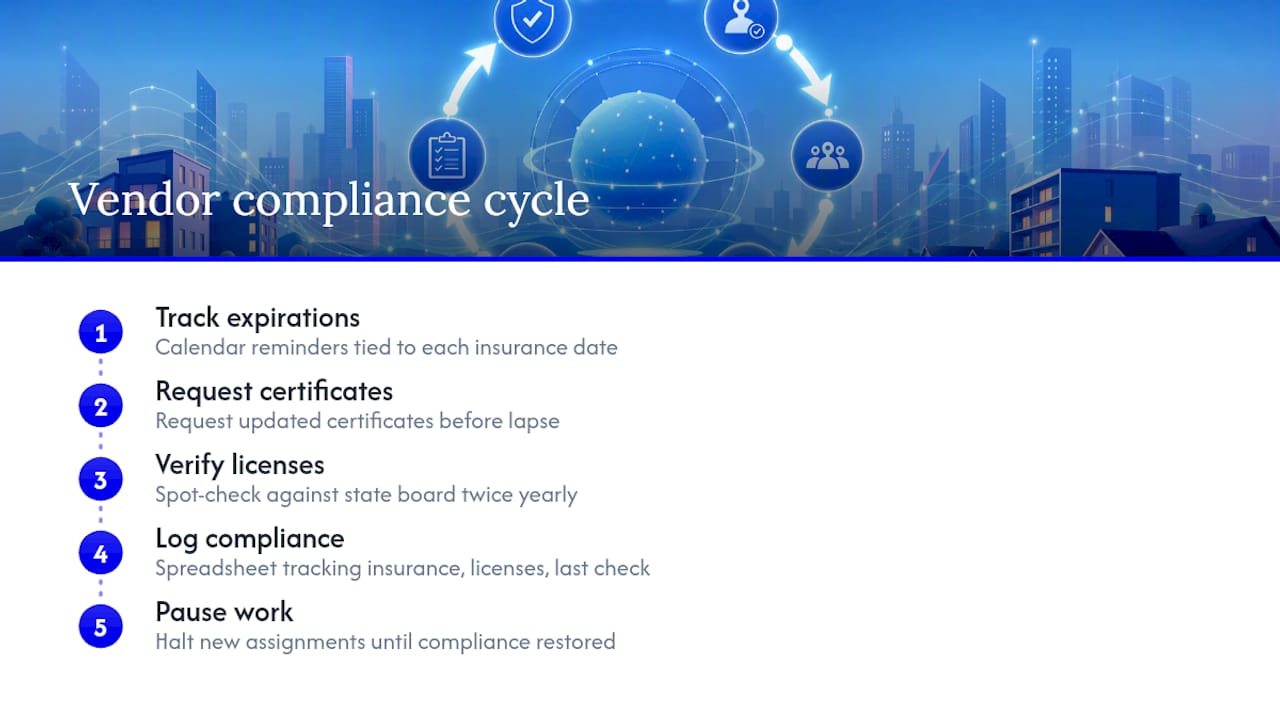
Periodically spot-check licenses against your state's licensing board, especially for trades where license renewal cycles are easy to lose track of. A quick audit twice a year catches most problems before they become your liability instead of the vendor's.
Keep a simple compliance log, even a spreadsheet works, tracking each vendor's insurance expiration, license renewal date, and last verification check. When a vendor falls out of compliance, pause new work orders immediately rather than assuming they'll catch up on their own schedule.
Turning Good Vendors Into Long-Term Partners
The vendors who show up fastest and charge fairly are usually the ones who feel like they're part of a stable relationship, not a rotating cast of one-off jobs. Building that loyalty starts with how consistently you pay.
Pay on the terms you agreed to, every time, and use ACH or another fast electronic method instead of making a contractor wait on a mailed check. Vendors remember which clients pay promptly, and that memory shapes whose calls they answer first during a busy week.
Give your top vendors real, recurring volume instead of spreading every job across your full list. A vendor who knows they'll get a steady stream of your turnovers or your plumbing calls has a direct incentive to prioritize your properties over a client who only calls sporadically.
Schedule periodic check-ins with your best vendors, even a short quarterly call, to review upcoming work and flag any pricing changes before they show up as a surprise on an invoice. That small effort keeps the relationship active instead of transactional, and it gives you a chance to catch problems, staffing changes, licensing gaps, before they affect your property.
Field-Tested Pitfalls Worth Avoiding
Keeping too many low-volume vendors per trade dilutes your leverage and slows response time, since no single contractor gets enough of your business to prioritize you. Standardize your invoice format and require before-and-after photos on every job, no exceptions. Schedule recurring check-ins with your top vendors so the relationship stays active between emergencies.
— Chaim
Let Milwaukeepm Run Your Vendor System for You
Building the vetting, onboarding, and tracking systems described above takes time most landlords don't have between showings, rent collection, and everything else on a property owner's plate. A full-service property manager handles maintenance coordination with vetted local vendors, runs tenant screening and marketing to protect your income, and provides an owner portal where every repair and invoice is visible without a single phone call.
A tenant guarantee may mean a placed tenant who leaves within the first year gets re-rented at no extra charge, providing an additional level of accountability in leasing arrangements. Full-service management runs at 10% of monthly rent, with a $650 one-time new tenant placement fee and no setup cost. If your portfolio has outgrown manual vendor tracking, request pricing details and see whether a managed system fits your properties better than building one yourself.
Where to Verify Vendor Requirements and Templates
For insurance-endorsement language, review Michigan State University's vendor insurance requirements. For contract structure, see this property management agreement template, and for trade-specific maintenance planning, check HVAC lifespan guidance for rental properties.
Sources
- Vendor management for property managers: The complete guide · DiscoveryMark
- Vendor coordination for property managers: 3 methods (US Tech Automations)
- Vendor Insurance Requirements | Office of Risk Management and Insurance | Michigan State University
- Vendor management for property management: Systems, KPIs & scaling guide (WiseUnit)
FAQ
What Does Vendor Management Include?
Vendor management for landlords covers vetting (insurance, licensing, references), written onboarding with a defined scope of work, ongoing performance tracking through KPIs, and relationship practices like timely payment and scheduled check-ins. A documented vendor management system also includes a quality review roughly every six months.
What Is a Vendor Management Fee?
There's no single industry-standard "vendor management fee." When landlords outsource this work to a property manager, it's typically bundled into the monthly management fee rather than billed separately. Milwaukeepm's management fee, which covers vendor coordination among other services, is 10% of monthly rent.
What Are the Four Stages of Vendor Management?
The four core stages are vetting, onboarding, tracking, and relationship management. Vetting confirms insurance, licensing, and references; onboarding sets written expectations; tracking measures performance through KPIs; and relationship management keeps top vendors engaged through fair terms and steady work.
What Are Some Popular Vendor Management Approaches for Landlords?
Landlords generally choose between manual coordination (calls, texts, spreadsheets), platform-native tools built into their property management software, or an automated execution layer using SMS-based nudges and bid requests. The right coordination method depends on portfolio size, with manual approaches typically straining once a coordinator manages more than roughly 100 to 150 units.