
Yes, you can terminate a property management agreement, but your contract's termination clause decides how fast and how cheaply. Read that clause first: it sets your notice period, any auto-renewal window, and whether early-termination fees apply. If you have documented cause, such as missing funds or a lapsed license, you may sidestep those fees entirely. Prepare a dated written notice and a records demand now, before you send anything.
TL;DR:
- Most contracts require 30 to 90 days' notice and may have auto-renewal windows that demand cancellation 60 to 90 days before renewal to avoid additional fees.
- Termination notices should reference the original contract, specify whether for cause or without cause, and include a clear effective date and a demand for final records.
- Building documented proof of breach, such as emails, bank statements, or photos, is essential to waive early-termination fees when terminating for cause.
- Demand a detailed, dated list of final payments, tenant files, keys, and records within 10 to 14 business days after termination to ensure a smooth handover.
- Escalate stalling record requests to licensing boards, small claims court, or attorneys, following a structured order of steps to recover necessary documents legally.
Table of Contents
- What to Check First: Termination Clause, Auto-Renewal, and Fees
- How to Write and Deliver a Termination Notice That Holds Up
- For-Cause vs. Without-Cause: Why Documentation Decides Your Fees
- What to Demand at Handover: Your Records Checklist
- Notifying Tenants and Moving Payments Without Missing Rent
- When the Manager Won't Hand Over Records: Your Escalation Options
- Your 30 to 60 Day Takeover Plan
- What Owners Get Wrong About Ending a Management Contract
- Get a Clean Takeover Instead of a Messy One
- Templates and Resources Worth Bookmarking
- Sources
What to Check First: Termination Clause, Auto-Renewal, and Fees
Before you draft anything, pull out the signed agreement and find three provisions: termination, renewal, and fees. These clauses usually sit together near the back of the contract, often under headings like "Term and Termination" or "Cancellation."
Most agreements set a notice period of 30 to 90 days, and many attach an auto-renewal window that locks you into another full term unless you cancel 60 to 90 days ahead of the renewal date. Miss that window and you could be stuck for another year regardless of performance.
Watch for these red flags while you review:
- Early-termination fees calculated as a multiple of monthly management fees
- Auto-renewal language with no capped notice window
- Vendor or maintenance contracts tied to the manager that survive termination
- Vague "cause" definitions that make breach hard to prove
- Silence on how records and deposits get returned
How to Write and Deliver a Termination Notice That Holds Up
A termination letter needs to do more than announce your decision. It has to create a paper trail that protects you if the relationship turns adversarial.
Every notice should include:
- Reference to the original contract date and parties
- A clear statement that you are terminating the agreement
- The effective date, calculated to satisfy your contract's notice period
- Whether termination is for cause or without cause, with a brief factual basis if for cause
- A demand for records, keys, and a final accounting by a specific date
Delivery matters as much as content. Send the notice by certified mail with return receipt, and email a copy the same day so there's a timestamped backup. Follow whatever delivery method your contract specifies, even if it seems redundant.
Keep the language factual and unemotional. Avoid accusations you can't back up in writing. A notice that reads like a vendetta invites a counterclaim; one that reads like a business letter closes the door cleanly.
Pro Tip: Send certified mail even when your contract only requires standard mail. The return receipt becomes your proof of delivery if a dispute ever reaches small claims court or a licensing board.

For-Cause vs. Without-Cause: Why Documentation Decides Your Fees
Terminating without cause means you simply follow the notice period and pay whatever fees the contract specifies. Terminating for cause can waive those fees entirely, but only if you can prove the breach.
Typical for-cause grounds include mishandled trust funds, failure to maintain the property, failure to provide required accounting, loss of the manager's real estate license, or Fair Housing violations. HUD's Office of Fair Housing and Equal Opportunity is the authoritative reference if you're alleging discriminatory conduct.
Build your file before you send anything:
- Dated emails showing unanswered maintenance requests or missed reporting deadlines
- Bank statements showing delayed or missing rent deposits
- Copies of work orders left open for weeks
- Inspection photos documenting deferred maintenance
- Written tenant statements about unresolved complaints
Check your contract for a "notice-and-cure" clause. Many agreements require you to notify the manager of a breach and give a defined period to fix it before you can declare for-cause termination. Skipping that step can hand the manager grounds for a counterclaim.
What to Demand at Handover: Your Records Checklist
Your termination notice should include a specific, dated demand for handover items. Vague requests get vague responses, so put the list in writing and attach a deadline.
Prioritize these items:
- Current rent roll showing every unit, tenant, and rent amount
- Full tenant files, including signed leases and applications
- Payment histories and the security deposit ledger, including where funds are held
- Physical keys, fobs, and access codes for every unit and common area
- Records of open work orders, active vendor contacts, and any equipment warranties
Request digital copies of everything, not just paper files, and set a firm delivery deadline, typically 10 to 14 business days after your effective date. Instruct the outgoing manager to include a final reconciliation statement showing every dollar collected and disbursed during their final month.
Notifying Tenants and Moving Payments Without Missing Rent
Tenants need clear, timely notice so rent doesn't get lost in the transition. Decide who sends that notice, either you or the outgoing manager, and include the effective date, new payment instructions, and an emergency contact.
Security deposits require extra care. State landlord-tenant statutes govern how deposits must be held and transferred, and the rules differ by state, so confirm where funds currently sit before you take custody.
- Set up an interim payment channel, such as a bank drop box or an owner portal, before the switch date
- Call your highest-value tenants directly rather than relying on a form letter
- Confirm the deposit transfer in writing, with an itemized ledger attached
When the Manager Won't Hand Over Records: Your Escalation Options
Some managers stall on records, especially when money is missing or maintenance was neglected. Escalate in order of cost and time, and keep every step in writing.
- Send a demand letter with a short, firm deadline, again by certified mail with return receipt
- File a complaint with your state's real estate commission or licensing board; a broker's license is real leverage, and boards can often compel record production faster than a civil suit
- Pursue small claims court for disputes involving modest amounts, like a withheld final accounting or a small fee dispute
- Retain a real estate attorney for larger fiduciary breaches, missing trust funds, or license-related claims
- Consider mediation or arbitration if your contract requires it before litigation; many agreements specify this route
Your 30 to 60 Day Takeover Plan
A clean handover runs on a calendar, not good intentions. Break it into phases so nothing slips through the gap between managers.
- Week 1: Send your written notice by certified mail, attach your records demand, and calendar every deadline. Instruct the manager to freeze new leases and postpone large repairs during the notice period.
- Week 2: Audit whatever records arrive against your checklist, confirm where the security deposit sits, notify tenants of the change, and stand up your interim payment channel.
- Weeks 3 to 4 and beyond: Complete vendor handoffs, collect the final accounting, transfer keys and access codes, and confirm your new manager's start date.
Pro Tip: Start interviewing replacement managers before you send your termination notice. A confirmed replacement means no gap where your property sits unmanaged.
What Owners Get Wrong About Ending a Management Contract
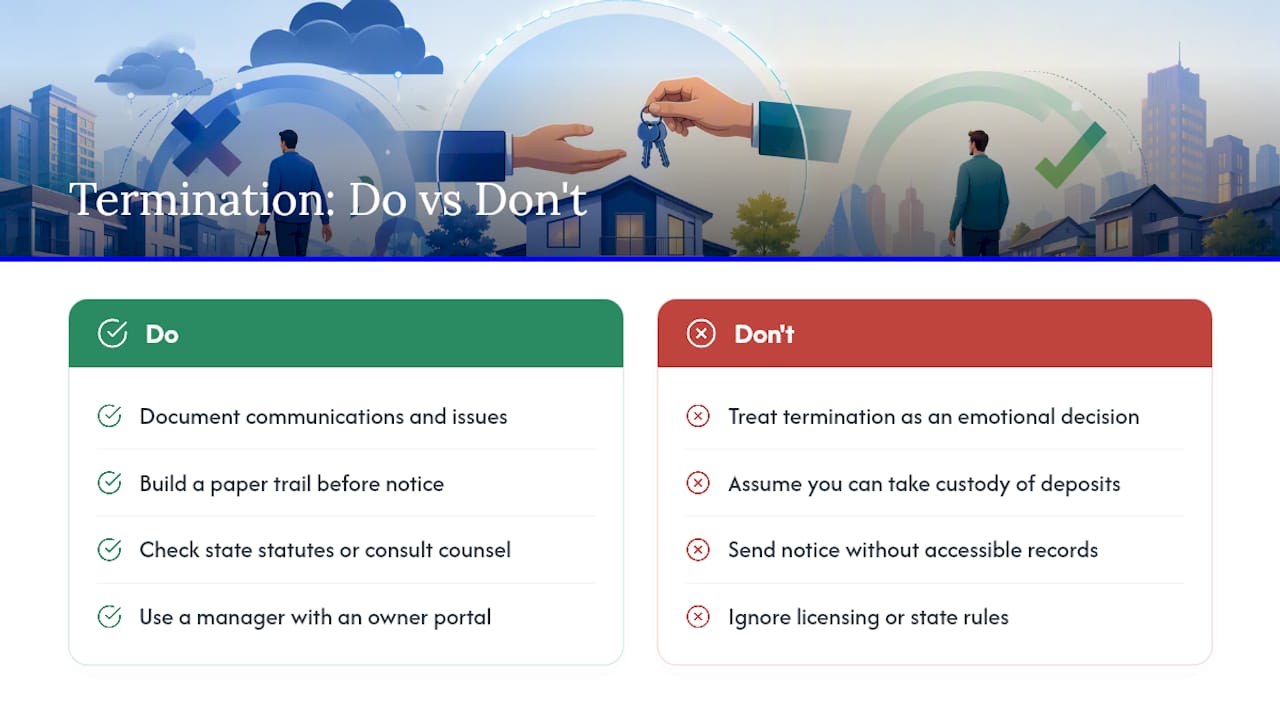
Most owners treat termination as an emotional decision when it's really a documentation exercise. The contract, not your frustration level, decides whether you owe a fee. I've seen owners with legitimate grievances pay thousands in early-termination penalties simply because they never built a paper trail before sending notice.
Security deposit rules and licensing procedures vary enough by state that guessing is risky. Check your state statute or talk to counsel before you take custody of deposit funds. A professional manager with a real owner portal can also cut transition friction dramatically, since records live in one searchable place instead of a filing cabinet you're fighting to access.
— Chaim
Get a Clean Takeover Instead of a Messy One
Milwaukeepm handles the parts of a management switch that trip up most owners: final accounting, security deposit custody, tenant communications, and vendor transfer, all coordinated so nothing falls through during the changeover. Instead of chasing a former manager for records while rent payments stall, you get a team that already knows how to audit incoming files and get tenants routed to a new payment system without missing a cycle.
If your current agreement is already causing headaches, start with a straightforward clause review or notice-drafting consultation before you send anything. Visit Stress-Free Investment Property Management in Milwaukee to talk through your specific contract and get a takeover plan built around your property, not a generic template.
Templates and Resources Worth Bookmarking
For notice language, check sample letters from eForms, iPropertyManagement, and Rents. For step-by-step legal context, see LegalClarity's termination guide and HUD's Fair Housing resources. Talk to a local real estate attorney whenever deposit funds or license complaints are involved.
Sources
- How to Fire Your Property Management Company: Steps - LegalClarity
- Property Management Agreement Termination Letter - eForms
- Rents
- Free Property Management Termination Letter Templates PDF - iPropertyManagement