
Require a completed application plus signed authorization, verifiable income at 2.5 to 3 times the rent, a credit report, rental-history verification, targeted eviction, or criminal checks. Every one of those criteria needs to live in a written policy applied the same way to every applicant. Skip the paperwork and you're screening on gut feeling, which is exactly what invites a fair-housing complaint.
Before you run a single check, collect the completed application and signed consent form. Nothing else matters until that's in hand.
Your baseline checklist should include:
- Completed rental application with signature and consent to screen
- Government-issued ID verification
- Income verification showing gross monthly rent multiplied by a common income multiple
- Credit report with a minimum score typically between 600 and 650
- Rental history verification with prior landlords
- Eviction record review, checking disposition and date
- Targeted criminal background check where legally permitted
Pro Tip: Print your criteria and keep a copy in every applicant's file, even the ones you approve. If you can't show you applied the same standard to everyone, the standard doesn't protect you.
Key Takeaways
Consistent, written tenant screening criteria applied to every applicant is what actually protects landlords from legal risk, not the specific thresholds chosen.
| Point | Details |
|---|---|
| Put criteria in writing | Draft a Fair Rental Criteria document specifying income, credit, and history standards before you list a unit. |
| Verify income at 2.5 to 3x rent | Accept pay stubs, tax returns, bank statements, or benefit letters as proof, especially for nontraditional income. |
| Read credit reports for context | A 600 to 650 minimum is common, but weigh recent delinquencies and collections over the raw score alone. |
| Confirm eviction disposition | Disregard filings where the tenant prevailed or the outcome is unclear before treating one as disqualifying. |
| Consider a managed screening process | Milwaukeepm runs compliant screening, portal documentation, and a first-year tenant guarantee for owners who want it off their plate. |
Table of Contents
- How Do You Write a Fair Rental Criteria Document?
- What Should a Rental Listing Say About Screening?
- What Information Does a Rental Application Need?
- How Do You Verify Income and Handle Self-Employed Applicants?
- What Credit Score Do You Need to Approve a Tenant?
- How Do You Verify Rental History With Prior Landlords?
- How Should You Review an Applicant's Eviction History?
- What Does a Fair Criminal Background Check Look Like?
- What Final Checks and Records Should You Keep?
- What Is the Right Way to Decide and Document a Denial?
- How Milwaukeepm Applies These Standards in Practice
- What Tenant Screening Myths Trip Up Landlords?
- Why Most Screening Advice Undersells Consistency
- A Property Manager Can Take Screening Off Your Plate
- Frequently Asked Questions
- Sources
How Do You Write a Fair Rental Criteria Document?
A written screening policy, often called Fair Rental Criteria, is the single most protective document a landlord can create. It forces you to define, in advance, exactly what qualifies an applicant, so you're never making judgment calls in the moment that could look like bias after the fact. Landlord associations that publish sample screening-criteria guidance consistently recommend spelling out income requirements, credit standards, and rental-history rules in writing and applying them to every applicant without exception.
Your document should cover:
- Income standard — the exact rent-to-income multiple you require and what documentation satisfies it.
- Credit policy — your minimum score, plus how collections or bankruptcies factor into the decision.
- Eviction and criminal-history rules — how far back you look and what disqualifies an applicant outright.
- Occupancy, pet, and fee policies — limits per bedroom, pet deposits, and your application fee refund terms.
A few sample rules you can adapt directly: "Applicant must show verifiable gross monthly income of at least 3 times the monthly rent." "Applicants with a credit score below 600 will require a co-signer or additional deposit." "Evictions filed within the past 3 years with a judgment against the tenant will result in denial."
Pro Tip: Give every applicant a copy of your written criteria before they apply. It cuts down on wasted showings from people who won't qualify anyway.
What Should a Rental Listing Say About Screening?
Your listing and any pre-screening conversation should state your objective requirements plainly, so unqualified applicants self-select out before you invest time showing the unit.
Effective listing language sounds like this:
- "Applicants must show gross monthly income of at least 3 times the rent."
- "Minimum credit score required as appropriate to your market; co-signers may be accepted in some cases."
- "No evictions with a judgment within the past 3 years."
A short phone pre-screen can confirm the basics fast: ask about move-in timeline, household size, income range, and whether they've ever been evicted, then stop there. Never ask about family status, national origin, disability, or religion, and avoid listing language like "perfect for young professionals" or "no kids" that implies a preference for or against a protected class. That kind of phrasing has landed landlords in real trouble with fair-housing enforcement, even when unintentional.
What Information Does a Rental Application Need?
A complete application does two things: it gives you what you need to screen, and it documents that you're screening everyone the same way.
- Full legal name, date of birth, and Social Security number for identity and credit matching.
- Current and prior addresses going back at least two years, for rental-history verification.
- Employment information, including employer name, position, and length of employment.
- Personal and professional references, with contact information.
- Signature and dated consent authorizing you to pull a credit report and contact references.
Accept a driver's license, state ID, passport, or military ID for identity verification, and match the name and date of birth against the application before you run anything. Under the Fair Credit Reporting Act, you need written authorization before pulling a consumer report, and that consent language should appear directly on the application itself, not buried in a separate document applicants might skip.
How Do You Verify Income and Handle Self-Employed Applicants?
The 2.5 to 3 times rent standard is the most common income benchmark landlords use, and it holds up well because it leaves enough of an applicant's income for utilities, food, and other obligations without setting the bar so high that qualified renters get excluded. On a $1,500 unit, that means requiring $3,750 to $4,500 in verifiable gross monthly income.
Acceptable documentation includes:
- Two to three recent pay stubs
- A current W-2 or the most recent year's tax return
- Two to three months of bank statements
- Benefit award letters for Social Security, disability, or pension income
- Housing voucher documentation from a local housing authority
Self-employed and gig-economy applicants won't have pay stubs, so lean on tax returns, 1099 forms, or bank deposit history averaged over three to six months. HUD guidance specifically flags that accepting alternative income documentation instead of demanding traditional pay stubs helps landlords avoid unlawfully excluding tenants with nonstandard but legitimate income.
Pro Tip: If a self-employed applicant's income is seasonal, average it across a full year rather than judging them by their slowest month.
What Credit Score Do You Need to Approve a Tenant?
A raw number only tells part of the story. Most landlords set a floor somewhere between 600 and 650, with applicants above 650 often treated as top-tier candidates who qualify without conditions, while scores under 400 frequently trigger automatic denial at many management companies.
What actually matters is what's driving the number:
- Payment history — one late payment two years ago reads very differently than six months of missed payments last year.
- Collections accounts, especially ones tied to a previous landlord or utility company.
- Recent delinquencies within the past 12 months, which carry more weight than older ones.
- Bankruptcies and judgments, including how long ago they were discharged.
A tenant with a 590 score dragged down by old medical debt is a different risk than one with a 590 driven by a recent eviction judgment and three collections accounts. Context changes the decision even when the number doesn't.
If a credit report contributes to a denial or to offering less favorable terms, the Fair Credit Reporting Act requires you to send an adverse-action notice identifying the reporting agency and the applicant's right to a free copy of the report. Skipping that step, even on an otherwise reasonable denial, creates legal exposure you don't need.
How Do You Verify Rental History With Prior Landlords?
A phone call to a previous landlord takes ten minutes and tells you more than almost anything else in the file. Confirm the dates of tenancy, whether rent was paid on time, any lease violations, whether the security deposit was returned in full, and whether there were complaints from neighbors.

Ask direct questions: "Would you rent to this person again?" "Did they give proper notice before moving out?" "Was there any damage beyond normal wear?" Confirm you're actually speaking with the property owner or manager of record, not a friend the applicant listed as a reference. A quick search of the property address against the applicant's stated dates usually confirms it.
Applicants with thin or no rental history, recent graduates, or people relocating for a new job, aren't automatically higher risk. Consider a co-signer, three to six months of bank statements showing consistent housing payments, or a stronger employment reference in place of a traditional landlord history.
How Should You Review an Applicant's Eviction History?
An eviction filing on a background report isn't automatically disqualifying, and treating it that way can create legal problems. HUD guidance is explicit that a filing where the tenant prevailed, or where the disposition is unclear, should not count against the applicant unless you can confirm what actually happened.
- Check the disposition first. A dismissed case or one resolved in the tenant's favor carries no weight.
- Weigh recency and relevance. An eviction with a judgment from eight years ago matters less than one from last year, and a nonpayment eviction is more relevant to your risk than a dispute over a noisy pet.
- Consider a conditional approval. A larger deposit or a co-signer can reasonably offset an older, isolated eviction without denying the applicant outright.
What Does a Fair Criminal Background Check Look Like?
Criminal history screening carries the highest legal risk of any part of the process, and HUD guidance is direct about it: blanket bans based on any criminal record, or on arrests that never led to a conviction, routinely produce unlawful disparate impact. Limit your criteria to convictions genuinely related to tenancy safety, violent offenses, or property crimes, not an applicant's entire record regardless of relevance.
- Skip arrest records entirely; an arrest without a conviction proves nothing.
- Weigh the nature of the offense, how long ago it occurred, and any evidence of rehabilitation.
- Never apply a blanket "no felons" rule across your entire applicant pool.
- Check your city and state for fair-chance housing ordinances before you finalize your criteria, since some jurisdictions restrict how far back you can look or bar criminal-history screening for certain offenses entirely.
Pro Tip: Run criminal checks after you've already verified income and rental history. If the applicant doesn't meet your basic financial criteria, you never need to touch the criminal question at all.
What Final Checks and Records Should You Keep?
Before you make a decision, close the loop with references and confirm nothing in the file contradicts what the applicant told you. Ask employers to confirm position, tenure, and whether the applicant is in good standing, and ask personal references how long they've known the applicant and in what capacity.
Watch for these red flags:
- Pay stubs or bank statements that look edited or inconsistent
- A prior landlord you can't reach after multiple attempts, or a number that traces back to the applicant
- A pattern of tenancies lasting six months or less across multiple addresses
- Application answers that contradict information on the credit or background report
Keep every application, screening report, and note from reference calls in a file for each applicant, approved or denied, for at least three years. If a fair-housing complaint surfaces years later, that file is your entire defense.
What Is the Right Way to Decide and Document a Denial?
Every applicant should land in one of three buckets: approve, conditionally approve, or deny, and each decision needs a paper trail tying it to a specific piece of evidence rather than a vague impression.
- Map each denial reason to documentation. "Insufficient income" should point to the exact pay stub or bank statement that fell short of your threshold.
- Send the adverse-action notice promptly if a consumer report played any role in the decision. It must name the reporting agency, state the applicant's right to a free report, and explain their right to dispute inaccuracies.
- Retain the full file for three years minimum: the application, the screening report, your written criteria, and any notes from reference calls.
This is the same discipline outlined in more detail in our tenant screening process guide, and it's worth building into your workflow before you ever list a unit.
How Milwaukeepm Applies These Standards in Practice
Running this checklist consistently across dozens of units is harder than it sounds, particularly when an applicant's income doesn't fit neatly into a pay-stub format. Milwaukeepm's screening process routinely evaluates alternative documentation, six months of bank deposits for a self-employed contractor, or a benefit letter for an applicant on SSDI, and offers conditional approval with an adjusted deposit rather than a flat denial when the underlying risk is manageable.
A tenant guarantee only works if the screening behind it is disciplined. We built our first-year guarantee because our process holds up under scrutiny, not despite it.
Owner and tenant portals remove a lot of the friction from verification: documents upload directly, reference calls get logged in one place, and owners can see exactly what evidence supports each decision. When a criminal record or an eviction filing raises a genuinely close call, that's the moment to loop in legal counsel or a full-service manager rather than guessing. For a look at how this works in practice, see our tenant screening case studies from Milwaukee rental properties.
What Tenant Screening Myths Trip Up Landlords?
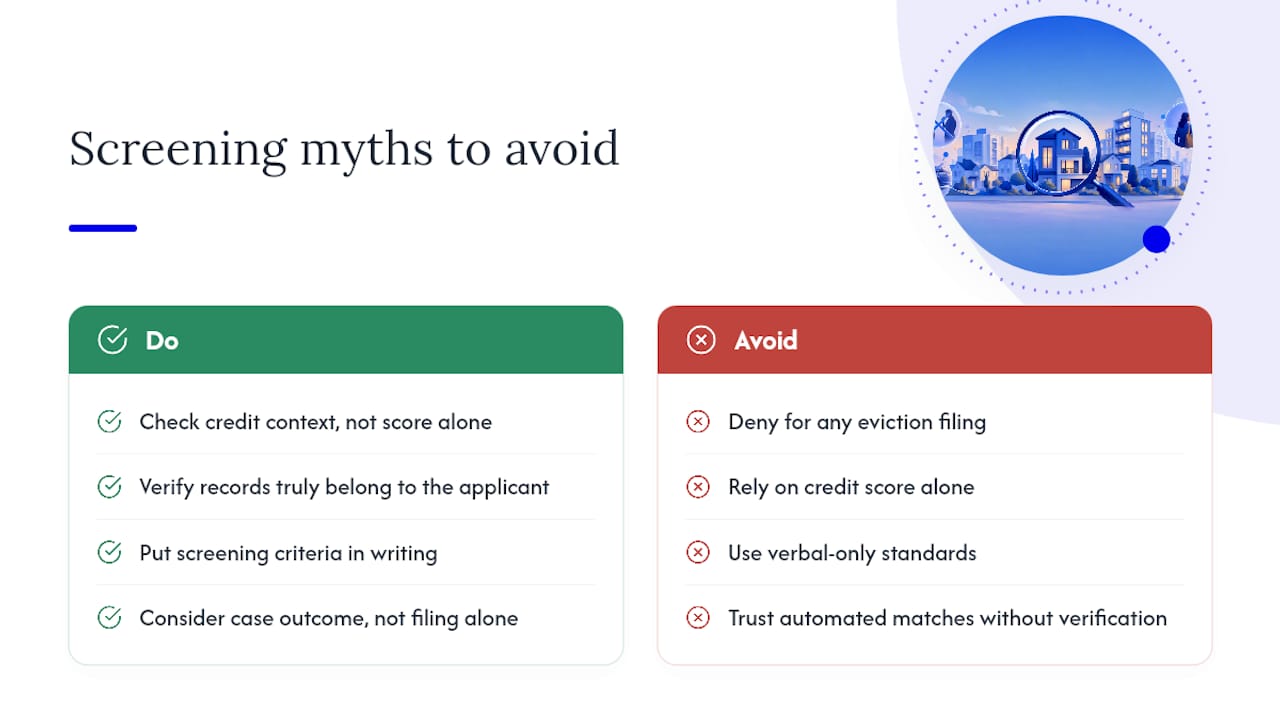
The biggest myth is that a higher credit-score minimum automatically means a safer tenant. It doesn't. A 680 score attached to three recent late rent payments is a worse bet than a 610 score with a clean payment history and one old medical collection. Score alone, without context, tells you less than landlords assume.
Another common mistake: treating any eviction filing as an automatic denial. As HUD's guidance makes clear, a filing where the case was dismissed or the tenant won proves nothing about their reliability, and denying on that basis alone invites a fair-housing challenge.
Landlords also frequently assume that verbal criteria are enough, "I always require good credit," without ever writing it down. Unwritten standards shift from applicant to applicant even when you don't mean them to, and that inconsistency is exactly what gets flagged in a discrimination complaint.
A subtler mistake involves database screening tools. Automated systems can misattribute someone else's criminal or eviction record to your applicant, particularly with common names, because name-similarity matching without a full date of birth or address history produces false positives. Before you deny someone based on a background report, confirm the record actually belongs to them. Some screening technology platforms build safeguards against this, but the final verification responsibility still sits with you.
Why Most Screening Advice Undersells Consistency
The technical details of screening, credit thresholds, income ratios, eviction lookback periods, get most of the attention in landlord forums and blog posts. They matter, but they're not what actually protects you legally. Consistency is. A landlord who applies a 610 credit minimum to every single applicant is on firmer legal ground than one who applies a 650 minimum but waives it for tenants they personally like.
Where conventional advice falls short is treating screening criteria as a one-time setup task. Your written policy needs revisiting every year or two, because local fair-chance ordinances change, income benchmarks shift with rent increases, and credit-reporting standards evolve. A policy written in 2022 that nobody's revisited since is a liability, not a protection.
If you take one thing from this guide, prioritize writing your criteria down and applying them the same way to every application that crosses your desk. The specific numbers you choose matter far less than whether you can prove, on paper, that you never changed the rules mid-game.
A Property Manager Can Take Screening Off Your Plate
Milwaukeepm handles the entire screening process end to end, so you're not the one chasing down pay stubs or deciding how to interpret a decade-old eviction filing at 9 p.m. on a Saturday.
The service includes drafting your written Fair Rental Criteria, running fully compliant screening on every applicant, giving you owner-portal visibility into each decision, and handling adverse-action documentation so nothing falls through the cracks. Milwaukeepm also backs placements with a tenant guarantee for the first year, which means the risk of a bad screening call doesn't sit entirely on your shoulders. That combination, compliant process plus a guarantee behind it, is the practical difference between screening on your own and having a team that's done it thousands of times handle it for you.
Beyond screening, Milwaukeepm's full-service property management covers marketing, rent collection, and maintenance coordination, so placement is just the starting point. If you're ready to stop drafting policies and start filling vacancies with qualified tenants, reach out to Milwaukeepm to talk through your property and get a screening process built around it.
Frequently Asked Questions
What credit score should landlords require for tenant approval? Most landlords set a minimum between 600 and 650, treating scores above 650 as top-tier applicants. The number matters less than the story behind it. Check for recent delinquencies, collections, and judgments rather than relying on the score alone.
What income-to-rent ratio is standard for tenant screening? A ratio of 2.5 to 3 times gross monthly rent is the most widely used benchmark. On a $1,800 unit, that means requiring $4,500 to $5,400 in verifiable monthly income before approval.
Can you deny an applicant for an eviction that was dismissed? No. HUD guidance specifically warns against treating a dismissed filing or one where the tenant prevailed as disqualifying. Confirm the actual case outcome before it factors into any decision.
Do you need written consent before running a credit check? Yes. The Fair Credit Reporting Act requires signed authorization before pulling a consumer report, and that language should sit directly on your rental application.
What are the biggest rental application red flags? Edited or inconsistent pay stubs, an unreachable prior landlord, a pattern of tenancies lasting under six months, and application answers that contradict the credit or background report all warrant a closer look before approval.
Sources
- What credit score do you need to rent an apartment? | Experian
- Guidance on the Screening of Applicants for Rental Housing | HUD (FHEO) — 2024
- Screening: Establishing Criteria — SFAA (sample guidance)
- Rentlatefee