
Four programs reliably lift lease renewals: standardized move-in onboarding, published maintenance response standards, a pre-renewal NPS action loop, and a lease-enrolled resident benefits package. If you do nothing else this week, fix your move-in checklist and publish a maintenance service-level agreement (SLA) in your tenant portal. Those two moves cost almost nothing and start paying off fastest, because industry research on retention programs consistently ranks move-in quality and maintenance responsiveness as the two strongest predictors of renewal.
- Standardized move-in onboarding (first 30 days)
- Published maintenance SLA with acknowledgement times
- Pre-renewal NPS survey and action loop
- Lease-enrolled resident benefits package
Most operators who run these four programs together see measurable retention lift within 60 to 90 days. That timeline matters for budgeting: you can test this before your next fiscal quarter closes.
Key Takeaways
Tenant retention improves fastest when move-in standardization, maintenance SLAs, pre-renewal NPS, and lease-enrolled benefits run together as one connected program, not as separate initiatives.
| Point | Details |
|---|---|
| Turn costs justify the investment | Each avoided turn saves roughly $3,000 to $5,000 in make-ready, marketing, and lost rent. |
| Start with move-in and SLAs | These cost the least and produce the fastest measurable lift in renewal behavior. |
| Time the NPS survey at day 270 | This gives a 90-day runway to resolve detractor issues before the renewal decision. |
| Lease-enroll benefits, don't opt-in | Enrollment by default drives adoption near 100% versus under 20% for opt-in programs. |
| Milwaukeepm builds this infrastructure in | Tenant guarantee, portals, and screening give owners a direct path to run these programs without building them from scratch. |
Table of Contents
- What Tenant Turnover Costs and Why Retention Pays Back
- Which Retention Programs Actually Move Renewal Rates?
- How Do You Roll Out Retention Programs in 90 Days?
- What KPIs Prove Your Retention Program Is Working?
- Copy-Ready Checklists You Can Use This Week
- How Investment Property Management Pros Builds These Programs
- An Editor's Note on Retention as Discipline
- Turn This Playbook Into a Managed Service
- Frequently Asked Questions
- Sources
What Tenant Turnover Costs and Why Retention Pays Back
A single unit turn typically runs $3,000 to $5,000 once you add make-ready work, lost rent during vacancy, and marketing spend to refill the unit. That range assumes a fairly routine turn. Add carpet replacement, appliance repair, or a slow leasing season, and the number climbs fast.

Vacancy length drives most of the pain. A unit that sits empty for three weeks instead of one week doesn't just cost rent. It resets your leasing team's workload, delays the next tenant's move-in prep, and often forces a rushed screening decision under time pressure.
Here's the math that makes retention budgets easy to justify: on a 100-unit portfolio with a 50% annual turnover rate, that's 50 turns a year. Lift retention by just 3 percentage points and you eliminate three turns. At $4,000 per turn, that's $12,000 back in your pocket, before counting the lease-up time you also recover.
- Average turn cost: $3,000–$5,000 per unit
- Main cost drivers: make-ready labor, lost rent, marketing/leasing time
- A 3% retention gain on 100 units saves roughly 3 turns annually
Retention programs rarely need a large budget increase. They need better sequencing of tasks you're likely already doing, just not consistently enough to show up in your renewal numbers.
Which Retention Programs Actually Move Renewal Rates?
Seven programs consistently show up in the data as the highest-leverage levers for keeping good tenants. Here's how to build each one, what it costs, and what to expect.
-
Standardized move-in and move-out experience. Build a written checklist covering unit walkthrough, appliance orientation, portal setup, and a welcome call within 48 hours of move-in. This is where first impressions of your management get locked in, and NAA's retention research treats a standardized onboarding sequence as a top-tier retention lever. Assign a single team member to own the first-30-day check-in call, not a rotating shift.
-
Maintenance response standards. Publish an SLA in plain language: emergency requests acknowledged within 24 hours, routine requests within 24 to 48 hours. Post it in the tenant portal so residents know what to expect before they ever submit a ticket. Response-time consistency correlates strongly with renewal decisions, likely because slow maintenance is the single most common complaint that pushes a satisfied tenant toward looking elsewhere. Track vendor response against the SLA weekly, not quarterly, and escalate any vendor missing the window twice in a row.
-
Pre-renewal NPS and action loop. Send a short satisfaction survey at day 270 of a 12-month lease, giving you a 90-day runway before the lease decision point. Any detractor score gets a callback within 48 hours, a documented resolution plan, and a re-survey 30 days later to confirm the fix landed. This loop, not the survey itself, is what moves renewal numbers.
-
Lease-enrolled resident benefits. Bundle air filter delivery, a renters insurance master policy, and credit-building rent reporting directly into the lease rather than offering them as optional add-ons. Lease enrollment changes the adoption math entirely: opt-in benefit programs often see under 20% uptake, while lease-enrolled versions reach close to 100% by design. One reported case found air filter subscriptions cut HVAC-related work orders by roughly 38%, which lowers your maintenance load while the tenant experiences it as a perk, not a chore.
-
Renewal incentive structure. Tier incentives by lease length. A 12-month renewal might get a modest rent-freeze offer; an 18 or 24-month renewal might pair with a small unit refresh, like new light fixtures or a paint touch-up. Pairing incentives with tangible upgrades reads as investment in the tenant, not a discount.
-
Community programming and referral programs. A quarterly resident event (budget $200 to $500 per event for a 50 to 100 unit property) and a formal referral bonus, paid only after the referred tenant signs, both build the kind of goodwill that shows up later as lower NPS detractor rates.
-
Communication cadence. A monthly touchpoint during months 4 through 9 of the lease costs far less than a single renewal-window scramble and keeps small frustrations from compounding into a move-out decision.
Pro Tip: Run the pre-renewal NPS survey through the same portal tenants already use for maintenance requests. Response rates drop sharply when you ask them to click into a separate email survey tool.
Any program touching incentives, benefits, or tenant communications needs to be applied uniformly across your resident population. The Fair Housing Act requires that perks, renewal offers, and outreach be administered without regard to protected characteristics, so document your criteria (lease length, payment history, unit type) before you roll anything out.
How Do You Roll Out Retention Programs in 90 Days?
Sequencing matters more than ambition here. Trying to launch all seven programs simultaneously usually means none of them get done well.
Days 1 to 30: Fix what's broken.
- Audit and rewrite the move-in checklist; assign an owner for the first-30-day call.
- Draft and publish the maintenance SLA in your tenant portal.
- Pull your current renewal rate by cohort so you have a baseline to measure against.
Days 31 to 60: Pilot the measurement layer.
- Launch the day-270 pre-renewal NPS survey for any leases ending in this window.
- Build the escalation workflow: who calls detractors, within what timeframe, and how resolution gets logged.
- Pilot one lease-enrolled benefit (air filter delivery is usually the cheapest and fastest to stand up) on a subset of units.
Days 61 to 90: Scale and formalize.
- Expand the benefits package portfolio-wide if the pilot shows reduced maintenance tickets.
- Set renewal incentive tiers and train leasing staff on how to present them.
- Schedule the first quarterly resident event and launch the referral program with clear payout terms.
Ownership needs to be explicit, not implied. The community manager owns move-in onboarding and the NPS action loop. The maintenance lead owns SLA compliance and vendor accountability. Regional operations owns the budget for incentives and events, and reviews renewal-rate data monthly against baseline. If you're unsure how these roles typically divide labor day to day, a breakdown of core property manager responsibilities is a useful reference point.
On budget: prioritize the SLA and move-in fixes first because they cost almost nothing beyond staff time. Reserve dollars for the benefits pilot and events once you have baseline NPS data confirming which units or tenant segments need the investment most.
What KPIs Prove Your Retention Program Is Working?
Five numbers tell you whether these programs are earning their keep. Track them monthly, not quarterly, so problems surface while you can still act on them.
- Renewal rate by cohort: segment by lease length and move-in date, not just a blended portfolio average.
- Pre-renewal NPS at day 270: track the score itself and the percentage of detractors who get contacted within 48 hours.
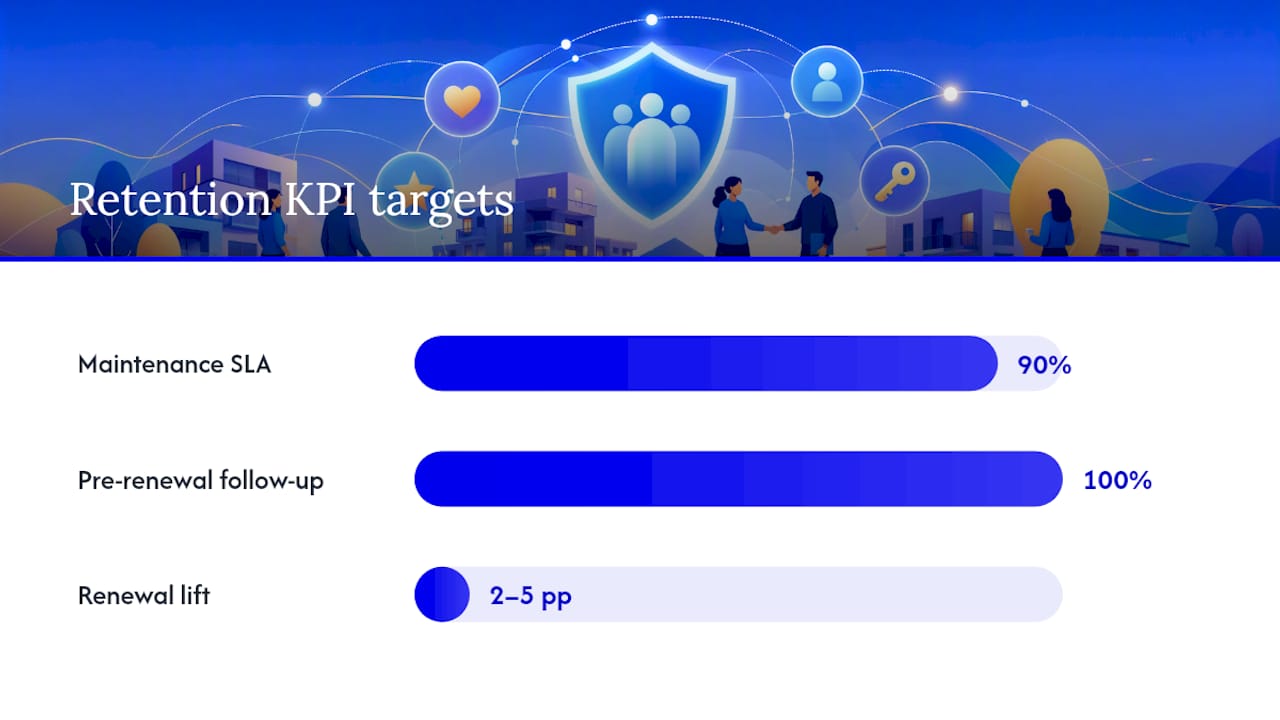
- Maintenance SLA compliance: aim for roughly 90% of tickets acknowledged within the published window.
- Days-to-turn: the gap between move-out and move-in ready; shrinking this recovers lost rent directly.
- Vacancy loss: dollar value of unrented days, tracked against your turn-cost baseline.
| KPI | Target |
|---|---|
| Maintenance SLA compliance | 90% of tickets acknowledged within stated window |
| Pre-renewal NPS detractor follow-up | 100% contacted within 48 hours |
| Renewal rate lift | 2 to 5 percentage points within two lease cycles |
| Days-to-turn | Under 10 days for standard units |
The action loop is what separates a survey from a program: assign each detractor response to a team member, document the resolution, close the ticket, then re-survey 30 days later to confirm the fix held. If you want to test whether a renewal incentive actually changes behavior, run it as a simple A/B split, one building or floor gets the tiered incentive offer, a comparable one doesn't, and compare renewal rates after one lease cycle.
Copy-Ready Checklists You Can Use This Week
Move-in checklist (first week):
- Walkthrough with signed condition report
- Portal login setup confirmed on-site
- Welcome call scheduled within 48 hours
- Maintenance SLA card provided in unit welcome packet
Maintenance SLA portal text (sample): "Emergency requests (no heat, water leak, no access): acknowledged within 24 hours. Routine requests: acknowledged within 24 to 48 hours, with a scheduled repair window."
Pre-renewal NPS survey (3 questions):
- On a scale of 0 to 10, how likely are you to recommend this property to a friend?
- What's the one thing we could improve before your lease renews?
- Are you planning to renew your lease? (Yes / Not sure / No)
Escalation email template opener: "Thanks for your feedback. We noticed your score and want to make this right before your renewal date. Here's what we're doing..."
Renewal offer timing: send the first formal renewal offer at day 270, follow up at day 300 if no response, and close the offer window by day 330 for a 12-month lease.
How Investment Property Management Pros Builds These Programs
Milwaukeepm implements most of this playbook as standard practice rather than as an add-on service. Tenant screening is built into every lease signed, backed by a first-year tenant guarantee that protects owners if a placed tenant doesn't work out. Owner and tenant portals handle maintenance requests, rent payments, and reporting in one place, which is exactly the infrastructure the pre-renewal NPS loop and SLA tracking described above depend on.
The programs that move renewal rates the most, standardized move-in, published maintenance response times, and a structured pre-renewal check-in, are also the ones easiest to let slip when a property manager is juggling leasing, maintenance calls, and owner reporting solo.
- Tenant screening and placement backed by a first-year guarantee
- Maintenance coordination with a preferred vendor network
- Transparent monthly and KPI reporting for owners
If you manage under a handful of units, running this playbook yourself is realistic with consistent effort. Once you're managing multiple properties or a portfolio, the coordination overhead alone often justifies handing the operational layer to a full-service manager.
An Editor's Note on Retention as Discipline
Most retention advice treats these programs as a checklist you complete once. The evidence says otherwise: retention compounds. Standardize the first 30 days of a lease and you change tenant behavior across the entire 12-month cycle, not just at renewal time.
The programs that get skipped most often, published SLAs and structured NPS follow-up, are the cheapest ones to run. Owners tend to spend on flashy amenities before fixing the maintenance ticket workflow, even though the data points the other direction entirely.
Turn This Playbook Into a Managed Service
Running all seven programs yourself takes consistent staff time most self-managing owners don't have to spare, especially the maintenance SLA tracking and the day-270 NPS follow-up loop. Milwaukeepm builds these into day-to-day operations rather than treating them as a separate initiative: tenant screening and a first-year tenant guarantee reduce the risk of a bad placement before retention even becomes a question, and owner and tenant portals give you the reporting infrastructure the KPIs above depend on.
If you'd rather have a team run the move-in standardization, maintenance coordination, and renewal outreach for you, explore Milwaukeepm's property management services or visit the main site to request a quote for your property.
Frequently Asked Questions
What is the fastest way to improve tenant retention? Fix your move-in process and publish a maintenance response SLA. Both take days to implement and typically show up in renewal behavior within one lease cycle.
When should I send a pre-renewal survey? Send it around day 270 of a 12-month lease. That gives a 90-day window to resolve any complaints before the tenant decides whether to renew.
How much does tenant turnover actually cost? Most unit turns run $3,000 to $5,000, covering make-ready work, lost rent, and marketing to refill the unit.
Should retention incentives be the same for every tenant? Yes. Incentives, benefits, and outreach must be applied consistently and documented against clear criteria to stay within Fair Housing Act requirements.
Is it better to hire a property manager or run retention programs myself? It depends on portfolio size. A single property is manageable solo with discipline; multiple properties usually benefit from a full-service manager who already has the screening, portal, and maintenance infrastructure built.
Sources
- Fair Housing Act | US Department of Justice
- The Art of Tenant Retention (NAA)
- Resident Retention Programs That Actually Work in Multifamily (Moved)