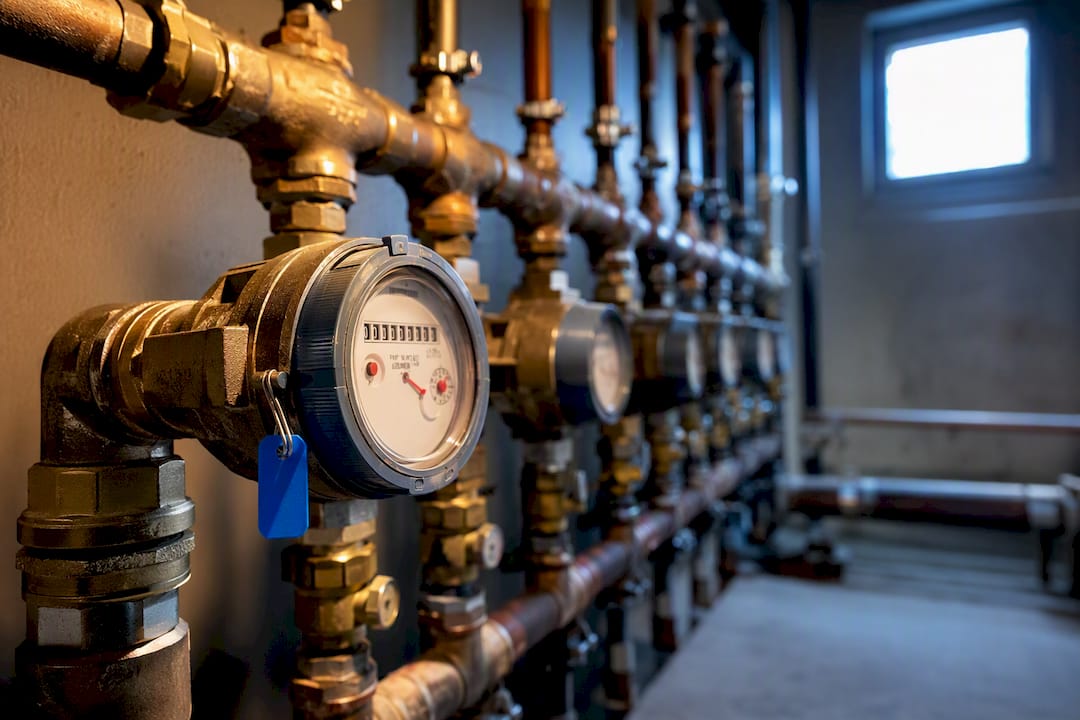
RUBS (Ratio Utility Billing System) lets a property owner split one master utility bill among tenants using a formula, instead of installing individual meters. It works well where submetering is costly or physically impossible, but it only holds up when the formula is disclosed in writing, matches state law, and reflects actual usage patterns fairly.
TL;DR:
- RUBS is most effective in older buildings with a single master meter and when installing submeters is cost-prohibitive or physically impossible.
- The most common RUBS formulas use occupancy or square footage data, often with a common-area deduction and optional adjustment factors for higher usage.
- Utilities like water, sewer, trash, and common-area electric are suitable for RUBS, while individual electric and gas billing may require submetering due to high usage variability.
- Owners benefit from low setup costs and quick implementation, but tenants face estimates that may lack transparency and can sometimes be inflated by billing fees.
- Legal requirements and restrictions on RUBS vary by state, so owners must verify local laws, disclose formulas explicitly, and obtain written tenant consent before implementation.
Table of Contents
- What Is RUBS and When Do Owners Use It?
- How Do RUBS Calculations Actually Work?
- Which Utilities Are Commonly Allocated via RUBS?
- What Are the Trade-Offs for Landlords and Tenants?
- What Legal Rules Govern RUBS in the United States?
- How Do You Implement RUBS Correctly?
- RUBS vs. Submetering: Which Fits Your Property?
- How Can Tenants Check and Dispute a RUBS Charge?
- How Milwaukeepm Approaches RUBS Implementation
- Get a Compliant RUBS Setup Without the Legal Guesswork
- Where to Verify RUBS Rules and Calculations
- Sources
- FAQ
What Is RUBS and When Do Owners Use It?
RUBS solves a simple problem: a building has one master water, gas, or electric meter, but multiple tenants using different amounts of that utility. Instead of retrofitting the whole property with submeters, the owner divides the master bill using a formula tied to occupancy, square footage, or a blend of both. The NCHM explains RUBS as a cost-recovery method used specifically where submetering isn't feasible, since it removes the need for expensive infrastructure upgrades.
You'll see RUBS most often in three scenarios. Older buildings with a single master meter often can't be retrofitted without tearing into walls or slabs, which makes submeters financially impractical. Owners running tight margins on Class B or C properties often choose RUBS because it costs far less to set up than a submetering conversion. Commercial and mixed-use portfolios sometimes use RUBS across multiple tenant types where usage tracking would otherwise require separate systems for each unit.
Utilities commonly allocated through RUBS include:
- Water and sewer service
- Trash and recycling collection
- Common-area electricity or gas
- Pest control and stormwater fees in some municipalities
- Heating costs in centrally heated buildings without individual thermostats
The trade-off is real: RUBS trades billing precision for lower upfront cost. That's a fair exchange in many buildings, but it means the formula itself carries a lot of weight, and getting it wrong creates friction with tenants fast.
How Do RUBS Calculations Actually Work?
Every RUBS formula starts from the same master bill, then splits it using one of four common methods:
- Occupancy-based: Divides the bill by the total number of occupants across the property, then multiplies by each unit's occupant count.
- Square footage-based: Allocates cost proportionally to each unit's size relative to total billable square footage.
- Hybrid: Blends occupancy and square footage, often 50/50, to smooth out extremes between small heavily occupied units and large lightly occupied ones.
- X-factor adjusted: Applies a multiplier for known variables like number of bathrooms or known high-usage appliances, refining the base formula further.
Most formulas also subtract a common-area deduction (CAD) before allocation, since hallway lighting or a leasing office bathroom shouldn't be billed to residents, and they prorate for billing days when someone moves in or out mid-cycle.
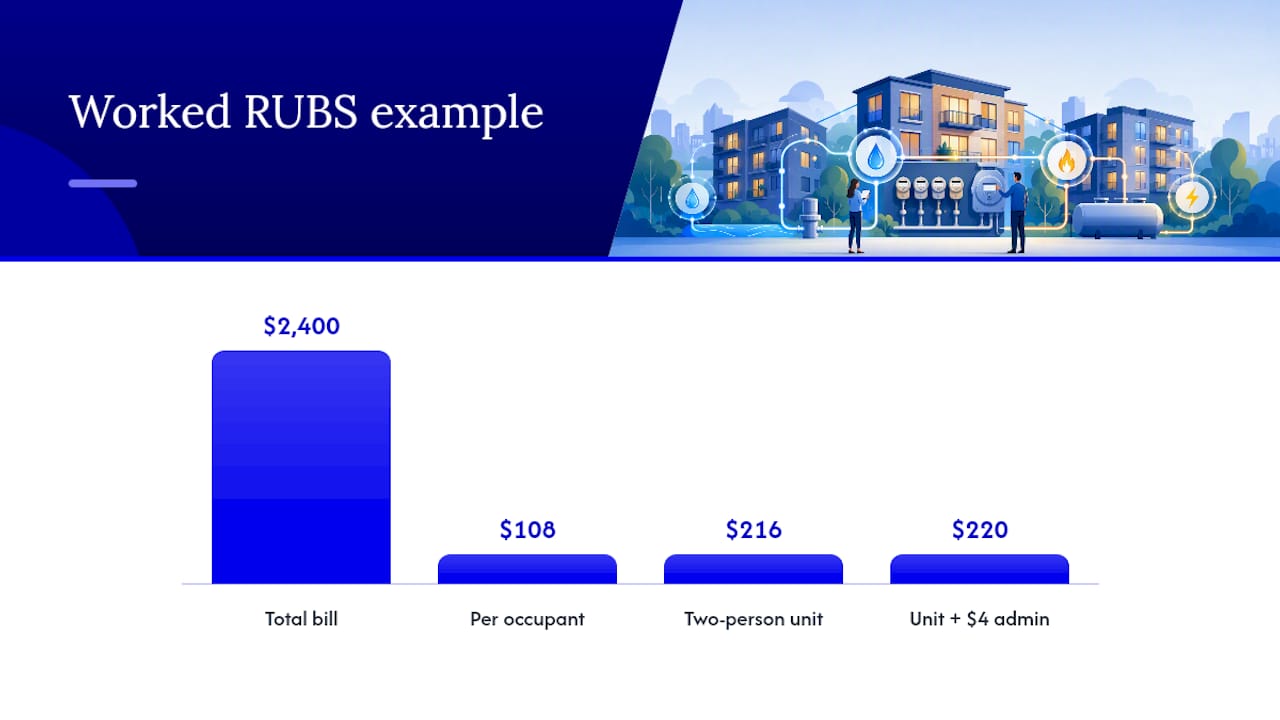
Here's a worked example. A 10-unit building gets a $2,400 water and sewer bill for the month. Using occupancy-based allocation across 20 total occupants, the per-occupant cost is $108. A two-person unit owes $216 for utilities that month. If the property adds a $4 per-unit administrative fee for billing processing, that unit's total utility charge becomes $220.
Statistic Callout: Industry sources tracking RUBS-billed properties report a measurable conservation effect of 13 to 18 percent in building-wide consumption once tenants start seeing utility costs tied directly to usage.
Practical worksheets built for 2 to 10 unit properties can automate this math, but they only work correctly with accurate occupant counts and a signed lease authorization on file.
Which Utilities Are Commonly Allocated via RUBS?
Not every utility fits the RUBS model equally well. Water, sewer, and trash tend to work cleanly through occupancy or square footage formulas because usage correlates reasonably well with household size. Gas and electric are trickier: usage varies enormously based on appliances, climate control habits, and how much time someone spends home, so RUBS estimates can feel unfair to low-usage tenants.
- Good RUBS candidates: water, sewer, trash, common-area electric
- Workable with caveats: gas heating in centrally metered buildings
- Better suited to submeters or direct billing: individual unit electricity, especially in climates with high air conditioning variance
- Regulated differently in many states: gas and electric, which often fall under public utility commission rules that don't apply to water and sewer
When usage variance is high, direct billing or submetering usually produces fairer outcomes than any ratio formula can.
What Are the Trade-Offs for Landlords and Tenants?
RUBS benefits owners in ways that are hard to ignore, but tenants absorb most of the downside risk when a program is poorly run.
Owner advantages:
- Lower upfront cost than submetering retrofits
- Faster to implement across an entire portfolio
- Creates a conservation incentive since tenants see utility costs tied to their unit
Tenant drawbacks:
- Bills are estimates, not direct measurements of actual use
- Formulas can feel opaque without a detailed invoice
- Third-party billing vendors often add processing fees on top of the master bill
Tenant advocates point out that RUBS bills are frequently estimates that may lack transparency, and some billing agents apply residential rates even when the landlord pays commercial rates, or add markup fees that inflate the tenant's share beyond what the master bill actually cost.
Pro Tip: If you're a landlord, publish the full formula and a sample calculation in your tenant handbook before rollout. Most disputes come from confusion, not from the math itself.
What Legal Rules Govern RUBS in the United States?
RUBS legality is not uniform across the country, and that variation catches a lot of owners off guard. Some states, like Connecticut, restrict or effectively ban RUBS for residential rentals. Others, including California, cap what owners can charge or require specific disclosure language. Colorado has drawn regulatory scrutiny over utility billing transparency in recent years. Legal treatment varies meaningfully by state, and what's routine in Texas might be unlawful in another state entirely.
Before implementing RUBS, take these steps:
- Check your state statute and any local municipal ordinances governing utility cost recovery
- Confirm whether your city requires specific disclosure language on tenant invoices
- Draft a lease addendum that spells out the exact formula, billing frequency, and any administrative fees
- Get written tenant consent, especially when converting existing leases mid-term rather than at renewal
The NCHM notes that RUBS must be authorized in writing, and lease addenda are standard practice precisely because skipping that step creates real legal exposure. One detail that surprises new owners: utility payments collected through RUBS are typically treated as gross rental income for tax reporting purposes, not as a pass-through expense, so your accountant needs to know the program exists.
How Do You Implement RUBS Correctly?
A clean rollout follows a predictable sequence, and skipping steps is usually what generates tenant complaints later.
- Verify legality in your state and municipality before drafting anything.
- Write a lease addendum specifying the formula, common-area deduction, billing cycle, and any per-unit administrative fee.
- Choose your formula (occupancy, square footage, hybrid, or X-factor) based on your building's layout and tenant mix.
- Set a billing cadence, monthly is standard, and decide whether you'll bill in-house or through a third-party vendor.
- Collect and retain every master utility bill so you can produce an itemized breakdown on request.
- Build a communication plan: advance notice, sample invoices, and a clear dispute channel before the first billed month.
Best-practice guidance suggests treating a RUBS rollout like a change-management project rather than a billing update. That means giving tenants real notice, walking them through a sample bill before charges start, and having a named contact for questions.
Pro Tip: Roll RUBS out at lease renewal rather than mid-lease whenever your state allows it. It sidesteps a lot of the "you changed the rules on me" pushback that fuels disputes.
A tenant portal that posts itemized invoices monthly does more to prevent disputes than any amount of upfront explanation, because tenants can check the math themselves anytime.

RUBS vs. Submetering: Which Fits Your Property?
The choice usually comes down to capital availability versus billing precision.
- Accuracy: Submetering measures actual usage; RUBS estimates it through a formula, so submetering wins on precision every time.
- Upfront cost: RUBS requires no hardware investment; submetering means retrofit costs that can run into the thousands per unit in older buildings.
- Timeline: RUBS can launch within a billing cycle or two; submetering installation can take months depending on building access and permitting.
- Conservation effect: Both create usage awareness, but submetering tends to produce stronger behavior change since tenants see their exact number.
- Legal complexity: RUBS carries more state-by-state legal variability; submetering is more uniformly accepted since it bills actual consumption.
Choose submetering when you're already doing major renovations, when your state restricts RUBS, or when tenant turnover is low enough to justify the upfront cost. Choose RUBS when capital is tight, the building can't easily support submeters, or you manage a portfolio where speed of rollout matters more than per-unit precision.
How Can Tenants Check and Dispute a RUBS Charge?
If a RUBS bill looks off, start by requesting documentation rather than assuming the worst.
- Ask for the master utility bill for the billing period in question
- Request the exact formula used, including occupancy counts or square footage figures
- Get an itemized invoice showing how your unit's share was calculated
Watch for red flags: a billing rate higher than what the utility company actually charges, unexplained fees that weren't disclosed in your lease, or a formula that changed without written notice. If your water bill spikes unexpectedly, a guide to diagnosing high water bill causes can help you rule out a leak or fixture problem before assuming the billing itself is wrong.
If the numbers don't add up, request a recalculation in writing first. If that goes nowhere, contact your local housing authority or tenant advocacy organization, and keep copies of every invoice and communication in case you need them later.
How Milwaukeepm Approaches RUBS Implementation
We treat RUBS as a compliance project first and a billing mechanic second. Every rollout starts with confirming state and local legality, then drafting lease language that spells out the formula, fees, and billing cycle in plain terms tenants can actually understand.
Our tenant and owner portals post itemized bills every cycle, so residents can see exactly how the master bill translates into their charge without calling the office. When a dispute comes up, we handle it through documented recalculation rather than back-and-forth guesswork, which keeps small disagreements from turning into lease violations or turnover.
— Chaim
Get a Compliant RUBS Setup Without the Legal Guesswork
Running RUBS correctly means checking state statutes, drafting airtight lease addenda, and giving tenants a way to see their bill breakdown without calling you every month. That's the exact operational load Milwaukeepm was built to absorb for owners who don't have time to become utility-billing lawyers on top of everything else.
Our property management services include lease addendum drafting, tenant portal billing that shows the itemized master bill and formula behind every charge, and a documented dispute process so complaints get resolved instead of escalated. For commercial portfolios juggling multiple tenant types and utility structures, our commercial management team handles the same compliance work at scale. If you're ready to add RUBS to your property without gambling on state law or tenant pushback, reach out to Milwaukeepm for a consultation on your specific building and lease terms.
Where to Verify RUBS Rules and Calculations
- NCHM's RUBS explainer for implementation basics and lease authorization requirements
- NCLC's tenant advocacy guide for dispute rights and billing transparency standards
- Your state housing authority's statute page for local legality before you sign anything
This article is general information, not a substitute for advice from a qualified lawyer. Consult a qualified legal professional about your own circumstances before acting on anything here.
Sources
- Ratio Utility Billing System (RUBS) explained
- An introduction to Ratio Utility Billing Systems for tenant advocates
- How to calculate a RUBS water bill
- What is a Ratio Utility Billing System? — Facilio
FAQ
How Are RUBS Charges Calculated?
Most formulas divide the master utility bill by total occupants or square footage after subtracting a common-area deduction, then multiply that rate by each unit's share, as shown in the worked example above using occupancy-based allocation.
Is RUBS Billing Fair to Tenants?
It can be, but fairness depends entirely on formula accuracy and disclosure. Tenant advocates note that RUBS bills are estimates that can be opaque, so a fair program requires an itemized invoice showing the master bill and the exact calculation.
Is Ratio Utility Billing Legal in My State?
It depends on where you live. Legal treatment varies by state, with some states banning or capping RUBS and others allowing it with disclosure requirements, so checking your specific state statute before implementation or before paying a charge is essential.
How Can I Understand My Utility Bill Under RUBS?
Request the master utility bill, the exact formula used, and an itemized breakdown showing how your unit's share was calculated. A tenant portal that posts this information automatically each cycle removes most of the guesswork.
What's the Difference Between RUBS and Submetering?
RUBS estimates your utility cost using a formula applied to a shared master bill, while submetering measures your unit's actual consumption directly. Submetering costs more upfront but delivers precise billing; RUBS costs less to implement but relies on formula accuracy for fairness.