
A workable rent collection policy names the exact due date, the grace period, the late-fee rule, an automated escalation timeline, and accepted payment methods, then applies all of it the same way to every tenant. Consistency and documentation are what turn a policy into a legal shield, not just a set of good intentions. Written clauses and a step-by-step checklist follow below.
TL;DR:
- A rent collection policy must specify exact due dates, local grace periods, and clear escalation steps to ensure enforceability and consistency.
- Proper documentation of notices, payments, and communication is essential for legal protection and fair housing compliance.
- Automated reminders, fee triggers, and ledger updates should be set up in trusted portals to maintain uniform enforcement across tenants.
- Lease clauses should explicitly cover partial payments, late fees, and repayment plans to avoid inadvertent waivers and legal issues.
- Running the policy on a single property first helps identify gaps, while larger portfolios require infrastructure to uphold consistent, automated enforcement.
Table of Contents
- What Belongs in a Rent Collection Policy?
- How Should Rent Collection Escalation Work Day by Day?
- What Should a Policy Say About Partial or Missed Rent?
- How Do You Track Arrears and Measure Collection Performance?
- Where Does Automation Fit in Rent Collection?
- What Should a Rent Collection Policy Template Include?
- How Milwaukeepm Applies This Policy in Practice
- Why Most Rent Collection Problems Aren't About Money
- Get a Policy Review Built for Your Portfolio
- Sources
What Belongs in a Rent Collection Policy?
A rent collection policy is only as strong as the specificity of its language. Vague terms like "rent is due monthly" invite disputes; exact wording closes them off before they start.
Due date wording. State the calendar day rent is due, not a range. "Rent is due on the 1st of each month" is enforceable. If the 1st falls on a weekend or holiday, decide in advance whether payment received the next business day counts as on time and write that into the lease. Most landlords extend the deadline in these cases, and doing so consistently avoids the appearance of favoritism.
Grace periods. A grace period is the window after the due date during which rent is late but not yet subject to a fee. There's no universal grace period. Some states require landlords to offer a grace period before charging a late fee, and where mandated, the length varies widely depending on the state. In the rest, rent is technically late the day after it's due, and landlords can charge from day one. A common default is three to five days, but that number only works if it matches the state-by-state grace period rules that actually govern the property. Check local law before setting the number, and never copy a grace period from a lease template written for a different state.
Late fees. Landlords generally choose between a flat fee (say, $50) or a percentage of rent (often 5 to 10%). Flat fees are easier to explain and defend; percentage fees scale with rent but draw more scrutiny in states with usury-style caps on fees. Whichever model is used, the lease should state the fee amount, when it triggers, and whether it recurs daily or applies once per late payment. Courts tend to strike down fees that look punitive rather than compensatory, so keep the number reasonable relative to actual administrative cost.
Accepted payment methods and fees. List every accepted channel explicitly:
- Online tenant portal (ACH transfer or card payment)
- Personal check or money order
- Cash, accepted only at a designated office with a receipt
- Drop box, for properties without on-site staff
If card payments carry a processing fee, disclose the percentage in the lease itself, not just on the portal's checkout screen. Tenants who feel surprised by a fee are far more likely to dispute it later.
Documenting consent. At lease signing, walk the tenant through the payment terms page by page and have them initial the rent, grace period, and late-fee clauses separately from the general signature line. This single habit does more to prevent "I didn't know" disputes than any amount of after-the-fact explanation.
How Should Rent Collection Escalation Work Day by Day?
Consistency is the entire point of an escalation timeline; this mirrors how landlords manage pet waste removal effectively to maintain operational consistency and property upkeep. A tenant who pays late in January and gets a phone call, then pays late in March and gets a formal notice, has grounds to argue the policy is arbitrary. A written, dated sequence removes that argument entirely.
Before the due date. Prevention starts at move-in, not on day one of a missed payment. Set every new tenant up on the portal, confirm their preferred payment method, and schedule an automated reminder three days before rent is due. Prevention-focused policies built around early contact and easy payment options consistently show lower arrears than reactive ones, because tenants who feel reminded rather than chased tend to pay faster.
Here's a practical sequence most self-managing landlords and small teams can adopt directly, with day counts adjusted to local grace period rules:
- Day minus 3: Automated portal reminder sent to the tenant.
- Day of due date: Rent posts. No action needed if paid.
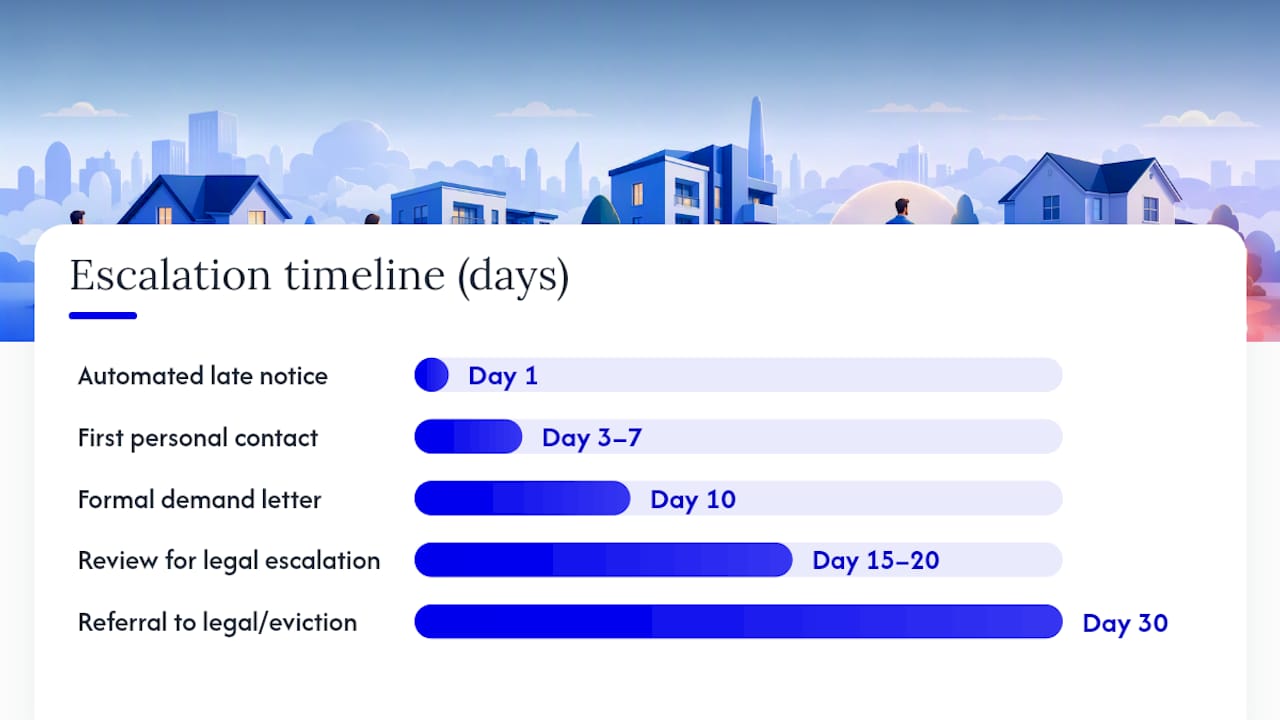
- Day 1 (or end of grace period): Automated late notice generated; late fee applied if the lease allows it at this point.
- Day 3 to 7: First personal contact, by phone or portal message, confirming the balance and offering payment options. This is also when a formal written notice, delivered per your state's requirements, typically goes out.
- Day 10: Formal demand letter or "pay or quit" notice, depending on state law, with a clear balance and deadline.
- Day 15 to 20: If no response or repayment plan is in place, review the file for legal escalation and confirm all documentation is complete.
- Day 30: Referral to legal counsel or the eviction process begins if the balance remains unresolved and no agreement is documented.
This structure mirrors the staged escalation model that sector guides recommend: prevention, early intervention, formal escalation, then legal action as the last resort, not the first response.
Documentation at every stage. Every notice needs proof of delivery, whether that's a certified mail receipt, a portal timestamp, or a photo of a posted notice on the door. Every phone call needs a one-line ledger entry: date, who spoke, what was agreed. This record is what protects a landlord if a case ever reaches a courtroom, and it's also what protects a tenant from being escalated unfairly by a manager who forgot an earlier conversation.
Pro Tip: Build your reminder and late-notice templates once, get them reviewed by local counsel, and then let automation send them on a fixed schedule. Manual, case-by-case decisions about "should I send the notice today or give it another day" are exactly where inconsistent enforcement and fair housing complaints creep in.
The legal caveat that overrides everything above. This timeline is a default, not a rule. Notice periods, required delivery methods, and even whether a grace period is mandatory vary by state and sometimes by city. A "pay or quit" notice that's valid in one state might need twice as many days in another, and if your reporting to credit bureaus factors into your process, federal guidance requires landlords to wait a minimum of 30 days after delinquency before doing so. Confirm every day count against current state grace period law before publishing it in a lease.
What Should a Policy Say About Partial or Missed Rent?
Partial payments are where policies quietly fall apart. A landlord who accepts $600 toward a $1,200 rent bill without a written clause covering that scenario can end up having accidentally waived the right to evict for the remaining balance, depending on state law.
The fix is a partial-payment clause written into the lease itself: something like, "Acceptance of a partial payment does not constitute a waiver of the landlord's right to collect the remaining balance or to pursue any other remedy, including eviction, unless agreed to in writing." That single sentence preserves every option while still allowing flexibility case by case.
Applying the payment correctly matters too. Standard accounting practice applies incoming funds to the oldest outstanding rent principal first, ahead of late fees, which keeps the accounting clean and protects the landlord's recoverable balance if the account ends up in court. Apply payments in the wrong order and the ledger can misrepresent how much rent, versus fees, is actually still owed.
Repayment plans. When a tenant can't pay in full but is communicating in good faith, a short written repayment agreement often beats an immediate legal filing. A workable plan includes:
- The total balance owed, broken into specific installment amounts and dates
- A review date, typically 30 days out, to confirm the plan is being followed
- A clause stating what happens automatically if a single installment is missed
- Both parties' signatures and a copy stored in the tenant's file
Where negotiation ends. Set a clear threshold in the policy itself, such as two missed installments on a repayment plan, or 30 total days of unresolved balance, after which the file moves to legal referral regardless of the tenant's explanation. Without that line, managers end up negotiating indefinitely, which is exactly how arrears balloon.
If a case does move toward legal action, gather the full record before referral: the signed lease, every notice with proof of delivery, the payment ledger, and any repayment agreement and its breach date. Milwaukeepm's overview of the eviction process walks through what happens once a file reaches that stage.
How Do You Track Arrears and Measure Collection Performance?
A policy without a ledger is just a document nobody checks. The operational backbone of rent collection is the delinquency ledger: a running record, per unit, of every dollar owed, paid, or written off.
A useful ledger entry tracks the tenant's name and lease dates, the original amount due, each payment received with how it was allocated between principal and fees, every contact attempt with date and outcome, every notice issued with its delivery proof, the current aging bucket, and the next scheduled escalation action.
The aging matrix. Most portfolios sort outstanding balances into three buckets:
- 0 to 30 days: Recently late; early intervention stage
- 31 to 60 days: Formal escalation likely underway
- 61 to 90+ days: Legal referral or write-off review
This structure matches the aging-matrix approach recommended for tracking arrears by duration and matching each stage to the right escalation action.
KPIs worth reviewing monthly, not just at year-end:
- Delinquency rate: percentage of tenants with an outstanding balance past due
- Collection rate: total rent collected divided by total rent billed
- Average days outstanding: how long unpaid balances typically sit before resolution
- Write-off rate: rent ultimately deemed uncollectible
A portfolio with a delinquency rate that creeps upward month over month, even slightly, is usually catching a problem in enforcement consistency before it shows up anywhere else.
Ledger entries and delivery proof do double duty as a fair housing defense. If a tenant later alleges selective enforcement, a dated record showing the same notice went out to every account at the same aging stage is the single strongest piece of evidence a landlord can produce.
Where Does Automation Fit in Rent Collection?
Manual rent collection doesn't scale, and worse, it invites inconsistency. A property manager juggling forty units by memory will, without meaning to, treat a friendly tenant differently than a difficult one. Automation removes that risk by treating every account the same way at the same stage.
What a tenant portal and ACH setup should handle on their own:
- Automated reminders sent a fixed number of days before the due date
- Late fees applied automatically the moment the grace period closes, with no manual approval needed
- Accounts flagged for staff follow-up once they cross a set aging threshold
- Ledger entries updated in real time as payments post
HUD's guidance on rent collection frames this directly: treat rent collection as a business process governed by predefined rules, not a personal judgment call made fresh each time. That framing is the difference between a policy that holds up under scrutiny and one that quietly erodes tenant by tenant.
Vendor checklist before adopting a portal system. Confirm the platform encrypts payment data, integrates with your existing accounting software so ledger entries don't require manual re-entry, and generates delivery proof (timestamps, read receipts) for every notice it sends automatically.
Pro Tip: If two tenants are behind by the same number of days, they should receive the exact same notice on the exact same day. The moment a manager starts making case-by-case exceptions to when a notice goes out, the paper trail that protects against fair housing complaints starts to have gaps in it.
Milwaukeepm's tenant portal is built around this exact logic: reminders, fee application, and ledger updates run on a fixed schedule rather than a manager's daily judgment call.
What Should a Rent Collection Policy Template Include?
A policy is only useful once it's written down in language a tenant can read and a court can enforce. Below is a starting template. Treat every bracketed section as a placeholder to customize, and never publish it without a local legal review.
Sample clauses to adapt:
- Due date: "Rent in the amount of $[amount] is due on the [day] of each month. If the due date falls on a weekend or federal holiday, payment received the next business day is considered timely."
- Grace period: "A grace period of [number] days applies after the due date, during which no late fee will be assessed, consistent with [state] law."
- Late fee: "A late fee of $[amount] or [percentage]% of monthly rent will be applied on day [number] following the due date and will not exceed the limits set by [state] law."
- Partial payment: "Acceptance of a partial rent payment does not waive the landlord's right to collect the remaining balance or pursue any other remedy available under the lease or applicable law."
- Repayment agreement: "Tenant and landlord agree to the following repayment schedule: [installment amounts and dates]. Failure to remit any installment by its due date will result in [consequence, e.g., resumption of standard escalation]."
- Escalation steps: "Landlord will provide notice at each of the following stages: [reminder, late notice, formal demand, legal referral], with proof of delivery retained in the tenant file."
- Recordkeeping: "All payments, notices, and communications related to rent collection will be logged in the tenant's ledger, including date, method, and outcome."
30-day implementation checklist:
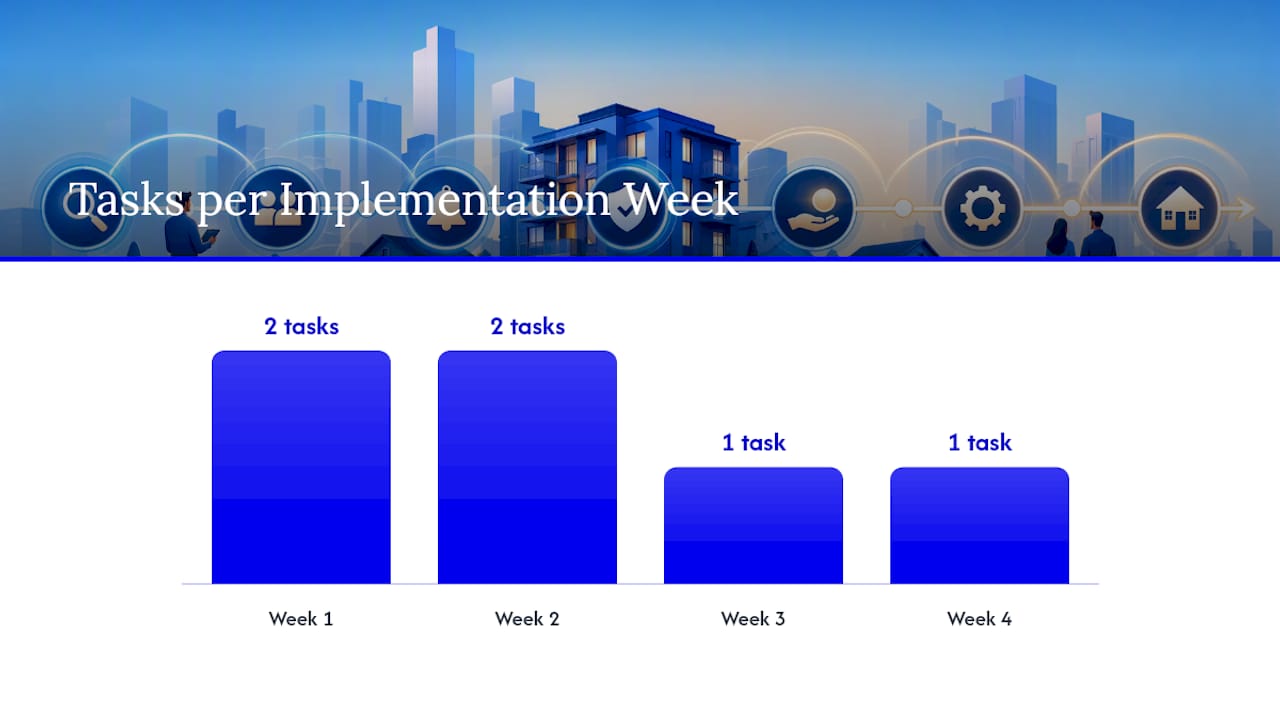
- Week 1: Draft policy language and route it to local counsel for a compliance check.
- Week 1: Confirm your state's grace period, late-fee cap, and notice requirements against the state grace period table.
- Week 2: Set up automated reminders, fee triggers, and ledger integration in your portal system.
- Week 2: Train any staff or partners on the escalation sequence and documentation standards.
- Week 3: Update lease templates for new tenants and prepare an addendum for existing leases where legally permitted.
- Week 4: Run a test cycle on one property, reviewing ledger entries and notice delivery proof before rolling out portfolio-wide.
Review cadence. Assign one person, whether that's the owner or the managing agent, to sign off on the policy annually and after any change in state or local law. Note the review date directly on the document so every version is traceable.
Professional bodies like NARPM publish model policies worth cross-checking your draft against before it goes live, and local housing authorities can flag jurisdiction-specific requirements a generic template will miss.
How Milwaukeepm Applies This Policy in Practice
Writing a policy is one exercise. Enforcing it the same way, every month, across dozens of units, is the harder problem, and it's the one most self-managing landlords underestimate. Consistent enforcement takes infrastructure: a portal that applies fees automatically, a ledger that updates in real time, and a legal partner ready the moment a file crosses the escalation threshold.
Milwaukeepm's tenant portal handles the mechanics described above: automated reminders, fee application on schedule, and ledger entries tenants and owners can both see. Its first-year tenant guarantee reduces the cost of a screening miss that leads to chronic late payment, and its eviction partnerships mean a file that reaches day 30 moves into legal hands without a gap in the paper trail. Owners get monthly reporting that mirrors the delinquency rate and aging matrix described earlier, without building the spreadsheet themselves.
For landlords weighing whether to run this process in house or hand it to a manager who already has the infrastructure built, the honest answer is that it depends on portfolio size and appetite for the administrative load. A single rental can be self-managed with discipline. A portfolio of ten or more units, spread across different tenants at different stages of the escalation timeline, is where manual tracking starts to break down.
Why Most Rent Collection Problems Aren't About Money
The conventional advice on rent collection treats it as a debt-recovery problem: chase the balance, escalate fast, protect the bottom line. That's incomplete. Most rent collection failures start as documentation failures. A landlord loses a case not because the tenant had a good excuse, but because nobody wrote down when the first notice went out.
The trade-off landlords actually face isn't consistency versus empathy. It's consistency versus improvisation. A policy applied automatically to every tenant at every stage is, paradoxically, the more humane approach, because it removes the guesswork and favoritism that make tenants feel targeted. The single habit worth automating first, before anything else, is the pairing of the first late notice with a ledger entry. Everything downstream depends on that pair happening reliably.
Three mistakes show up again and again: lease language vague enough to argue about, enforcement that varies tenant to tenant, and documentation thin enough to lose in front of a judge. Fix those three and most collection problems shrink on their own.
Before rolling a new policy across an entire portfolio, run it on one property for a full cycle. What looks airtight on paper often reveals a gap the moment a real tenant tests it.
— Chaim
Get a Policy Review Built for Your Portfolio
Milwaukeepm is the direct alternative to piecing this policy together yourself, one spreadsheet and one late notice at a time. Where a self-managed setup means building your own reminder schedule, fee triggers, and ledger from scratch, Milwaukeepm's tenant portal already runs that infrastructure, backed by a first-year tenant guarantee and eviction partnerships that pick up exactly where the escalation timeline leaves off.
If your current process depends on remembering to send a notice or manually calculating a late fee, that's the gap most likely to cost you a case down the line. Milwaukeepm's full-service property management applies the payment terms, escalation stages, and recordkeeping described above the same way across every unit in your portfolio. Visit Milwaukeepm to request a policy review and see how your existing lease terms would translate into an automated, documented collection process.
Sources
- iPropertyManagement: Late rent laws & grace periods (state table)
- Rentlatefee
- Bolsover District Council: Rent Collection Policy 2026 (example local authority policy)
- NARPM (National Association of Residential Property Managers)