
Yes, in most cases someone has to issue a 1099, and figuring out who depends on which direction the money moved. If you own rental property and pay a property manager, you generally issue that manager a 1099-NEC for management fees if they're not incorporated. If your manager collects rent from tenants and forwards it to you, they may need to issue you a 1099-MISC reporting those rents, based on the agent/intermediary rule the IRS laid out in Information Letter INFO 2002-0102. And when your manager pays contractors or vendors on your behalf, they usually need to issue those vendors 1099-NEC forms too.
Here's the quick verdict, broken down by payment type:
- Rent remitted by a manager to an owner: the manager may owe the owner a 1099-MISC (Box 1) if they collected and forwarded rent as an agent.
- Management fees paid to an unincorporated manager: the owner typically issues a 1099-NEC if fees for the year hit the reporting threshold.
- Contractor or vendor payments made by the manager: the manager issues 1099-NEC forms to those contractors, using the owner's funds but the manager's payer relationship.
Your single most important next step, regardless of which side of these transactions you sit on: collect a completed Form W-9 from every property manager, contractor, or vendor before you send them a dollar. Without it, you're stuck guessing at tax ID numbers and entity types in January, which is exactly when you don't have time to guess.
Key Takeaways
Property manager 1099 compliance comes down to tracking who moved the money, collecting a W-9 before any payment goes out, and filing the correct form by its specific deadline.
| Point | Details |
|---|---|
| Collect W-9s upfront | Request a completed W-9 before the first payment to any manager, contractor, or vendor. |
| Confirm who pays vendors | Check your management agreement to see whether the owner or manager issues each 1099. |
| Tag payments by category | Separate management fees, rent remittances, and contractor payments the moment you record them. |
| Run vendor totals in December | Reconcile full-year vendor payments against your W-9 file before the January rush. |
| Set an internal January deadline | Target January 20 internally, ahead of the IRS's January 31 recipient deadline. |
| Work with a manager who tracks this for you | Milwaukeepm collects vendor W-9s and can generate year-end 1099s when the management agreement specifies it. |
Table of Contents
- Which 1099 Form Applies to Property Manager Payments?
- When Are Property Managers Exempt From 1099 Filing?
- How Do You Collect a W-9 From a Property Manager?
- When Are 1099 Forms Due, and How Do You File Them?
- What Happens If You File a 1099 Late or Incorrectly?
- What Contract Language and Workflows Prevent 1099 Errors?
- When Should You Call a CPA Instead of Handling It Yourself?
- What Does IRS Guidance Actually Say About Property Managers?
- How Milwaukeepm Handles 1099s for Owner-Clients
- Get Help With 1099 Compliance Before Year-End
- Where to Verify These Rules Directly
- Frequently Asked Questions
- Sources
Which 1099 Form Applies to Property Manager Payments?
Three forms cover almost every property management transaction: 1099-NEC, 1099-MISC, and 1099-K. They serve different purposes, and mixing them up is one of the most common filing mistakes landlords make.
Form 1099-NEC reports nonemployee compensation. This is the form you use when you pay an unincorporated property manager for their services, or when a property manager pays an unincorporated contractor for repairs, cleaning, or landscaping. The IRS guidance on Form 1099-NEC confirms it applies to service payments, not to rent itself.
Form 1099-MISC is the form for rent. Box 1 specifically covers rental payments, and it's the form a property manager uses when remitting collected rent to a property owner, per the agent rule described in IRS instructions for Forms 1099-MISC and 1099-NEC. It also covers other miscellaneous payments like legal settlements or prizes, though those rarely come up in day-to-day property operations.
Form 1099-K is different from the other two because it's not filed by you at all. Payment processors and third-party networks, think credit card processors or platforms that handle tenant rent payments electronically, issue 1099-K forms to report the gross payment volume they processed. If a tenant pays rent through a portal or app that settles funds like a merchant account, that transaction may already be captured on a 1099-K, which affects whether you need to separately report it.
| Form | Who Files It | Who Receives It | Typical Trigger |
|---|---|---|---|
| 1099-NEC | Owner or property manager | Unincorporated service provider | Management fees or contractor payments for services |
| 1099-MISC | Property manager | Property owner | Rent collected by manager and remitted to owner |
| 1099-K | Payment processor | Owner or manager receiving processed funds | Payments settled through a third-party network |
Thresholds attach to when payments were made, not when you sit down to file. Payments made during 2025 used the longstanding $600 threshold, but some guides note a shift to a $2,000 threshold for payments made on or after January 1, 2026 under later legislative changes. If your payments to a single payee span both years, track them separately by payment date rather than lumping the whole relationship into one number.
Three scenarios show how this plays out in practice:
-
A property manager collects $18,000 in rent from tenants over the year and forwards it to the owner. The manager issues the owner a 1099-MISC reporting that amount in Box 1.
-
An owner pays an unincorporated management company $2,400 in flat monthly fees. The owner issues that company a 1099-NEC, assuming the total clears the applicable threshold for the payment year.
-
The property manager hires a plumber to fix a unit, paying $850 out of the operating account. The manager, not the owner, issues the plumber a 1099-NEC because the manager made the payment.
When Are Property Managers Exempt From 1099 Filing?
Several common situations remove the filing requirement entirely, and knowing them saves you from sending forms nobody needs.
Corporations are usually exempt. If your property manager, contractor, or vendor operates as a C-corporation or S-corporation, you generally don't need to issue a 1099-NEC for their services. This is the single biggest reason to collect a W-9 before paying anyone: the form asks the payee to check their tax classification box, and "corporation" often ends the conversation.

Payments already captured by a processor don't need duplication. If a payment platform or merchant processor already reports a transaction on a 1099-K, you typically don't need to separately issue a 1099-NEC or 1099-MISC for that same payment. Duplicate reporting confuses IRS matching systems and can trigger unnecessary correspondence.
Attorneys are the exception to the exemption. Payments to attorneys for legal services get reported on a 1099-NEC or 1099-MISC regardless of whether the law firm is incorporated. The IRS treats legal fees as a special category specifically because attorneys frequently operate as corporations that would otherwise dodge reporting.
Real estate agents acting purely as intermediaries sometimes fall outside standard reporting rules, similar to how the agent rule works for property managers collecting rent. The dividing line usually comes down to whether the party is passing funds through or actually earning the payment as their own income.
Run through this decision flow before you file anything:
- Is the payee a corporation? If yes, you likely skip the 1099, except for attorney payments.
- Was the payment processed through a third-party network that already reports it? If yes, skip duplicate filing.
- Was the payment for rent, or for services? Rent flows onto a 1099-MISC; services flow onto a 1099-NEC.
One nuance worth flagging: as industry guidance on landlord filing obligations points out, property managers trigger 1099 obligations more often than individual landlords simply because they handle more vendor relationships and often pay from pooled trust accounts. Responsibility tracks whoever actually cut the check and whose funds were used, which matters when an owner and manager share a property account.
How Do You Collect a W-9 From a Property Manager?
A completed W-9 tells you three things you absolutely need before issuing any 1099: the payee's legal name, their taxpayer identification number, and their tax classification. The W-9 form itself is short, but it's the single most effective defense against filing an incorrect or unmatched information return.
Request one before the first payment goes out, not after. A short email works fine:
"Before we begin working together, we're required to collect a completed Form W-9 for our records. Please fill out and return the attached form at your earliest convenience so we can process payments accurately."
For every payee, whether that's your property manager, a contractor, or a maintenance vendor, keep three documents on file:
- The signed W-9, updated whenever the entity's structure changes.
- Copies of invoices or service agreements showing what was paid and why.
- Proof of payment, whether that's a bank record, a canceled check image, or a portal transaction log.
Pro Tip: Store W-9s in a dedicated folder by tax year and cross-reference them against your payment ledger every quarter, not just in January. Catching a missing W-9 in September gives you months to chase it down instead of days.
If a vendor refuses to provide a W-9, you're not off the hook. File the 1099 using whatever information you have, note the missing TIN, and keep records showing you tried. Refusing to file at all because a vendor stonewalled you creates a bigger problem than filing an imperfect form.
When Are 1099 Forms Due, and How Do You File Them?
Deadlines for property management 1099s follow a consistent pattern, but the paper and electronic dates diverge, and missing the distinction is a common unforced error.
Both 1099-NEC recipient copies and IRS copies are due January 31, regardless of whether you file on paper or electronically. There's no grace period built into the electronic filing date for this particular form, which trips people up because they assume e-filing always buys extra time.
1099-MISC works differently. The recipient copy is also due January 31, but the IRS copy has two separate deadlines depending on method: paper filers must submit by February 28, while electronic filers get until March 31. Consolidated deadline references like the one from TIDY's property management tax guide recommend setting an internal deadline around January 20, well ahead of any IRS date, so you have a buffer to fix errors before they become late filings.
Electronic filing isn't optional once you cross a volume threshold. If you're filing 10 or more information returns in aggregate across all form types, the IRS requires electronic submission. Below that threshold, paper filing remains an option, though most property managers with any real vendor volume end up e-filing anyway because it's faster to correct.
Your practical filing options include:
- The IRS FIRE system (Filing Information Returns Electronically) for direct electronic submission.
- IRS-authorized e-file providers and tax software platforms that generate and transmit 1099s on your behalf.
- A CPA or enrolled agent who handles the filing as part of a broader tax engagement.
Whatever method you choose, verify the current year's exact dates on IRS.gov before you file. The general instructions for the 1099 series get updated periodically, and relying on a date you remember from two years ago is how deadlines get missed.
What Happens If You File a 1099 Late or Incorrectly?
The IRS uses a tiered penalty structure, and it scales up fast the longer a correction takes. Filing within 30 days of the deadline costs $60 per form. Miss that window but file before August 1, and the penalty climbs. Filing after August 1, or not filing at all, brings the top tier: penalties as high as $680 per form, based on IRS guidance on information return penalties.
Here's how quickly that adds up: a property manager who handles a dozen vendor relationships and misses the deadline on all twelve 1099-NEC forms isn't looking at a single $680 penalty. They're looking at $680 multiplied by twelve, more than $8,000, for a paperwork issue that a W-9 collection habit would have prevented entirely. If the IRS determines the failure was intentional disregard rather than an honest mistake, the penalty removes its cap altogether and can exceed the standard tiers by a wide margin.
If you discover a missed or incorrect 1099 after the fact, work through it in this order:
- Prepare a corrected form as soon as the error surfaces, marking it clearly as a correction rather than a duplicate original.
- Send the corrected copy to the recipient first, then transmit the corrected version to the IRS.
- Pay any penalty that's been assessed rather than letting it sit, since interest accrues on unpaid penalties.
- Bring in a CPA once dollar amounts get material or you're correcting multiple years at once.
For broader context on catching up after a missed deadline, general guidance on filing after a missed tax deadline covers the remediation mindset that applies here too: act fast, document your correction, and don't let one missed form turn into a pattern of avoidance.
What Contract Language and Workflows Prevent 1099 Errors?
Most 1099 mistakes trace back to a management agreement that never specified who's responsible for what. Fix that at the contract stage and you eliminate most of the confusion before it starts.
Your management agreement should spell out, in plain language, who pays vendors directly, who issues 1099s for those vendor payments, and how rent remittances are classified. There's a meaningful legal difference between a manager acting "on account of" the owner (functioning purely as a pass-through) versus acting as a principal party to the transaction, and that distinction determines who carries the filing burden. Reviewing how property managers structure their core responsibilities can help you see where these lines typically fall in a well-drafted agreement.
Run a year-end reconciliation every December and again in early January:
- Pull a full vendor payment report for the calendar year, sorted by payee.
- Cross-check every vendor over the reporting threshold against your W-9 file.
- Flag any vendor missing a W-9 and request it immediately rather than waiting until the filing deadline is a week away.
- Confirm which entity, owner or manager, actually made each payment, since that determines who files.
Pro Tip: Tag every vendor payment by category the moment you make it, not months later. A bookkeeping system that separates "management fee," "contractor," and "rent remittance" at the point of payment turns a stressful January reconciliation into a five-minute export.
Operationally, three habits do more to reduce risk than anything else: consistent vendor onboarding that requires a W-9 before the first check, automated payment tagging inside your accounting software so nothing falls through a manual tracking gap, and explicit 1099 responsibility clauses written into the management agreement itself so nobody assumes the other party is handling it. Guidance on choosing a property manager that touches on contract review is worth revisiting with this specific clause in mind if your current agreement is silent on it.
When Should You Call a CPA Instead of Handling It Yourself?
Some situations are straightforward enough to handle with a checklist. Others aren't, and knowing the difference saves you from an expensive mistake.
Call a CPA when you're dealing with any of these:
- A correction involving a large dollar amount, where an error compounds across multiple tax years.
- Ambiguous entity classification, especially LLCs that elected S-corporation status but don't clearly disclose it on their W-9.
- Multi-state filings, where state-level 1099 requirements diverge from federal rules.
- Retroactive reclassification of a worker or vendor relationship that changes how prior payments should have been reported.
- A large portfolio with frequent vendor turnover, where the sheer volume of transactions makes manual tracking unreliable.
Before that meeting, bring everything your CPA will need to move fast: every W-9 you've collected, a ledger showing vendor payment totals for the year, copies of your management agreements, and any 1099 forms you've filed in prior years. Walking in with organized records turns a two-hour consultation into a thirty-minute one.
If you want to verify a specific rule directly rather than relying on secondhand guidance, the IRS maintains updated instructions and forms on IRS.gov, and you can also review published information letters for scenarios closely matching yours.
What Does IRS Guidance Actually Say About Property Managers?
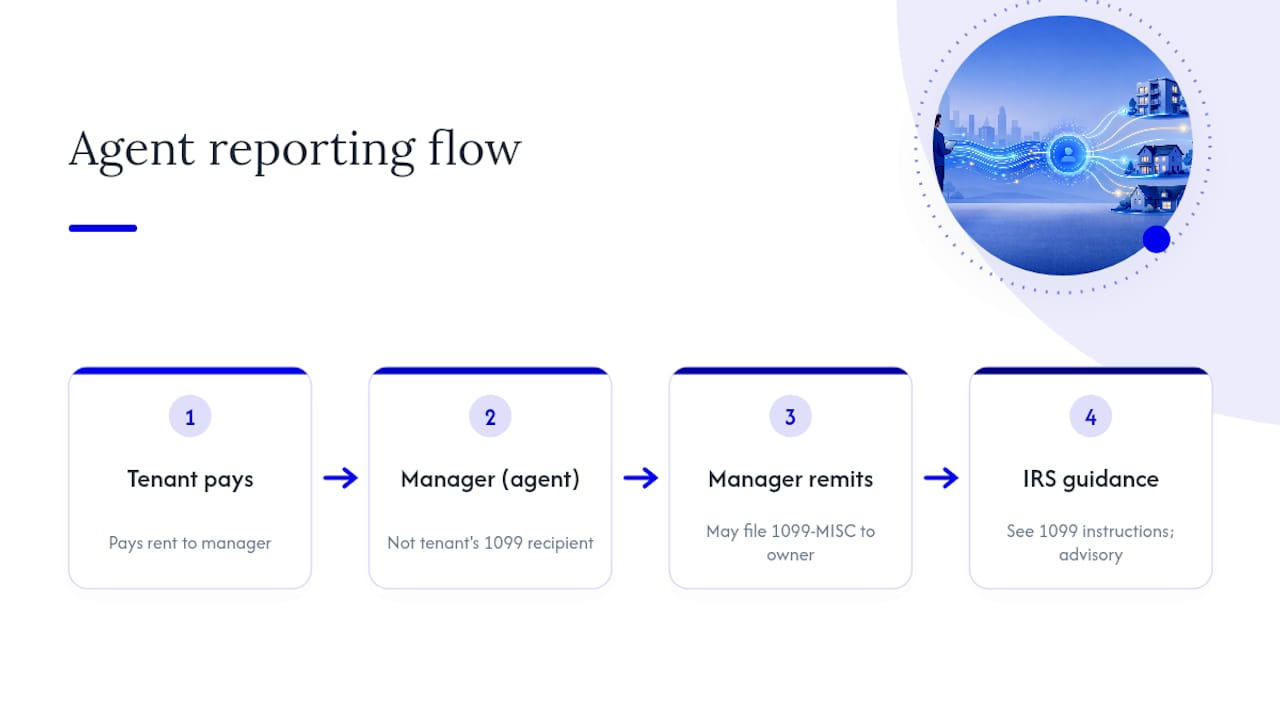
The clearest primary source on this topic is IRS Information Letter INFO 2002-0102, which addresses the exact scenario that confuses most landlords: a property manager collecting rent from tenants and forwarding it to an owner. The letter explains the agent/intermediary rule, meaning tenants don't issue 1099s to the manager for rent they pay, because the manager isn't the actual recipient of that income. But the letter also clarifies that when the manager turns around and pays that rent to the owner, the manager may have its own 1099-MISC filing obligation for that remittance.
The agent rule doesn't erase reporting duties, it relocates them. A property manager who collects rent as an intermediary isn't the tenant's 1099 recipient, but becomes the filer of record when passing that rent along to the property owner.
That's the piece most explainers gloss over, and it's worth sitting with because it explains why your manager might send you a 1099-MISC even though you're the property owner, not a contractor.
Beyond that letter, the technical backbone of everything in this guide comes from a handful of official documents: the instructions for Form 1099-NEC, the instructions for Forms 1099-MISC and 1099-NEC, the general instructions for the 1099 series, and the W-9 form and instructions. These define box usage, filing thresholds, and the mechanics of correction filings.
One caveat matters here: information letters like INFO 2002-0102 are advisory, not binding precedent for every fact pattern. They explain how the IRS reasons through a scenario, but your specific situation, especially if it involves multiple entities, trust accounts, or unusual lease structures, may warrant a direct read of the instructions or a conversation with a CPA before you assume the letter's conclusion applies exactly to you.
How Milwaukeepm Handles 1099s for Owner-Clients
Owners who work with a full-service manager shouldn't have to become tax specialists to stay compliant, and that's the practical standard Milwaukeepm holds itself to. On the operational side, Milwaukeepm collects W-9s from vendors before authorizing payment, processes contractor and maintenance payments through tracked accounts, and, when the management agreement specifies it, handles year-end 1099 generation for vendors paid on the owner's behalf.
What stays the owner's responsibility doesn't disappear, though. Owners still need to confirm their own tax classification with their manager, review year-end reports for accuracy, and keep their own copies of W-9s and management agreements in case questions come up during a later tax filing.
Before signing any management agreement, run through this short checklist:
- Confirm the agreement explicitly states who issues 1099s for vendor payments and rent remittances.
- Request a copy of your year-end owner report and cross-check it against your own bank records.
- Keep your own file of every W-9 your manager has on record for vendors working on your property.
Daily accounting workflows, like tracking vendor payments and maintenance coordination, are exactly where 1099 tracking either holds together or falls apart. A manager who tags every payment correctly the day it's made is a manager who hands you a clean 1099 in January instead of a scramble.
Get Help With 1099 Compliance Before Year-End
Chasing down W-9s, sorting rent remittances from contractor payments, and reconciling a full year of vendor activity in the last week of December is exactly the kind of work that eats an owner's weekend. Milwaukeepm handles that operational load as part of full-service management, collecting W-9s at vendor onboarding, tagging payments by category as they happen, and generating year-end 1099s for vendors when your management agreement calls for it.
That doesn't replace your CPA, and it shouldn't. Tax positions, entity classifications, and final filing decisions still belong with a qualified tax professional who knows your full financial picture. What Milwaukeepm does is make sure the underlying records, W-9s, payment logs, vendor totals, are accurate and organized well before your CPA ever opens the file. If your current setup leaves you guessing which vendors are missing paperwork every January, reach out through Milwaukeepm's services page to schedule an operational review of your property's payment and reporting workflow.
Where to Verify These Rules Directly
- IRS — About Form 1099-NEC: purpose, thresholds, and filing basics for nonemployee compensation.
- IRS — Instructions for Forms 1099-MISC and 1099-NEC: box-by-box guidance, including rent reporting and corporate exemptions.
- IRS — Form W-9: the form to collect from every payee before issuing payment.
- IRS — General Instructions for the 1099 Series: filing methods, e-file requirements, and correction procedures.
- IRS — Tax Preparer Penalties / Information Return Penalty Guidance: current penalty tiers for late or incorrect filings.
- IRS Information Letter INFO 2002-0102: the agent/intermediary rule for property managers remitting rent.
Deadlines and thresholds shift periodically, so confirm current-year figures on IRS.gov before you file. If you'd rather have a management team handle the operational side of this while you focus on your portfolio, Milwaukeepm's landing page is a starting point for that conversation.
Frequently Asked Questions
Do property managers send a 1099 to owners? Yes, when a property manager collects rent from tenants and forwards it to the owner, the manager may need to issue that owner a 1099-MISC reporting the rent in Box 1, based on the agent rule in IRS Information Letter INFO 2002-0102.
Do I issue a 1099 to my property manager? If your property manager is unincorporated and you paid them management fees above the reporting threshold for the payment year, you generally issue them a 1099-NEC. Incorporated management companies are typically exempt, which is why collecting a W-9 upfront matters.
What form does a property manager use to pay a contractor? Property managers issue 1099-NEC forms to unincorporated contractors and vendors they pay directly, using the owner's funds but the manager's role as the paying party.
Do tenants ever need to send a 1099 to a property manager? No. Tenants aren't required to issue 1099s to property managers for rent payments, since the manager acts as an intermediary collecting funds on the owner's behalf rather than as the final recipient of that income.
What happens if I miss a 1099 filing deadline? Penalties are tiered, starting at $60 per form for filings within 30 days of the deadline and rising to as much as $680 per form for filings after August 1 or forms never filed at all, according to IRS penalty guidance.
This article is general information, not a substitute for advice from a qualified financial advisor. Consult a qualified financial professional about your own circumstances before acting on anything here.
Sources
- IRS Info Letter GENIN-130532-02 (INFO 2002-0102)
- IRS — About Form 1099-NEC
- IRS — Form W-9 (Request for Taxpayer Identification Number and Certification)
- IRS — Instructions for the 1099 series (i1099gi.pdf)
- IRS — Tax Preparer Penalties / Information return penalty guidance
- IRS — Instructions for Forms 1099-MISC and 1099-NEC