
A property management report is a monthly statement that shows what a rental property earned, spent, and netted, alongside the operational details behind those numbers. The single figure to check first is net operating income, or NOI, because it tells you in one line whether the property is actually making money after collections and expenses. Everything else in the report, from occupancy to maintenance logs, exists to explain how that number came to be.
TL;DR:
- Proper standardization of data across multiple systems and consistent general ledger categories are key to reliable monthly property reports.
- Owners should verify that reports reconcile directly with bank activity, include operational metrics, and arrive on a predictable schedule.
- A good report should explain any variances over 10% from budget or prior month, with a clear narrative and recent lease and occupancy details.
- Immediate issues like repairs or evictions require prompt communication, not waiting for the next scheduled monthly statement.
- Owners should expect a comprehensive one-page report with cash flow, occupancy, major events, and upcoming risks, along with a clear variance explanation.
Table of Contents
- Key Takeaways For Judging Your Property Management Report
- What Counts As A Property Management Report?
- Financial Statements Every Monthly Report Must Include
- Operational Metrics That Explain The Numbers
- Why Standardized Data Makes Reports More Reliable
- When Should You Receive Your Property Management Report?
- A Sample Monthly Report You Can Request
- How Milwaukeepm Approaches Owner Reporting
- Ready For Reporting That Actually Explains Itself?
- Where To Go For Reporting Standards And Compliance
- What Most Owners Get Wrong About Their Own Reports
- Sources
Key Takeaways For Judging Your Property Management Report
Before you dig into line items, run your report through a fast quality check. A report that passes these five tests is doing its job; one that fails several is costing you money in blind spots.
- The profit-and-loss statement reconciles to actual bank activity, not just internal software totals.
- Occupancy and rent roll figures match the current lease file, including any recent turnovers.
- Delinquency and collections status is broken out by tenant and by days past due.
- A short narrative explains any variance over roughly 10% from budget or the prior month.
- The report arrives on a predictable schedule, whether through an owner portal or PDF, without you having to ask.
Owners generally prefer a portal for real time access and a downloadable PDF for their own records and tax files. If your manager can't tell you exactly when your statement lands each month, that's worth asking about directly.
What Counts As A Property Management Report?
A property management report is really two documents wearing one name. The owner statement is a financial summary built for you as the investor: income, expenses, net proceeds, and account balances. The operator dashboard, used internally by property staff, tracks day-to-day items like maintenance tickets and lease renewals that don't always make it into your monthly packet.
You should expect the owner statement monthly, tied to a set closing date. Immediate communications, on the other hand, belong to specific triggers, not the calendar. A burst pipe or an eviction filing shouldn't wait for next month's PDF.
Financial Statements Every Monthly Report Must Include
The profit-and-loss statement is the backbone of any credible owner report. It should list rent collected, other income like late fees or laundry revenue, operating expenses broken out by category (maintenance, utilities, insurance), management fees, and the resulting NOI. If your manager only hands you a single net number without these lines, you can't verify anything.
Reconciliation is where reports either earn trust or lose it. A properly built statement shows a direct link between the general ledger and the bank statement for that period, so the numbers you see match money that actually moved.
A useful benchmark: the IRS expects landlords to keep organized records of rental income and expenses for deduction purposes, which means your monthly statement should already be in a format your accountant can use at tax time without translation.
Owner-specific lines matter just as much as the P&L itself:
- Beginning cash balance for the period
- Ending cash balance after expenses and distributions
- Reserve fund held back for future repairs
- Distribution amount actually paid to you
Variance commentary ties it together.
Operational Metrics That Explain The Numbers
Financial figures tell you what happened. Operational metrics tell you why, and they're where owners most often catch problems the P&L alone would hide.
- Rent roll: current rent per unit, lease start and end dates, and a lease expiration calendar so you're not blindsided by three leases ending the same month.
- Occupancy rate: typically calculated as occupied units divided by total units, with some variation in whether units under renovation count as vacant or not.
- Delinquency aging: tenants behind on rent, broken into buckets like 0 to 30, 31 to 60, and 60-plus days, with a short note on collection steps taken.
- Maintenance summary: routine work orders closed, plus any capital project spending tracked separately from day-to-day repairs.
Fair housing rules also touch reporting more than owners expect. When a report references tenant-related decisions, denials, notices, or policy applications, HUD's fair housing guidance sets the boundaries your manager has to operate within, and a well-run report reflects that in how it documents those decisions.
Why Standardized Data Makes Reports More Reliable
Most reporting failures trace back to one root cause: data scattered across accounting software, a separate maintenance tracker, and a bank portal that don't talk to each other. When a manager runs multiple properties on inconsistent general ledger categories or conflicting occupancy definitions, owner statements become a manual patchwork job assembled under deadline pressure, and mistakes creep in.

Automated aggregation solves the structural problem, not just the speed problem. Pulling bank feeds, maintenance logs, and lease data into one reporting layer cuts the manual reconciliation that causes line-item errors, and platforms built around this approach, like Neudash's owner reporting automation, report that teams often spend a significant amount of time assembling statements manually when data lives in separate systems. RevolutionRE's reporting tools take a similar approach, standardizing data across multiple property management systems so scheduled reports go out consistent and reconciled.
Look for these signals that a manager has actually solved the standardization problem rather than papered over it:
- Consistent GL category names across every property in a portfolio
- A visible audit trail linking each report line to its source transaction
- Reports delivered on the same date each month, not "whenever it's ready"
- Narrative commentary generated alongside the numbers, not bolted on afterward.
Pro Tip: Ask your manager how many separate systems feed into your monthly report. If the honest answer is three or more with no integration between them, expect delays and occasional reconciliation errors, no matter how polished the final PDF looks.
When Should You Receive Your Property Management Report?
-
Set a monthly baseline. Most owners should expect their statement within 5 to 10 business days after the month closes, tied to a bank reconciliation cutoff.
-
Know the trigger events. Major repairs, legal action like an eviction filing, or a sudden vacancy spike should generate an immediate alert, not wait for the monthly cycle.
-
Choose your access method. Owner portals give you on-demand access to historical statements; PDFs work better for tax records and offline review. Some vendors now push toward live dashboards, and LiveLook's real-time dashboards argue that monthly snapshots go stale between updates, though most owners still want a concise monthly PDF with a narrative summary they can actually read start to finish.
-
Verify against a simple checklist. Did it arrive on the expected date? Does it reconcile? Is there a narrative explaining anything unusual?
A Sample Monthly Report You Can Request
If your current statement feels thin, ask your manager for something close to this one-page structure:
- Top line: cash received, cash disbursed, and net cash flow for the month
- Year-to-date summary: cumulative NOI against annual budget
- Occupancy snapshot: units occupied, vacant, and any lease expiring within 60 days
- Top three events: the three most significant items that happened this period, in plain language
- 30 to 60 day outlook: upcoming lease renewals, planned capital work, or known risks
Here's how a variance line should actually read: "Maintenance expense was $3,100 over budget due to a roof repair at Building C, a one-time cost not expected to recur." Compare that to a report that just shows a raw dollar variance with no explanation, that gap is exactly where owners lose confidence in a manager.
If your current statement is missing any of these five elements, name them specifically when you ask for a revised template. Managers respond faster to "please add a 60-day lease expiration view" than to a general complaint about clarity.
How Milwaukeepm Approaches Owner Reporting
Owners shouldn't have to chase down a reconciled statement or guess why an expense spiked. Milwaukeepm builds monthly reporting around the same checklist covered above: reconciled P&L, current occupancy, and a narrative that explains the numbers instead of just listing them.
The owner portal gives owners on-demand access to statements and account history rather than waiting on an email, and it pairs with a first-year tenant guarantee that reduces the collections and turnover risk that so often shows up as unexplained variance on a monthly report. Day-to-day operational transparency, the kind covered in how property managers handle daily duties, feeds directly into the numbers owners see each month. That link between daily operations and monthly reporting is where a lot of management companies fall short, not because the numbers are wrong, but because nobody explains where they came from.
Ready For Reporting That Actually Explains Itself?
Milwaukeepm gives owners something most Milwaukee-area management companies don't bundle together: a reconciled monthly statement with real narrative context, backed by a first-year tenant guarantee that limits the turnover and collections issues that usually cause the ugliest variance lines. You get an owner portal built for on-demand access, not a folder of PDFs you have to hunt down every month.
If your current reports leave you guessing why a number moved, or your manager can't tell you when your next statement is coming, that's a signal worth acting on. Milwaukeepm's property management services cover tenant screening, maintenance coordination, and the reporting structure outlined above, all visible through the tenant and owner portals. Reach out through Milwaukeepm's site to request a sample report for your property and see exactly what you'd receive each month before you switch anything.
Where To Go For Reporting Standards And Compliance
- IRS guidance on rental income and recordkeeping for what records to keep and which expenses are deductible.
- HUD's fair housing resources for the rules governing tenant-related decisions and disclosures.
- NARPM for industry reporting standards and continuing education for property managers.
- SteraM Flats' property management best practices guide for a broader investor-facing perspective on what to expect from a manager in 2026.
What Most Owners Get Wrong About Their Own Reports
The biggest mistake owners make isn't accepting a bad report, it's not knowing what a good one looks like, so they never ask for better. Most owners I've seen evaluate a property manager on responsiveness or rent price alone, and skip past reporting quality entirely until something goes wrong and they realize they can't reconstruct what happened three months ago.
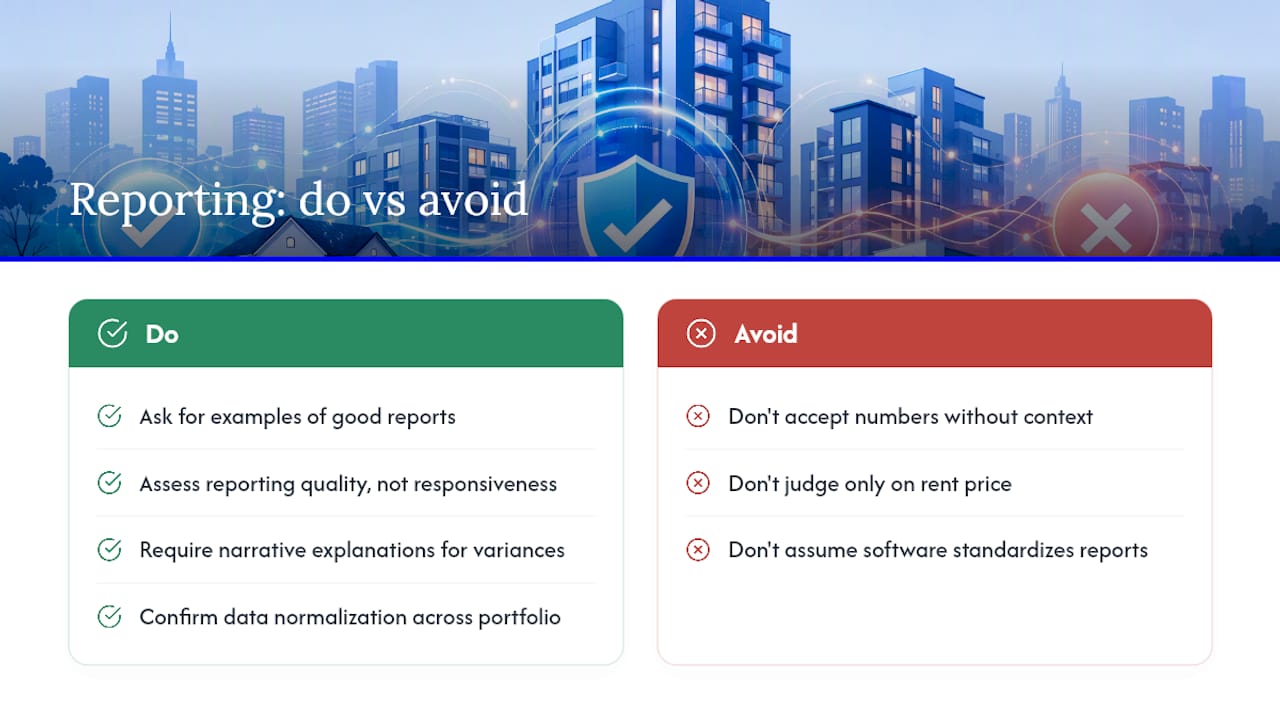
Here's the uncomfortable truth: a report full of numbers with zero narrative is often worse than a slightly delayed report with context attached. Numbers without explanation generate more owner phone calls than any other single reporting failure, because owners are left to guess whether a variance is a one-time event or the start of a trend. That guessing game erodes trust faster than a late statement ever will.
The other overlooked issue is standardization. Owners assume their manager's software handles this automatically. It often doesn't, especially across a portfolio with mixed property types, where GL categories and occupancy definitions frequently drift from one property to the next until someone forces consistency. A manager who can't explain how their reporting data gets normalized across a portfolio is one who hasn't solved the problem yet, no matter how professional the final PDF looks.
— Chaim
Sources
- Tips on rental real estate income, deductions, and recordkeeping | IRS
- Fair housing | HUD
- Owner reporting automation for property management | Neudash
- Reporting & dashboards | RevolutionRE
- National Association of Residential Property Managers (NARPM)