
A preferred vendor network is a vetted, prioritized roster of licensed, insured contractors that a property manager or owner trusts for repairs and maintenance. It cuts response time, lowers liability, and stabilizes maintenance costs by routing work to proven providers first. If you manage property, your next step is reviewing your vetting criteria against a real checklist. If you're a vendor, start assembling your credential packet now.
TL;DR:
- Building a preferred vendor network can take six to eighteen months and involves extensive credential verification and trial jobs for contractors.
- Automated compliance tracking platforms can reduce administrative burden by monitoring license and insurance renewals, preventing lapses.
- Ongoing vendor evaluation should focus on response time, invoice accuracy, and tenant feedback, not just initial credential checks.
- Clear, written contracts with explicit insurance, liability, and scope language are essential for long-term vendor relationships and dispute prevention.
- Maintaining a balanced vendor roster with multiple qualified providers per trade helps avoid dependency risks and schedule bottlenecks.
Table of Contents
- How a Preferred Vendor Network Works Day to Day
- Benefits and Trade-Offs for Owners, Managers, and Vendors
- How to Get on a Preferred Vendor List as a Contractor
- Building and Operating a Preferred Vendor Network as a Manager
- Compliance and Technology: Keeping Credentials Current
- Typical Timeline and Costs to Build a Preferred Vendor Network
- Evaluating Vendors Beyond the Initial Background Check
- Keeping Vendor Relationships Strong Over Time
- Legal Considerations and Contract Management for Preferred Vendors
- How We Approach Vendor Coordination
- A Managed Alternative If You'd Rather Not Build This Yourself
- Sources
- FAQ
How a Preferred Vendor Network Works Day to Day
A preferred vendor network runs on a simple principle: pre-vetted contractors get first call, and everyone else waits. The property manager or a designated maintenance coordinator maintains the roster, typically covering plumbing, electrical, HVAC, roofing, appliance repair, and general handyman work.
Routing follows priority rules. Emergency requests, a burst pipe or a lockout, go straight to the top-rated vendor for that trade, with a fallback name queued if the first contact doesn't answer within a set window, often 15 to 30 minutes. Routine work orders, like a leaky faucet or a squeaky door, get batched and assigned during normal business hours, often rotating among two or three qualified vendors to keep everyone busy and honest on pricing.
The preferred vendor designation itself signals that a contractor cleared credential checks and delivered on at least one trial job before earning steady placement on the list.
Benefits and Trade-Offs for Owners, Managers, and Vendors
Owners get faster repairs, more predictable invoices, and fewer surprise liability exposures. Vendors get a steady pipeline of work without chasing new clients constantly. Both sides win when the network runs well, but it isn't free of friction.
The upside shows up in daily operations:
- Faster response times because vendors already know the property and the manager's expectations
- Consistent workmanship quality since underperformers get rotated out
- Negotiated rates that beat one-off market pricing
- Less administrative time spent vetting contractors for every single work order
- Lower compliance risk because insurance and licensing are checked once, not every job
The trade-offs are real too. Building a solid roster takes months, not weeks. Managers can grow complacent and stop shopping rates once a vendor becomes reliable. Leaning on a single plumber or single HVAC contractor creates dependency risk if that person retires, gets overbooked, or raises prices sharply. And every renewal cycle for insurance and licenses adds administrative work if nobody automates it.
Track these four KPIs to know if your network is actually performing: average response time, callback rate for repeat repairs, invoice accuracy against quoted estimates, and compliance lapse rate for expired credentials.
How to Get on a Preferred Vendor List as a Contractor
Getting added to a property manager's approved list is a documentation exercise first, a relationship exercise second. Here's the realistic path.
- Gather your core documents. Most managers require a current trade license, a certificate of insurance (COI) that names the property owner or management company as an additional insured, a completed W-9, and often a background check for anyone entering occupied units.
- Submit an application or intake form. Many management companies now use online portals rather than emailed PDFs, so check whether the company has a formal vendor intake process before cold-calling.
- Complete a trial job. Expect one or two smaller assignments before you land on the actual preferred list. This is where invoice accuracy and communication responsiveness get evaluated.
- Wait through the credentialing window. Building genuine trust with a property management company typically takes 6 to 18 months of consistent, reliable work. Don't expect instant priority status after one good job.
Pro Tip: Call your insurance agent before you apply and ask them to add the property manager as an additional insured on your COI in advance. Vendors who show up with this already done get processed noticeably faster than those who scramble after the request.
Keep a bilingual invoice template ready if you serve a market with non-English-speaking property owners, and standardize your billing format so managers can process payment without back-and-forth questions.
Building and Operating a Preferred Vendor Network as a Manager
Running a preferred vendor network well means treating it as an ongoing system, not a one-time list you build and forget.
Start with selection criteria that are specific enough to defend if a tenant or owner ever questions why a vendor got the job:
- Minimum insurance coverage amounts (general liability is standard; some trades need workers' compensation too)
- Verified, active trade licenses checked directly against state licensing boards
- At least two references from comparable property types
- A completed trial job scored against response time and invoice accuracy benchmarks
Onboarding should lock in rate agreements up front, define response-time windows by request type, set clear invoicing rules, and confirm the additional-insured language on every COI before the vendor gets dispatched.
Once vendors are active, performance management keeps the list honest:
- Score every job on response time, workmanship, and billing accuracy
- Rotate underperformers out rather than letting loyalty override results
- Keep at least two vendors per trade so a single contractor's schedule or pricing never becomes a bottleneck
Governance matters more than most managers expect. Document your selection criteria in writing, and keep records showing vendors were chosen on objective merit rather than personal relationships. That paper trail protects you if an owner or a rejected vendor ever asks why a particular contractor made the cut. Milwaukeepm's own commercial property management approach follows this same onboarding logic across its vendor relationships.
Compliance and Technology: Keeping Credentials Current
An expired COI is a liability exposure hiding in plain sight, and it's the single most common failure point in vendor networks that otherwise look well run.
Continuous monitoring, not annual spot checks, is what actually prevents lapses. Requesting additional-insured status and tracking one centralized vendor record instead of duplicate files per property cuts down on missed renewals significantly. Compliance-led platforms take this further by blocking a vendor from bidding on or being paid for work the moment a credential lapses, rather than catching the gap after the job is already done.
Look for these features when evaluating vendor management software:
- Automated COI parsing that flags expiration dates without manual entry
- Integration with your existing property management system
- Configurable requirements by ownership group, since one owner's insurance minimums may differ from another's
- Bilingual support for vendor-facing forms and communications
Portfolios managing dozens of vendors across multiple ownership groups benefit most from dedicated software; a handful of properties with two or three trusted contractors can often get by on a well-maintained spreadsheet with calendar alerts. One case cited by NetVendor describes a portfolio reducing its compliance staffing need from eight people to three after automating credential intake, though results like that depend heavily on portfolio size and existing process maturity.
Typical Timeline and Costs to Build a Preferred Vendor Network
Expect the first usable version of a preferred vendor network to take three to six months if you're actively recruiting and vetting contractors across four or five core trades. A fully mature network, one with backup vendors, negotiated rates, and a track record long enough to trust performance data, often takes 6 to 18 months to reach.
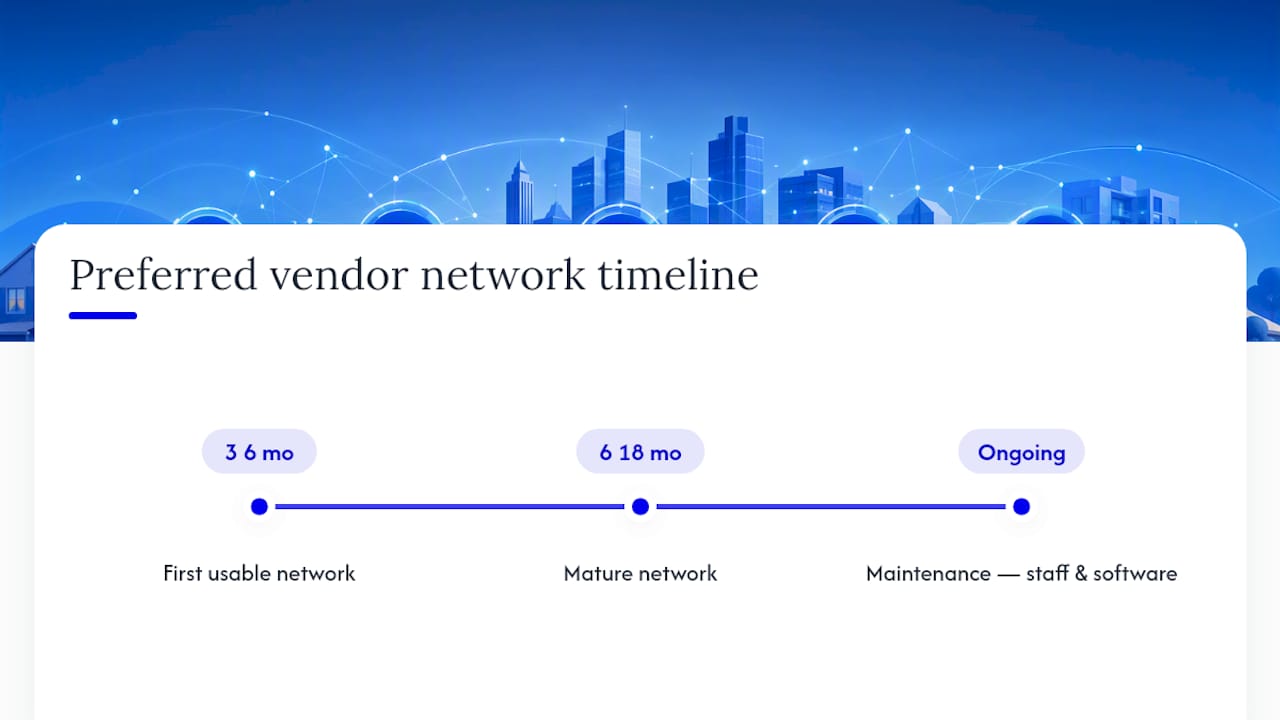
Costs break into two categories: staff time and software. Staff time is the bigger line item early on. Someone has to verify licenses, chase down insurance documents, run background checks, and manage trial jobs. For a small portfolio, this might be a few hours a week folded into an existing property manager's role. For larger portfolios, it can justify a dedicated vendor coordinator position.
Software costs vary by platform and portfolio size, and most vendor management tools price based on unit count or vendor volume rather than a flat rate. The trade-off is straightforward: manual tracking costs more in staff hours but nothing in software fees, while automated platforms cost a subscription but save on administrative labor once a portfolio grows beyond a small number of units.
Maintenance costs continue indefinitely. Renewals need chasing every year, trial jobs for new vendors need scheduling, and rate negotiations should happen periodically since locked-in pricing from three years ago rarely reflects current material and labor costs. Budget for this as an ongoing operational line, not a one-time setup expense.
Evaluating Vendors Beyond the Initial Background Check
Passing the initial credential check gets a vendor onto the list. It doesn't guarantee they stay there.
Ongoing evaluation should track hard performance metrics: on-time arrival rate, first-visit resolution rate (did they fix it right the first time, or did the tenant call back within a week), and invoice accuracy against the original estimate. A vendor who consistently quotes low and bills high is a red flag even if their license and insurance are perfectly current.
Tenant and owner feedback matters just as much as the numbers. A contractor might hit every metric on paper while leaving a trail of frustrated tenants over communication style, cleanliness, or scheduling reliability. Build a simple feedback loop, even a short survey after major repairs, so this qualitative signal doesn't get lost.
Risk assessment deserves a periodic refresh too. A vendor's insurance can lapse, their business can change ownership, or their trade license can move into a renewal grace period without anyone noticing unless someone is actively checking. Quarterly reviews of your top-tier vendors catch problems before they become liability exposures.
The vendors worth keeping long-term are usually the ones who communicate proactively when something's wrong, not just the ones who never seem to have problems. A contractor who calls to say a repair will run over budget because of an unexpected issue behind the wall is more valuable than one who stays silent and hands you a surprise invoice.
Keeping Vendor Relationships Strong Over Time
A preferred vendor network isn't a static list. It's a working relationship that needs the same maintenance as any other business partnership.
Set clear communication protocols from day one: who the vendor contacts for a normal work order versus an emergency, how quickly they should confirm receipt of an assignment, and what documentation they need to submit before invoicing. Ambiguity here creates friction fast, and friction is what pushes good vendors toward other clients who make their lives easier.
Dispute resolution needs a defined path before a dispute actually happens. Decide in advance how billing disagreements get resolved, whether that's a standard markup cap on materials, a required photo of completed work, or a simple escalation contact if a vendor and a tenant disagree about what needs fixing. Handling these situations consistently, rather than improvising each time, keeps vendors from feeling singled out or unfairly treated.
Recognition goes further than most managers assume. A vendor who consistently delivers strong work and gets more volume, faster payment terms, or first priority on lucrative jobs will stay loyal longer than one who gets treated identically to a brand-new, unproven contractor. Loyalty in this business runs both directions.
Periodic check-ins, even informal ones, catch small frustrations before they become reasons for a vendor to walk away. A contractor who feels heard when they raise a concern about parking access or unit entry procedures is a contractor who sticks around for the next ten years, not just the next ten jobs.
Legal Considerations and Contract Management for Preferred Vendors
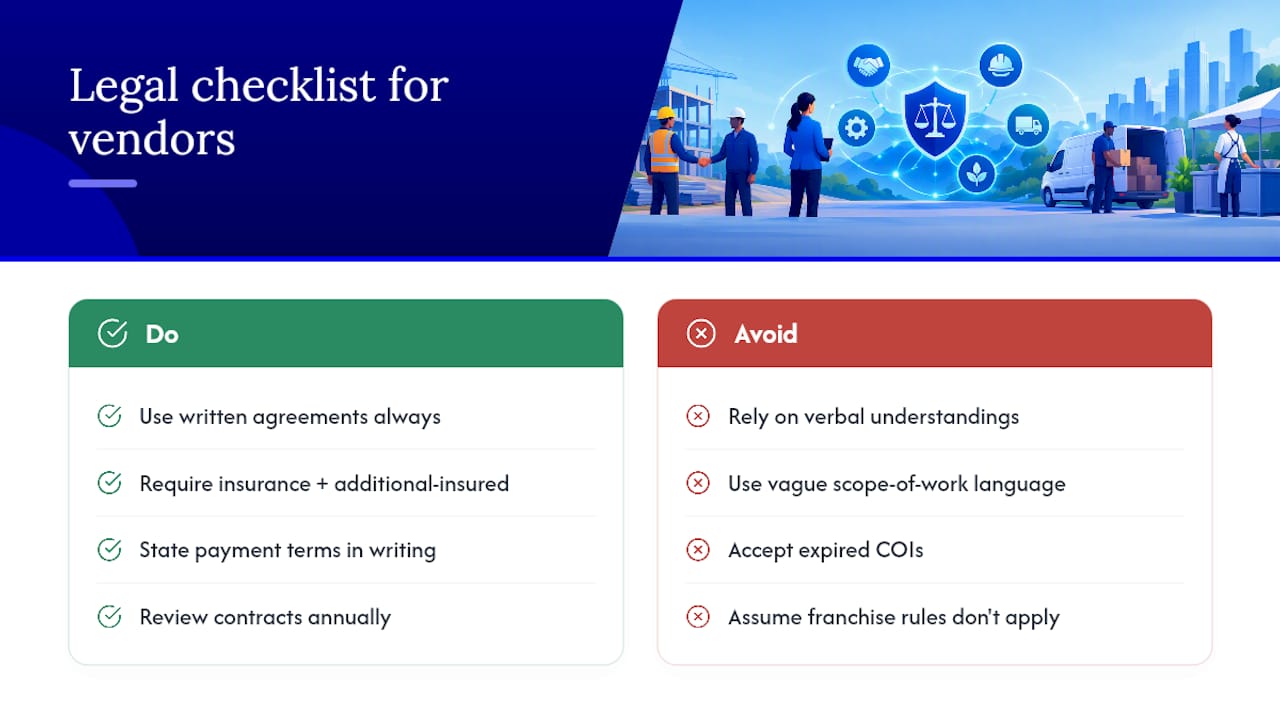
Every preferred vendor relationship should run on a written agreement, even for contractors you've worked with for years. Verbal understandings don't hold up when a dispute over payment terms or liability actually happens.
Contracts should spell out insurance requirements explicitly, including minimum coverage amounts and the additional-insured language naming the property owner or management company. They should define payment terms clearly: net 15, net 30, whatever fits your cash flow, but state it in writing rather than assuming everyone agrees on timing. Scope-of-work language matters too, since vague contracts create room for disputes over what counts as included work versus a billable add-on.
Liability allocation deserves specific attention. Clarify who's responsible if a vendor's work causes property damage or if a tenant is injured during a repair visit. This is exactly where an expired or improperly worded COI turns from a paperwork gap into a genuine financial exposure.
Franchise-style or membership-based preferred vendor programs add another layer. Organizations like the IFA's preferred vendor program require formal applications and demonstrated value to a member network, which means vendors joining these programs should understand the disclosure obligations involved. The FTC's guidance on franchise relationships offers useful background on disclosure expectations, even for property managers running vendor programs outside a formal franchise structure.
Review contracts annually, not just at signing. Rates change, insurance requirements evolve, and a contract written three years ago may no longer reflect current risk exposure or market pricing.
How We Approach Vendor Coordination
Preferred vendors are the backbone of how some property managers deliver on maintenance timelines and property performance for owners across their portfolios. Vetted contractors work directly with our owner and tenant portals to coordinate repairs quickly, which supports the 12-month tenant guarantee we offer on new leases: fast, reliable maintenance keeps tenants satisfied and reduces turnover risk in that first critical year.
— Chaim
A Managed Alternative If You'd Rather Not Build This Yourself
Building and maintaining a preferred vendor network from scratch takes real time: chasing licenses, tracking insurance renewals, running trial jobs, and rotating out underperformers. If that sounds like more administrative work than you want to take on, Milwaukeepm already runs this system for owners across its managed portfolio.
Our full-service property management includes maintenance coordination with vetted contractors, tenant screening, and the 12 month tenant guarantee on new leases, so a placed tenant who leaves early gets re-rented at no additional charge. Monthly management runs 10% of collected rent, with a $650 flat fee for new tenant placement and no setup or onboarding cost. If you'd rather hand off vendor coordination and focus on the returns, check current pricing and packages and request an evaluation of your property.
Sources
- Vendor Selection in Property Management Made Simple | NetVendor
- Preferred Vendor: The Investor's Contractor Network | REI Prime
- TrackMyVendor resources — vendor insurance and compliance tracking
FAQ
What Is a Preferred Vendor?
A preferred vendor is a contractor who has passed a property manager's or organization's credential checks (license, insurance, background check) and earned priority placement for work orders. Status typically requires completing a trial job before landing on the ongoing list.
What Is a Vendor Network?
A vendor network is the full roster of approved contractors an organization uses across all trades, from plumbing to landscaping. A preferred vendor network is the tier within that roster that gets priority routing and often negotiated rates.
How Do I Get on an Insurance Preferred Vendor List?
Insurance-related preferred vendor lists, common for restoration and repair contractors, usually require submitting proof of licensing, a COI naming the insurer or managing company as additional insured, and completing an application through the insurer's vendor portal. Response time performance and customer satisfaction scores heavily influence continued placement once you're on the list.
Does "Preferred Vendor" Mean You Have to Use Them?
No. A preferred vendor designation means a contractor gets first consideration for work orders, not that they're the only legally required option. Property managers, including Milwaukeepm, still retain the flexibility to bring in outside contractors for specialized jobs or when a preferred vendor is unavailable.