
Maintenance coordination is the operational discipline of managing every maintenance request from the moment it's submitted to the moment the work is verified, documented, and closed out. It's what turns a scattered pile of repair calls into a system that owners, production supervisors, and property managers can actually rely on. Done well, it prevents small problems from becoming expensive ones and keeps tenants, technicians, and operations staff on the same page.
Here's what the role delivers in practice:
- Work-order ownership from intake to close. A coordinator logs every request, triages it by urgency, and follows it through scheduling, execution, and verified completion.
- Vendor and budget management. Coordinators vet contractors, negotiate service terms, and control costs by comparing quotes and enforcing spending thresholds.
- Schedule alignment. Whether it's a tenant's access window or a production line's shift change, coordinators build maintenance schedules that avoid unnecessary disruption.
The sections below break down the specific responsibilities, the day-to-day workflow, the KPIs that matter, and the tools coordinators use to keep all of it running.
Key Takeaways
Maintenance coordination works because it converts scattered repair requests into a documented, SLA-driven process that protects tenant retention, controls vendor costs, and frees supervisors for strategic work.
| Point | Details |
|---|---|
| Hire trigger | Add a coordinator once backlog, complaints, or missed PM compliance outpace what one supervisor can handle. |
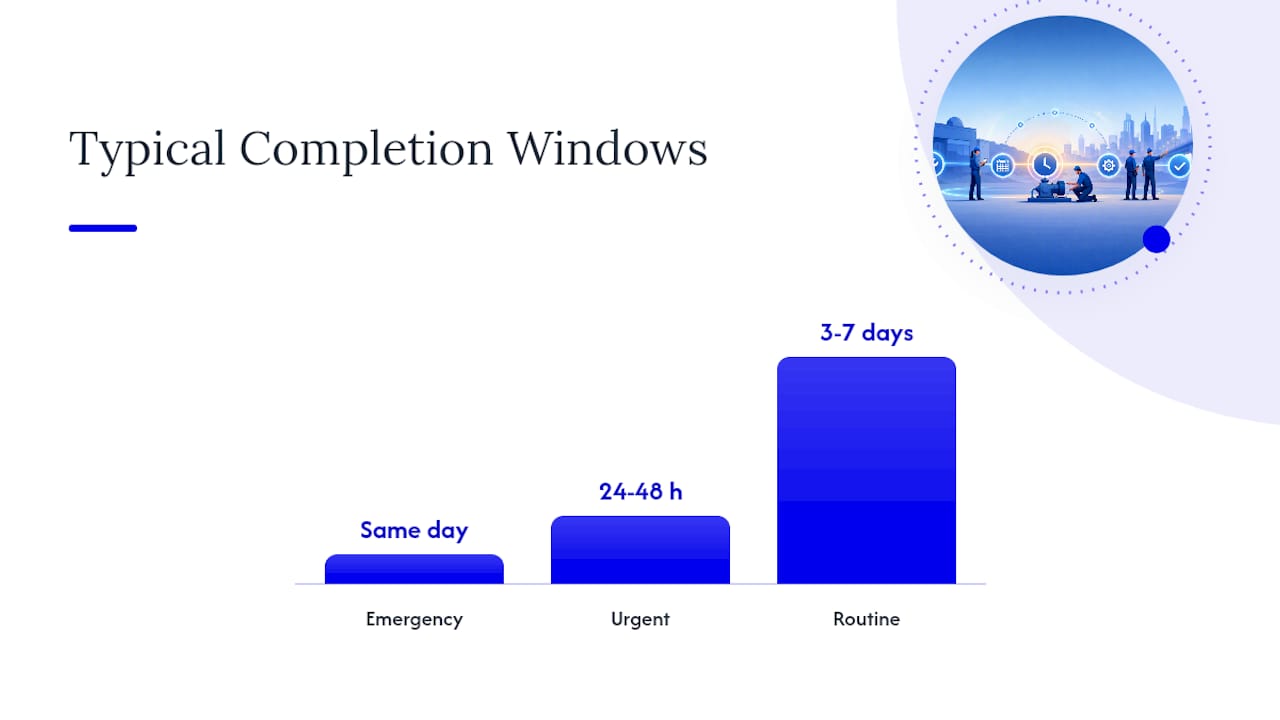
| SLA priorities | Set response and completion windows by tier: emergency under 4 hours, urgent 24 to 48 hours, routine 3 to 7 days. |
| Essential tools | Use a CMMS or proptech platform (like UpKeep, ManWinWin, or Propertymeld) with mobile intake and vendor portals. |
| Non-obvious pro tip | Automate triage rules to cut inbox lag, the delay between request and dispatch, before it stalls resolution time. |
| Most important KPI | Track time to verified resolution, not just response speed, since it best predicts tenant retention. |
| Milwaukeepm's approach | Milwaukeepm pairs preferred vendor networks with SLA enforcement and same-day photo documentation across its managed portfolio. |
Table of Contents
- What Are the Core Responsibilities of a Maintenance Coordinator?
- How Does the Work-Order Lifecycle Actually Work?
- What Skills and Traits Make a Coordinator Effective?
- When Does It Make Sense to Hire a Maintenance Coordinator?
- Which CMMS Tools Support Maintenance Coordination?
- How Should Coordinators Manage Vendors and Procurement?
- How Do You Align Maintenance With Production or Occupant Schedules?
- Which KPIs Actually Measure Coordination Effectiveness?
- What Certifications and Career Paths Apply to Coordinators?
- What Problems Come Up Most Often, and How Do You Fix Them?
- How Did One Property Management Team Put This Into Practice?
- Why Maintenance Coordination Matters More Than Owners Realize
- How Milwaukeepm Handles Maintenance Coordination for You
- Frequently Asked Questions
- Sources
What Are the Core Responsibilities of a Maintenance Coordinator?
A maintenance coordinator functions as the central point of contact for organizing, scheduling, and purchasing maintenance services and parts, managing work orders from submission through completion while making sure the work meets safety and quality standards, according to IDCON's role breakdown. That single sentence covers a lot of ground, and the daily reality behind it looks like this:
- Intake and triage — logging every incoming request and sorting it by urgency and asset criticality.
- Prioritization — deciding what gets scheduled today versus next week, based on agreed criteria rather than who calls loudest.
- Dispatching — assigning the job to the right internal technician or external vendor.
- Vendor liaison — serving as the point of contact for contractors, from scheduling access to resolving billing questions.
- Parts procurement — ordering materials, tracking lead times, and avoiding stockouts that stall jobs.
- Preventive maintenance scheduling — building and maintaining the calendar for inspections and routine service before something breaks.
- Documentation and closure — collecting photos, invoices, and sign-offs before a work order is marked complete.
If you manage a team and want to check whether a job description matches best practice, run it against that list. A coordinator whose role stops at "answers the maintenance phone" is underused. One who owns the full cycle, including procurement and documentation, is doing the job as it's meant to be done.
Pro Tip: Inbox lag, the delay between a request landing and someone actually dispatching it, is one of the most common sources of maintenance delays, and OpsPilot's benchmarking data points to automated triage templates as the fix. Set standing rules (a burst pipe is always "emergency," a squeaky door is always "routine") so tickets route themselves instead of waiting for a human to read and categorize every single one.
How Does the Work-Order Lifecycle Actually Work?
The maintenance coordination process moves through a consistent sequence: intake, triage, priority assignment, scheduling, execution, verification, invoicing, and close. Skip a step, and you either create rework or lose the documentation that protects you later.
It starts when a tenant, a production supervisor, or an internal team submits a request, ideally through a portal rather than a phone call, since portals timestamp everything automatically. The coordinator screens it against pre-agreed criteria (is this actually an emergency, or does it just feel like one?) and assigns a priority tier. From there, scheduling happens around vendor availability and, in manufacturing settings, around production windows. Once the technician completes the work, verification, not just a technician's say-so, confirms the job is actually done. Only then does invoicing and closure happen.
Response and completion windows vary by priority tier, and setting realistic ones up front prevents disputes later:
| Priority Tier | Typical Response Window | Typical Completion Window |
|---|---|---|
| Emergency | Under 4 hours | Same day |
| Urgent | Within 24 hours | 24 to 48 hours |
| Routine | Within 48 hours | 3 to 7 days |
These ranges reflect common industry benchmarks compiled by Breasy's maintenance response-time guide, and they're a reasonable starting point for setting your own service-level agreements. A workable SLA should specify four things: the response window, the completion window, a documentation requirement, and an escalation trigger for when a vendor misses the mark.
Here's the part that trips up a lot of otherwise well-run operations: tracking response time alone is misleading. Buildium's research on property management metrics makes the point directly, time to verified completion, not just acknowledgment speed, is what actually protects tenant retention and limits liability exposure. A coordinator can respond to every ticket within an hour and still leave tenants furious if the actual repair drags on for two weeks. Measure the whole arc, not just the first step.
What Skills and Traits Make a Coordinator Effective?
The best maintenance coordinators combine soft skills with practical trade knowledge, and the mix shifts as the role grows in scope. At minimum, look for these:
- Clear communication, since the coordinator is the translation layer between tenants, technicians, vendors, and ownership.
- Scheduling discipline, juggling multiple jobs, vendor calendars, and access windows without letting anything slip.
- Basic trade knowledge, enough to know whether a "leak" needs a plumber today or can wait for a routine inspection.
- Procurement instincts, comparing vendor quotes and spotting inflated pricing.
- CMMS literacy, comfort with the software systems that log, track, and report on work orders.
- Documentation discipline, because a work order without photos and sign-offs is a liability waiting to happen.
- Prioritization judgment, the ability to apply agreed emergency criteria consistently instead of reacting to whoever sounds most upset.
At the entry level, hire for communication and organization, someone who can log tickets accurately and follow a checklist. As the role matures, the job shifts toward negotiation with vendors, budget oversight, and building preventive schedules that reduce reactive calls in the first place.
To test these skills before committing, run a 30-day trial with a defined scorecard: how many tickets did they triage correctly, how many vendor quotes came in under budget, how consistent was the documentation. A candidate who can explain their triage logic clearly in an interview, walking you through how they'd handle a mid-priority request competing with an emergency, usually performs the same way on the job.
When Does It Make Sense to Hire a Maintenance Coordinator?
The role looks different depending on the setting, but the underlying job, owning the request-to-completion cycle, stays the same across industries:
- Property maintenance coordinator — manages tenant-facing requests, vendor scheduling, and documentation for residential or commercial portfolios.
- Operations or production coordinator — bridges maintenance and production teams in manufacturing, screening requests so operations staff don't overwhelm the maintenance department directly, a function IDCON identifies as central to reducing reactive maintenance.
- Facilities coordinator — oversees building systems, vendor contracts, and preventive schedules across a corporate or institutional footprint.
- Public-works coordinator — manages maintenance requests for municipal infrastructure, often juggling multiple departments and public reporting requirements.
You'll know it's time to add a dedicated coordinator when a few signals stack up: your work-order backlog climbs past what one supervisor can clear in a normal week, average time-to-resolution keeps stretching past your stated SLA, tenant complaints or production outages tick up, or preventive maintenance compliance starts slipping because nobody has bandwidth to schedule it proactively. UpKeep's overview of the coordinator role frames this well: coordinators exist specifically to take administrative and scheduling work off a supervisor's plate so that person can focus on strategic planning instead of chasing paperwork. If your maintenance supervisor spends more time on the phone with vendors than on preventive planning, that's your sizing signal.
Which CMMS Tools Support Maintenance Coordination?
Software categories worth knowing fall into a few buckets: computerized maintenance management systems (CMMS) built for facilities and industrial settings, and proptech platforms built specifically for residential and commercial property maintenance. UpKeep represents the industrial CMMS category, with mobile-first ticket intake and technician workflows. ManWinWin represents a more traditional, asset-heavy CMMS approach common in manufacturing and plant maintenance. Propertymeld represents the property-management side, built around tenant portals, vendor coordination, and documentation for rental operations.
When you're evaluating any tool in these categories, run it against a practical checklist:
- Ease of ticket intake — can a tenant or production operator submit a request in under a minute, from a phone?
- Mobile technician workflows — can the assigned technician update status, upload photos, and close the job from the field?
- Vendor portals — do outside contractors get their own access point instead of relying on emails and phone tag?
- SLA automation — does the system flag jobs approaching an escalation trigger automatically?
- Reporting — can you pull KPI dashboards without manually compiling spreadsheets?
- Integrations — does it connect to your accounting software or existing tenant/ERP systems?
| Feature Category | Why It Matters for Coordination |
|---|---|
| Mobile intake | Reduces inbox lag by letting requesters submit directly, timestamped |
| Vendor portal access | Cuts down on phone tag and speeds up scheduling confirmations |
| Automated SLA flags | Surfaces jobs approaching an escalation trigger before they breach it |
| Reporting dashboards | Turns raw work-order data into KPI reports without manual compiling |
Once you've picked a system, a few integration habits make it work harder. Connect it to your accounting platform through an API or webhook so invoice data flows automatically instead of requiring manual entry. Require photo documentation before releasing any invoice for payment, it's the single easiest way to prevent disputes over whether work was actually completed. And build automated triage rules directly into the intake form so tickets self-sort by urgency before a human ever touches them.
How Should Coordinators Manage Vendors and Procurement?
Vendor management is where a lot of the cost control in maintenance coordination actually happens, and it starts before you ever sign a contract. Vet every vendor against a consistent checklist: current insurance and licensing, verifiable references, realistic response capability for your geographic area, and a track record of clean documentation on past jobs.

Contract structures vary, but the most useful ones for maintenance service coordination include defined SLAs rather than vague "as needed" language. A solid SLA spells out the response window, the completion window, documentation requirements (photos, signed invoices), and what happens, whether that's a penalty, a credit, or simply losing future work, if the vendor misses the mark consistently. Breasy's SLA framework treats these four elements as the difference between an expectation and an enforceable obligation.
Budgeting discipline matters just as much as vendor selection. Set clear approval thresholds so routine repairs under a certain dollar amount don't require a multi-day sign-off chain while anything above that threshold gets a proper quote comparison. On quote turnaround specifically, a 48-hour benchmark is common in single-family rental operations, since slow quotes are one of the biggest hidden drags on total time-to-resolution. For lower-cost parts management, keeping a small stock of common replacement items on hand (thermostats, faucet cartridges, standard filters) avoids the wait for a vendor to source them for routine jobs. Property owners handling turnover work often lean on outside specialists for prep and listing services, which is where a partner like Fix. Move. Haul.'s realtor and listing prep services fits into the broader vendor network.
How Do You Align Maintenance With Production or Occupant Schedules?
Scheduling conflicts are where maintenance coordination either earns its keep or creates new problems. In manufacturing, that means never scheduling a non-emergency repair during a production run without checking the shift calendar first. In property management, it means respecting tenant access windows and giving proper notice.
A few practices consistently cut down on disruption:
- Bundle jobs. If three separate maintenance tasks affect the same production line or the same unit, schedule them together instead of interrupting operations three separate times.
- Give advance notice. For anything beyond an emergency, 24 to 48 hours' notice lets production supervisors or tenants plan around the work.
- Use lockout/tagout protocols consistently. Any job involving equipment shutdown needs a documented lockout/tagout process, not an informal "just be careful" understanding.
- Build a contingency route. If the primary vendor can't make the scheduled window, have a backup on call rather than starting the search from scratch.
- Consider after-hours trade-offs. Night or weekend scheduling avoids production downtime but usually costs more in vendor rates, so weigh the premium against the disruption it prevents.
A simple communication template helps here: state the work being done, the expected duration, the access or shutdown requirements, and a contact number for questions, sent at least a day ahead except in true emergencies. For planned shutdowns affecting multiple systems, bundling every deferred job into that single window is usually cheaper than five separate site visits spread across a month.
Which KPIs Actually Measure Coordination Effectiveness?
Not every metric deserves equal weight. Here's what actually matters, in rough order of importance:
- Time to resolution — the full span from request to verified completion, the single best predictor of tenant or production satisfaction.
- First-time fix rate — the percentage of jobs resolved without a return visit.
- PM compliance rate — the percentage of scheduled preventive maintenance actually completed on time.
- Work-order backlog — the number of open tickets at any given time, a leading indicator of understaffing.
- Cost per work order — average spend per ticket, useful for spotting vendor overcharging.
- Vendor SLA adherence — the percentage of jobs a given vendor completes within the agreed window.
| KPI | Definition | Benchmark Guidance |
|---|---|---|
| Time to resolution | Request submission to verified completion | Should track against your SLA windows by priority tier |
| Emergency response | Time to technician dispatch for emergencies | Under 4 hours per Breasy's benchmarks |
| PM compliance | Share of scheduled preventive work completed on time | Higher compliance correlates with fewer emergency calls |
| Work-order backlog | Open tickets at any point in time | Rising backlog signals staffing or process gaps |
One caution worth taking seriously: a blended average response time can hide real problems. KPI Depot's analysis of maintenance response time notes that this metric needs to be segmented by priority tier and asset criticality, because averaging emergency and routine jobs together masks whether your urgent work is actually getting handled fast enough. Report these numbers on a monthly cadence to ownership or operations leadership, and always pair the raw figures with narrative context. A backlog number alone doesn't tell an owner much; a backlog number next to "up 15% because two vendors dropped their contracts" tells the real story.
What Certifications and Career Paths Apply to Coordinators?
A few credentials carry real weight in this field. The Certified Maintenance and Reliability Professional (CMRP) designation signals strong technical grounding, particularly useful for coordinators working in manufacturing or plant environments. On the property management side, credentials tied to organizations like NARPM, including maintenance coordinator specific certificates, demonstrate familiarity with tenant-facing workflows and fair housing considerations. General administrative or procurement certificates round out the skill set for coordinators who handle heavy vendor negotiation.
Beyond formal certifications, practical training matters just as much:
- CMMS vendor training, since most platforms offer their own certification or onboarding courses.
- Vendor safety training, particularly for coordinators overseeing work involving lockout/tagout or hazardous materials.
- Negotiation and procurement workshops, which pay for themselves quickly through better vendor pricing.
The typical career arc moves from coordinator into maintenance supervisor, overseeing a small technician team directly, and from there into either a maintenance planner role, focused heavily on preventive scheduling and reliability, or a full facilities manager position with broader budget and strategic authority. Coordinators who build strong CMMS and vendor management skills early tend to move faster through that progression.
What Problems Come Up Most Often, and How Do You Fix Them?
A handful of failure modes show up again and again across property management and manufacturing settings, and most have straightforward fixes:
- Problem: inbox lag delays dispatch. Fix: automate triage with standing rules so requests route themselves by urgency instead of waiting for manual review.
- Problem: everything gets labeled "emergency." Fix: publish clear, agreed criteria for what actually qualifies, and hold to them consistently rather than yielding to whoever escalates loudest.
- Problem: missing documentation creates disputes later. Fix: require photo documentation before releasing any invoice for payment, no exceptions.
- Problem: underperforming vendors go unnoticed until a crisis. Fix: keep a simple vendor scorecard tracking response time, first-time fix rate, and SLA adherence, reviewed quarterly.
- Problem: parts delays stall otherwise-scheduled jobs. Fix: stock common replacement parts in-house and set a 48-hour quote turnaround expectation for anything requiring outside procurement.
The screening piece deserves extra attention. Agreed emergency criteria, decided in advance rather than in the heat of a panicked phone call, protect the organization from misallocating emergency resources on jobs that could have waited, a discipline IDCON highlights as central to keeping reactive work under control.
How Did One Property Management Team Put This Into Practice?
A mid-size residential portfolio, several dozen units across multiple properties, faced a familiar problem: tenant complaints about slow repairs were rising, and the property manager was spending most of each day fielding maintenance calls directly instead of managing leases and owner relationships.
The fix was adding a dedicated maintenance coordinator and formalizing the request-to-completion process. The coordinator's first move was standing up clear SLA tiers: emergencies dispatched within 4 hours, urgent jobs within 24 to 48 hours, and routine work scheduled within 3 to 7 days, ranges consistent with industry benchmarks for property maintenance. Every completed job required a photo before the invoice was approved for payment.
| Metric | Before Coordinator | After Coordinator |
|---|---|---|
| Tenant complaint volume | Elevated, frequent escalations | Reduced significantly within the first quarter |
| Average time to resolution | Inconsistent, often exceeding SLA | Tracked consistently against tiered SLAs |
| Property manager time on maintenance calls | Majority of the workday | Freed for lease and owner management tasks |
The property manager's role shifted the way UpKeep's research on the coordinator function describes, administrative and scheduling burden moved to the coordinator, freeing the manager for strategic work. If you're tracking similar outcomes for your own portfolio, the daily duties a coordinator absorbs mirror what's outlined in our breakdown of a property manager's core responsibilities.
Why Maintenance Coordination Matters More Than Owners Realize
Owners tend to think about maintenance coordination as a back-office function, something that happens quietly and only surfaces when it fails. That's backwards. The maintenance request process is one of the clearest signals a tenant or a production team gets about whether the people running the operation actually have things under control. A slow, undocumented repair tells a tenant their lease renewal is a coin flip. A fast, well-documented one builds the kind of trust that shows up directly in retention numbers and in fewer disputes down the line.
The owners who get the most value out of maintenance coordination are the ones who stop treating it as a cost center and start treating it as a retention and risk-management function. That reframe changes what gets measured, what gets reported, and how much authority a coordinator actually has to make decisions. Property management done right relies on experience managing these systems at scale and on documented outcomes across a real portfolio.
How Milwaukeepm Handles Maintenance Coordination for You
Running a tight maintenance coordination process takes a coordinated vendor network, consistent SLA enforcement, and documentation that holds up if a dispute ever comes up, three things most independent owners don't have the bandwidth to build from scratch. Milwaukeepm handles all of it as part of full-service property management: a preferred vendor network for faster dispatch, owner and tenant portals that keep every request timestamped and visible, and monthly KPI reporting so you see time-to-resolution and vendor performance without having to compile it yourself.
Same-day documentation practices mean every completed job comes with photo proof before an invoice gets approved, protecting you from disputes and giving you a clean paper trail on every property in your portfolio. If you manage commercial assets, our commercial management services apply the same SLA discipline to a different asset class. For a full look at how maintenance coordination fits into the rest of what we handle, from tenant screening to owner reporting, visit our property management services page and request a maintenance audit to see how your current process compares.
Frequently Asked Questions
What is the difference between maintenance coordination and facility management? Maintenance coordination focuses specifically on managing the work-order lifecycle, intake, scheduling, vendor liaison, and closure. Facility management is broader, covering building systems, capital planning, and long-term asset strategy, with maintenance coordination often functioning as one piece of that larger operation.
How fast should maintenance response times be? It depends on priority tier. Emergencies typically warrant dispatch within 4 hours, urgent issues within 24 to 48 hours, and routine requests within 3 to 7 days, based on common industry benchmarks. The right numbers for your operation depend on asset type and tenant or production expectations.
Do small property portfolios need a dedicated maintenance coordinator? Not always. A portfolio under roughly 20 to 30 units can often run on a property manager handling coordination directly. Once backlog, complaint volume, or missed preventive maintenance start climbing, it's usually time to formalize the role.
What software do maintenance coordinators typically use? CMMS and proptech platforms designed for ticket intake, vendor scheduling, and reporting, tools in categories represented by UpKeep, ManWinWin, and Propertymeld, depending on whether the setting is industrial, plant-based, or residential property management.
What's the biggest mistake teams make in maintenance coordination? Treating every request as equally urgent. Without agreed criteria for what actually qualifies as an emergency, coordinators end up reacting to whoever complains loudest instead of managing the queue by real priority, which drives up costs and burns out vendors.
This article provides general operational guidance and does not constitute legal, financial, or safety compliance advice. Confirm specific requirements with a qualified professional or the relevant regulatory authority for your property or facility.
Sources
- Operations Maintenance Coordinator - IDCON resource library
- Maintenance coordinator | UpKeep Learning
- Maintenance request response time benchmarks | OpsPilot Blog
- Maintenance Response Time - KPI Depot
- Top property management maintenance metrics | Buildium