
A leasing fee is a one-time, nonrefundable charge that covers the administrative work of putting a new tenant into a property, typically collected by the property manager, landlord, or leasing broker at the start of a lease. It usually runs between a low to mid-hundreds dollar range for a flat fee, or a substantial fraction to full equivalent of one month's rent when a broker handles the placement. Once screening and lease preparation begin, refunds are rare.
TL;DR:
- Leasing fees typically range from $150 to $500 for property management, or 50% to 100% of one month's rent for brokers, depending on the role.
- The fee covers tenant screening, marketing, lease drafting, move-in coordination, and administrative setup, not rent replacement or future management.
- Leasing fees are generally nonrefundable once screening or lease preparation begins, but some agreements include specific guarantees or clauses for partial refunds.
- Local regulations vary, with some cities requiring clear disclosure, and fair housing laws mandating consistent application of fees across applicants.
- Renters should consider the total move-in cost, including security deposits and first and last month's rent, when evaluating affordability of a unit.
Table of Contents
- What Is a Leasing Fee, and Who Actually Charges It?
- What Does a Leasing Fee Actually Pay For?
- How Much Do Leasing Fees Typically Cost?
- How Is a Leasing Fee Different From an Application Fee or Security Deposit?
- Can You Get a Leasing Fee Back If the Deal Falls Through?
- Where Do Local Rules Limit or Regulate Leasing Fees?
- Can You Negotiate a Leasing Fee?
- Does Charging a Leasing Fee Make Financial Sense for Landlords?
- How Does a Leasing Fee Affect What Renters Actually Pay to Move In?
- What Disputes Come Up Most Often Over Leasing Fees?
- Do Leasing Fees Work the Same Way in Every Rental Market?
- Why Fee Transparency Matters More Than the Fee Amount
- How Milwaukeepm Handles Leasing Fees Transparently
- Why Transparent Leasing Fees Actually Save You Money
- Get Transparent Leasing Fees Backed by a Real Guarantee
- Where to Verify Local Leasing Fee Rules
- Sources
What Is a Leasing Fee, and Who Actually Charges It?
You'll see this charge under several names, and that inconsistency is part of why it confuses people. A property management company might call it a leasing fee, a lease-up fee, or a tenant placement fee. A broker might call it a commission. An owner who self-manages might not itemize it at all and instead fold the cost into a slightly higher advertised rent.
Three different parties can end up collecting this money, and each has a different incentive:
- Property managers charge it as a separate line item because tenant placement is a distinct service from ongoing management, and they're compensating for the labor of screening, marketing, and paperwork.
- Landlords who self-manage sometimes charge a lease fee directly, though many absorb the cost and recover it through rent pricing instead.
- Real estate brokers working a rental placement often charge a commission structured as a percentage of the first year's rent or one month's rent, a model borrowed from sales transactions rather than management services.
The distinction matters when you're comparing quoted rent. A unit listed at $1,500 with a separate $400 leasing fee costs less upfront than one listed at $1,600 with the fee baked in, but only if you're staying long enough for the math to favor the itemized version. According to LeaseRunner's breakdown of lease fees, the charge is fundamentally an administrative and lease-execution cost, not a rent substitute, which is why it's supposed to appear on a move-in statement rather than get buried in the rent figure.
For property managers, this fee also functions as a signal. A company that itemizes it clearly, rather than hiding it, tends to be more transparent about the rest of its fee structure too. That's worth noticing before you sign a management agreement or a lease.
What Does a Leasing Fee Actually Pay For?
Renters often ask what they're getting for this charge, and owners deserve the same clarity before agreeing to pay it out of their rental income. The fee isn't arbitrary. It corresponds to a specific set of tasks that happen before a tenant ever gets a key.
- Tenant screening. Background checks, credit pulls, income verification, and rental history checks all cost money, often $30 to $75 per applicant in third-party report fees alone, and someone has to review the results.
- Marketing and listing exposure. Professional photography, listing syndication across rental sites, and coordinating showings all take real time and, frequently, real ad spend.
- Lease drafting and legal compliance. A properly drafted lease has to reflect current state and local law, which changes often enough that using a stale template creates real liability.
- Move-in coordination. Scheduling the walkthrough, documenting unit condition with photos or video, and handling key handoff all fall under this fee.
- Administrative onboarding. Setting up the tenant in a payment portal, entering lease terms into a management system, and opening a maintenance request channel round out the work.
LeaseRunner's guide lists this same cluster of tasks as the standard justification for the charge, and it lines up with how most professional management companies structure their pricing.
Pro Tip: Ask for an itemized breakdown of what your leasing fee covers before you pay it. A manager who can't explain the charge in specific terms probably isn't tracking their own costs closely, and that's worth knowing before you hand them your property or your deposit.
Turnover-related costs sometimes get folded into this fee too, particularly cleaning and minor repairs between tenants, though that's more common in full-service management agreements than in a la carte broker arrangements. If you're an owner comparing quotes, ask specifically whether turnover work is included or billed separately. That single question can explain a $200 difference between two otherwise similar-sounding fee structures.
How Much Do Leasing Fees Typically Cost?
Fee structures fall into two broad camps: flat fees and percentage-based commissions, and which one applies usually depends on whether you're dealing with a property manager or a broker.
Flat residential leasing fees generally run $150 to $500, with the higher end more common in expensive metro markets where screening and compliance work carries more risk and more paperwork. Broker-handled placements work differently. Industry fee analysis from ClearLead puts broker commissions at 50% to 100% of one month's rent, a structure that mirrors real estate sales commissions more than property management pricing.
| Fee model | Typical range | Who usually charges it |
|---|---|---|
| Flat leasing fee | $150 to $500 | Property managers, self-managing landlords |
| Broker commission | 50% to 100% of one month's rent | Leasing brokers, agents |
| Commercial leasing fee | Percentage of base rent over the lease term | Commercial brokers |
Commercial leasing works on a different basis entirely. Instead of a flat fee tied to a single move-in event, commercial deals often calculate the fee as a percentage of total base rent across the full lease term, reflecting the longer commitments and higher stakes of commercial space. Milwaukeepm's commercial management services reflect that structural difference directly, since a five-year commercial lease carries very different placement economics than a twelve-month residential one.
For owners, the useful exercise is annualizing the fee. A $400 leasing fee on a unit that turns over once every two years costs you $200 a year in effective overhead. The same fee on a unit that turns over annually doubles that cost, which is exactly why ClearLead recommends modeling leasing fees against turnover frequency rather than looking at the fee in isolation.
How Is a Leasing Fee Different From an Application Fee or Security Deposit?
These three charges get lumped together constantly, and the confusion costs renters real money when they don't know which one they can dispute or recover.
- Application fees are charged upfront, before approval, usually $25 to $75, and they cover the direct cost of running a background or credit check on that specific applicant. They're paid regardless of whether you get the unit.
- Security deposits are collected at signing to cover potential damage or unpaid rent, and most states cap the amount, often at one or two months' rent, with specific rules for how and when it must be returned.
- Leasing fees are charged after approval, once you've been selected as the tenant, and they cover the administrative cost of finalizing that specific tenancy rather than the cost of evaluating you as a candidate.
The timing is the clearest way to tell them apart. If you paid before anyone reviewed your application, that was an application fee. If you paid after your application was accepted and you were preparing to sign, that's the leasing fee. If the money is sitting in escrow, tied to unit condition and legally required to be returned minus documented damages, that's the deposit.
Before signing anything, ask for each charge in writing, with its own line item and its own explanation. A lease that lumps "move-in fee" into one number without breaking out the deposit portion is a lease that's going to be harder to dispute later if something goes wrong.
Can You Get a Leasing Fee Back If the Deal Falls Through?
The standard rule is straightforward: once screening, marketing, or lease preparation work has started, the leasing fee is gone. You're paying for labor and services already rendered, not for a completed outcome, which is why most lease agreements state the fee is nonrefundable in plain language.
There are real exceptions, though, and they matter if you find yourself in a dispute:
- Written guarantees. Some property managers, including firms that offer a tenant placement guarantee, will waive or refund part of the fee if a placed tenant breaks the lease early within a defined window.
- Fraud or misrepresentation. If the fee was charged for services that were never actually performed, that's a different legal situation than a simple change of plans.
- Lease-specific refund clauses. Some contracts build in partial refunds tied to specific conditions, so the actual lease language always controls, not the general industry norm.
If you believe a fee was collected improperly, document the timeline in writing, quote the exact lease language back to the property manager or landlord, and escalate to your local housing department if the conversation stalls. Small claims court remains an option when the amount is significant and the paper trail is solid.
Where Do Local Rules Limit or Regulate Leasing Fees?
There's no federal law capping leasing fees, but that doesn't mean anything goes. Cities and states have stepped in where they see the practice creating unfair costs for renters, and the patchwork of rules is exactly why you can't assume the norm in one market applies in another.
New York City requires landlords and brokers to disclose broker fees clearly and prohibits charging tenants certain fees without that disclosure. Massachusetts publishes specific guidance on when tenants versus landlords are responsible for broker fees. Philadelphia's Fair Housing Commission maintains an unfair rental practices page that spells out landlord disclosure obligations. These aren't identical rules, and a fee structure that's routine in one city can be restricted in another.
Fees also intersect with fair housing law. The Fair Housing Act prohibits applying screening criteria or fees in a way that discriminates based on protected class, which means a leasing fee structure has to be applied consistently across all applicants, not adjusted case by case.
Best practice on both sides of the transaction is the same: put every charge on an itemized move-in cost statement before signing, not after. HUD's tenant rights resources are a solid starting point for renters who want to understand federal protections, and property owners should check their state's consumer protection or real estate commission page, since states like Texas publish consumer protection notices specifically for this purpose.
Can You Negotiate a Leasing Fee?
Leasing fees are more negotiable than most renters assume, particularly in a market where a unit has been sitting vacant for a while. If you're a renter, ask directly: landlords in a soft rental market would often rather waive $300 than lose a qualified applicant and restart the marketing clock.
- Ask for a waiver outright, especially off-season. Vacancy is expensive for owners, and a fee waiver often costs less than another month of an empty unit.
- Offer something in trade. A longer lease term, a higher security deposit, or an earlier move-in date can justify a landlord waiving the fee without changing their overall math.
- Compare the full cost, not just the fee. A unit with a $500 fee and lower rent can beat a fee-free unit with rent padded to cover the same cost.
Landlords have their own set of alternatives worth considering before defaulting to a separate charge. Some absorb the leasing fee into rent pricing to appear more competitive in listings, since renters often filter by advertised rent before they ever see the fee schedule. Others offer a limited placement guarantee instead of dropping the fee entirely, which keeps the fee justified as insurance rather than pure overhead.
Pro Tip: If you're an owner in a competitive submarket, ask your property manager whether they'll guarantee the placement for 90 days in exchange for the standard leasing fee. That guarantee turns a flat cost into a hedge against a bad tenant match, which is a very different value proposition than a fee with no backing at all.
Does Charging a Leasing Fee Make Financial Sense for Landlords?
The leasing fee exists to recover a real cost, but whether charging it separately helps or hurts you depends on your market and your vacancy risk.
Run the numbers on a simple example. Marketing and screening a unit properly costs roughly $300 to $600 in real labor and third-party report fees. A vacant unit renting for $1,500 a month costs you $50 a day in lost income. If charging a $400 leasing fee makes your listing look less competitive and adds even eight extra vacant days to your time-to-lease, you've erased the entire benefit of charging the fee in the first place.
- If your market is tight and applicants are plentiful, a separate leasing fee rarely slows down leasing velocity and directly offsets your marketing and screening spend.
- If your market is soft or your unit is priced at the top of its comp set, absorbing the fee into rent or waiving it for a strong applicant often closes the deal faster than holding firm on the charge.
- Portfolio owners benefit from modeling the fee against actual turnover frequency per unit, since a property that turns over every three years carries a very different effective cost than one that turns over annually, a point ClearLead's fee modeling guidance makes directly.
The full property management fee stack matters more than any single line item in isolation, since leasing fees interact with monthly management rates and renewal fees to determine your actual net yield.
How Does a Leasing Fee Affect What Renters Actually Pay to Move In?
For renters, a leasing fee doesn't exist in isolation. It stacks on top of the first month's rent, the security deposit, and often the last month's rent, and that combined total is what determines whether a unit is actually affordable, not the advertised monthly rent alone.
Consider a unit listed at $1,500 a month with a $400 leasing fee, a $1,500 security deposit, and first month's rent due at signing. The real move-in cost is $3,400, more than double the advertised monthly figure. That gap catches a lot of renters off guard, particularly first-time renters comparing units purely by monthly rent without pricing out the full move-in statement.
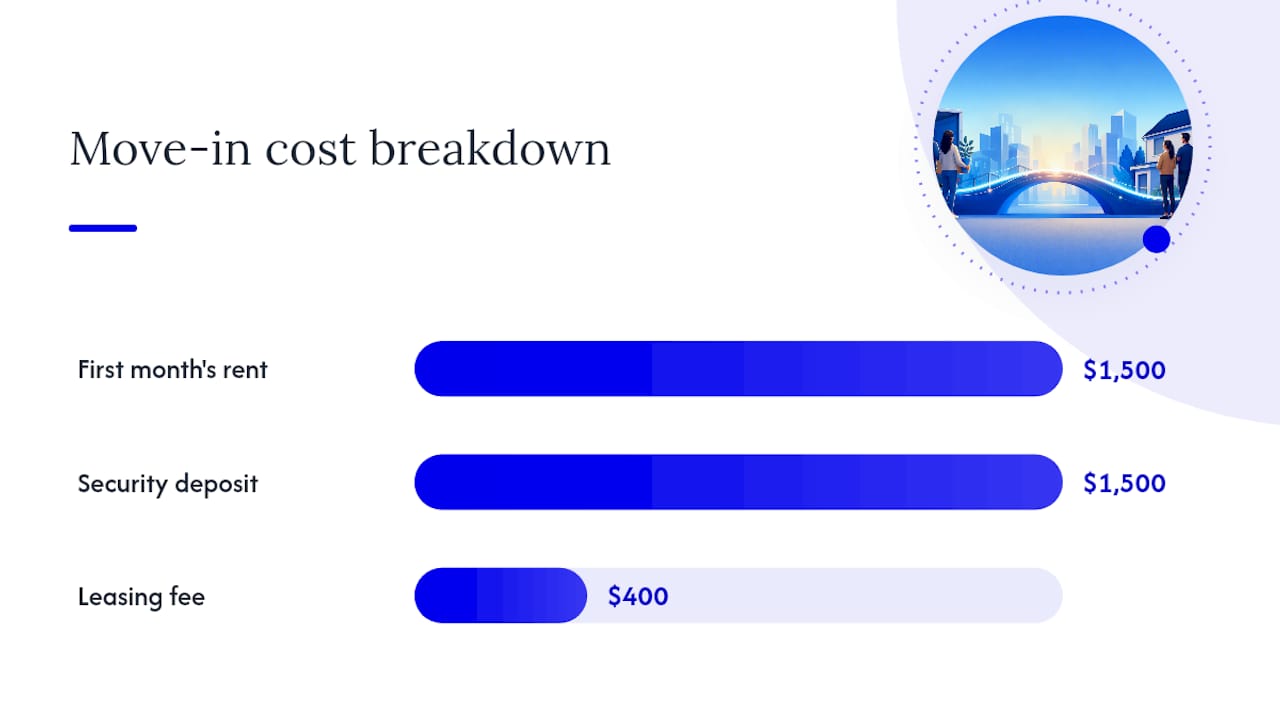
This is where the itemized versus bundled distinction from earlier really matters for your budget. A unit with a lower advertised rent but a separate leasing fee might still cost less at move-in than a unit with rent padded to cover the same charge, depending on how large the deposit is relative to rent. Run the actual total, not just the monthly number, before ruling a unit in or out.
Renters working with tight budgets should ask upfront whether the leasing fee can be split across the first two months of rent instead of paid in one lump sum at signing. Not every landlord will agree, but plenty will, since it costs them nothing and removes a real barrier to closing the lease. It's a small ask that can make the difference between affording a unit and having to walk away from it.
What Disputes Come Up Most Often Over Leasing Fees?
Most leasing fee disputes trace back to one root cause: the fee wasn't clearly disclosed or itemized before the tenant agreed to pay it. That single gap generates a predictable set of conflicts on both sides of the transaction.
The most common complaint is a fee that appears on the move-in statement without ever being mentioned during the application or showing process. Renters reasonably feel blindsided when a charge they didn't budget for shows up at signing, and that frustration escalates fast if the landlord can't clearly explain what the fee covers. The NYC broker fee disclosure requirements exist specifically because this pattern became widespread enough to draw regulatory attention.
A second recurring dispute involves fees charged when a lease falls through after signing but before move-in, often due to a job loss, a change of plans, or a failed final verification. Tenants frequently expect a full or partial refund in these situations, while landlords point to the nonrefundable language in the lease and the work already completed.
Resolution generally follows a predictable path: check the lease language first, since a well-drafted lease should specify exactly when the fee becomes nonrefundable. If the language is vague or the fee was never disclosed as required by local law, tenants have real standing to file a complaint with their city's consumer protection office or housing department. Most disputes resolve well before reaching small claims court once both parties can point to what the lease actually says.
Do Leasing Fees Work the Same Way in Every Rental Market?
Residential and commercial leasing operate on different fee logic, and treating them as interchangeable is a common mistake for owners moving between the two.
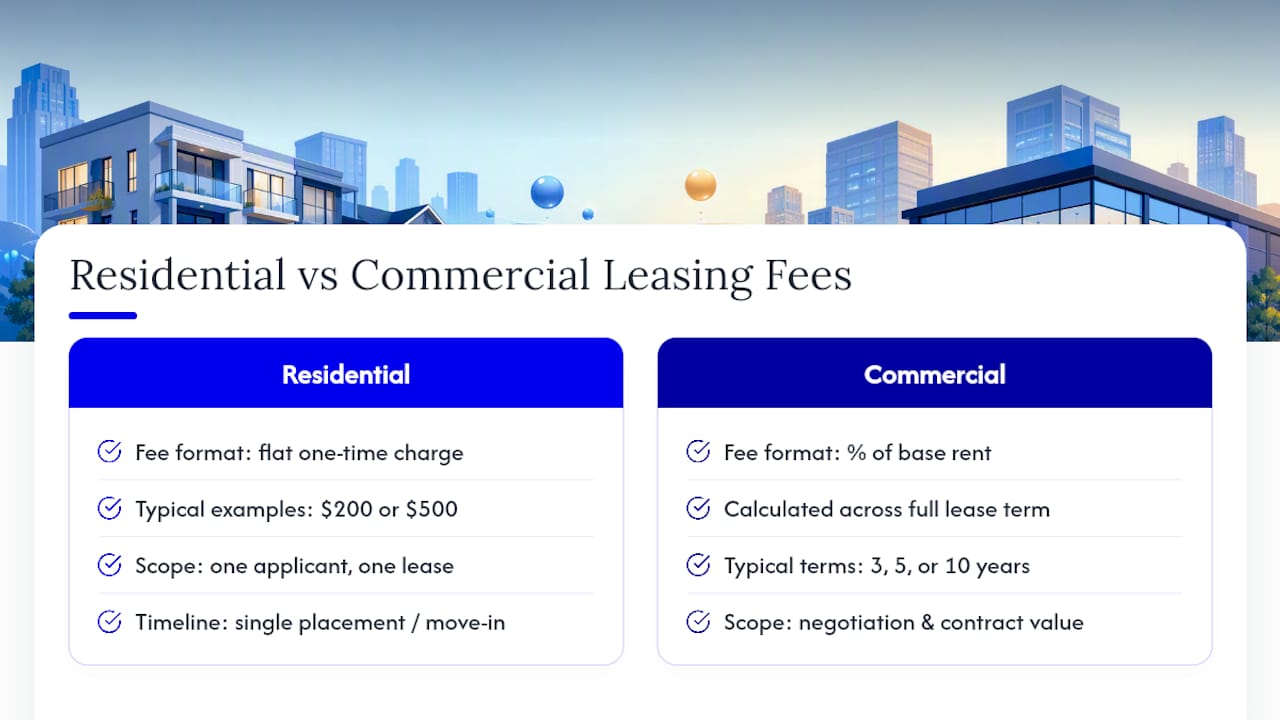
Residential leasing fees are typically a flat, one-time charge tied to a single tenant placement event, whether that's $200 for a straightforward single-family rental or closer to $500 for a competitive urban apartment with heavy screening requirements. The fee reflects a discrete, short transaction: one applicant, one lease, one move-in date.
Commercial leasing works on a longer timeline and a different math entirely. Rather than a flat administrative charge, commercial leasing fees often calculate as a percentage of base rent across the full lease term, which frequently runs three, five, or ten years rather than twelve months. A commercial broker negotiating a five-year office lease is compensated for a fundamentally different scope of work than a residential leasing agent filling a one-bedroom apartment, and the fee structure reflects that difference in complexity, negotiation time, and contract value.
The practical takeaway for owners: if you manage both residential and commercial properties, don't assume your residential leasing fee benchmarks apply to your commercial units, or vice versa. Milwaukeepm's commercial management services price leasing work against lease term and contract value rather than a flat per-unit rate, which is the standard commercial approach for good reason. The stakes, timeline, and negotiation complexity simply don't compare to a standard residential turnover.
Why Fee Transparency Matters More Than the Fee Amount
The dollar figure on a leasing fee matters less than most people assume. What actually predicts a good landlord-tenant relationship, or a good owner-manager relationship, is whether that fee was disclosed clearly and tied to specific, verifiable work.
A $500 fee with a full itemized breakdown and a documented screening process builds more trust than a $200 fee that shows up unexplained on a move-in statement. Owners who insist on transparency from their property manager tend to see fewer disputes and better tenant retention, because tenants who understand what they paid for rarely feel like they were charged an arbitrary tax on moving in. Renters should apply the same standard when comparing units: ask what the fee covers before you compare the number.
— Chaim
How Milwaukeepm Handles Leasing Fees Transparently
Owners deserve to know exactly what a leasing fee buys before they agree to pay it, and Milwaukeepm structures its pricing around that principle rather than around a vague catch-all charge.
- A one-year tenant guarantee backs every placement, so the leasing fee is tied to an actual outcome commitment, not just a completed task list.
- Owner and tenant portals handle onboarding, rent collection, and maintenance requests, which keeps the administrative work the fee covers visible and trackable rather than opaque.
- Detailed monthly and KPI reporting means owners can see exactly how leasing and marketing spend translates into filled units and reduced vacancy days.
- Fee structures are laid out clearly before an owner signs a management agreement, with no surprise charges buried in a move-in statement later.
This is the same standard of disclosure recommended throughout this guide: itemize the charge, explain the work behind it, and back it with a real guarantee. Owners get a leasing fee that functions as insurance against a bad placement, not a cost with no accountability attached.
Why Transparent Leasing Fees Actually Save You Money
Owners who insist on clear, itemized leasing fees end up with better tenant relationships and fewer surprises down the line. When a tenant understands exactly what they paid for at move-in, they're less likely to dispute a charge later or start the tenancy feeling nickel-and-dimed, and that goodwill often shows up months later as an easier renewal conversation. Owners deserve the same clarity from their property manager. If a leasing fee comes with a real guarantee behind it, that's a very different value proposition than a flat charge with no accountability attached.
Get Transparent Leasing Fees Backed by a Real Guarantee
Milwaukeepm structures leasing fees around a straightforward trade: you get professional marketing, full tenant screening, and a lease-ready unit, backed by a one-year tenant guarantee that most flat-fee arrangements never offer. That guarantee is the real difference from paying a leasing fee with no accountability attached. If your placed tenant doesn't work out within the guarantee window, you're not just out the fee and starting over with no recourse.
Owners get full-service leasing and management that covers marketing, screening, lease preparation, and move-in coordination under one itemized, upfront fee structure, with reporting through an owner and tenant portal that keeps every charge visible from day one. If you manage a commercial property, the commercial management team prices leasing work against your specific lease term rather than a generic flat rate. Ready to see what transparent leasing actually costs for your property? Request a quote from Milwaukeepm and get a fee breakdown before you sign anything.
Where to Verify Local Leasing Fee Rules
Rules on leasing and broker fees vary by city and state, so always check your local requirements before signing or collecting a fee.
- HUD tenant rights and resources for federal housing guidance
- NYC broker fee disclosure FAQ as an example of city-level fee regulation
- Massachusetts residential rental broker fee guidance for state-level rules
- RentrIQ's landlord resource blog for practical, landlord-facing operational guidance
Sources
- What Is a Lease Fee? The Hidden Move-In Cost Most Renters Miss — LeaseRunner
- HUD — Tenant rights and resources
- NYC Department of Consumer and Worker Protection — FAQ: Broker fees
- Mass