
Start renewals 120 days out and run a segmented, documented playbook that pairs fair market-based pricing with swift maintenance response and selective incentives. That combination protects net operating income better than any single tactic. The core of effective lease renewal strategies rests on four pillars working together: a disciplined outreach timeline, defensible pricing with targeted incentives, maintenance operations that back up your promises, and automation that tracks results without losing the personal touch.
TL;DR:
- Most renewal failures stem from slow maintenance responses that erode tenant trust, making timely repairs crucial before renewal discussions begin.
- Implementing a structured renewal cadence starting 120 days before lease expiration, with targeted outreach and incentives, boosts renewal rates significantly.
- Basing rent increases on local market comparisons and offering concessions instead of discounts can prevent pushback and maintain profitability.
- Segmenting tenants by value and risk allows personalized communication that increases response rates and renewal success.
- Automating renewal alerts, tracking satisfaction scores, and coordinating maintenance enhances efficiency and reduces missed opportunities.
Table of Contents
- Why Lease Renewals Matter More Than Owners Realize
- A Practical 120/90/60 Renewal Cadence and Checklist
- Pricing Renewal Offers: Market Comps, Increases, and Concessions
- Communication and Personalization: Templates, Channels, and Segmentation
- Maintenance Operations That Actually Raise Renewals
- Technology and Automation for Renewal Tracking
- Negotiation, Documentation, and Choosing an Addendum vs. a New Lease
- Metrics and KPIs to Measure Renewal Program Success
- Running a 90-Day Retention Playbook in Practice
- Why Most Renewal Programs Fail at the Wrong Point
- How Investment Property Management Pros Handles Renewals For You
- Sources
- FAQ
Why Lease Renewals Matter More Than Owners Realize
Turnover is expensive in ways that don't show up until the unit sits empty. Industry estimates put the average per-unit turnover cost at roughly $3,700 to $3,782, covering lost rent during vacancy, marketing, cleaning, and make-ready repairs. Multiply that across a 50-unit portfolio with average retention, and the gap between a mediocre renewal program and a good one can run into tens of thousands of dollars a year.
Turnover math: A single avoided move-out saves you close to $3,700 in direct costs, before you even count the leasing team's time or the risk of an extended vacancy in a slow season.
Small retention gains compound. A tenant who renews twice instead of leaving after one term doesn't just save you one turnover cost; they build toward a longer tenancy where marketing spend, screening fees, and setup costs get spread across more months of rent. A structured renewal process, rather than one handled reactively lease by lease, is what separates portfolios that hit those numbers from ones that don't.
A Practical 120/90/60 Renewal Cadence and Checklist
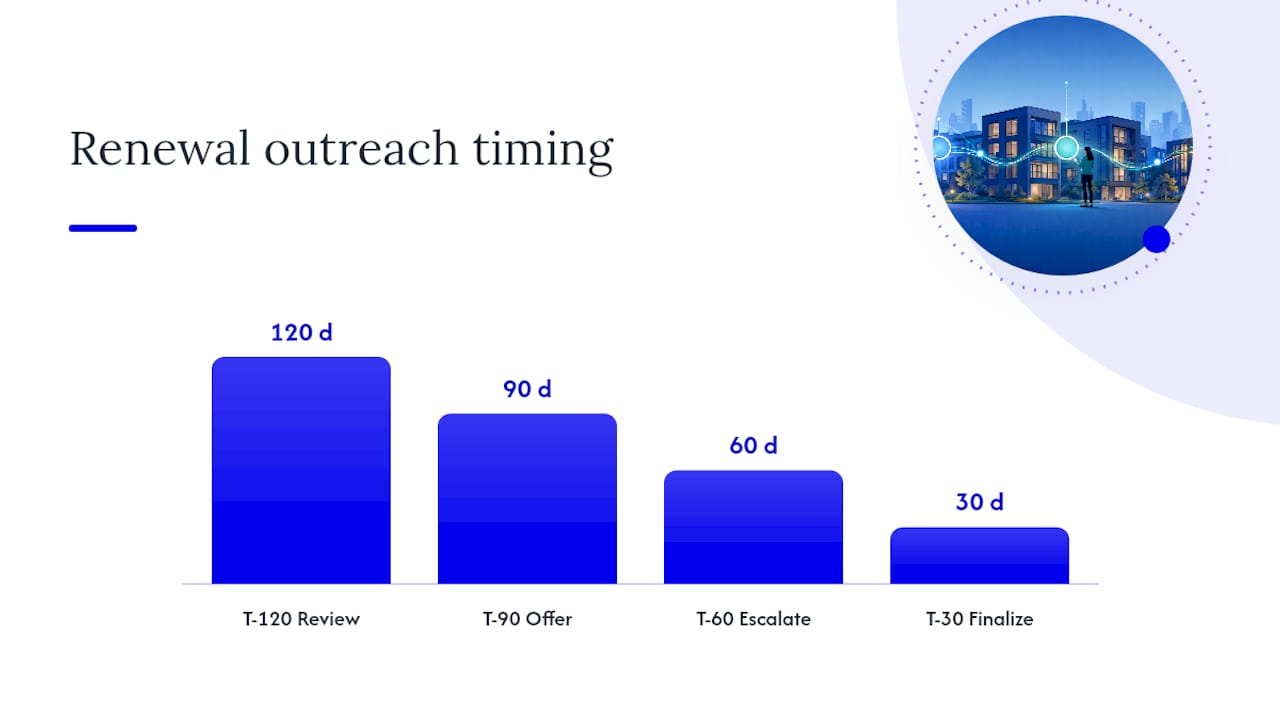
Ad-hoc renewal outreach loses tenants who would have stayed with better timing. A structured cadence built around 120, 90, and 60 days before lease expiration consistently outperforms last-minute phone calls, and programs that add AI-assisted timing on top of that structure report measurable improvements in renewal rates.
Here's how the timeline breaks down:
- T-120 days: Review payment history, open maintenance tickets, and any satisfaction signals for each tenant. Send a low-pressure "temperature check" message asking about their renewal intent.
- T-90 days: Send the formal renewal offer letter with two or three choices, such as a 12-month term at market rate, a 6-month term at a premium, or a locked rate with a longer commitment. Include an e-signature link.
- T-60 days: Escalate outreach for anyone who hasn't responded. This is where your incentive playbook comes in, especially for tenants flagged as at-risk during the T-120 review.
- T-30 days: Finalize signed renewals and trigger marketing for any unit where the tenant has declined, giving your leasing team a full month of runway instead of a scramble.
Pro Tip: Build your T-90 renewal offer letter as a template with variable fields for rent, term options, and a personalized opening line. Consistency saves time; personalization is what actually gets replies.
Pricing Renewal Offers: Market Comps, Increases, and Concessions
A renewal increase that isn't grounded in market data invites pushback and, worse, invites the tenant to start comparing your price against listings on the way out the door. Before you set a renewal rent, pull three to five comparable units within a half-mile radius and check what they're actually renting for, not what they're listed at.
From there:
- Apply graduated increases based on tenant profile. A tenant with a spotless payment history and low maintenance calls warrants a smaller bump than a unit with chronic late payments, and documenting that rationale protects you if the increase is ever questioned.
- Offer concessions that cost less than a turnover instead of dropping the increase entirely. A one-time credit, a minor upgrade, or a small appliance swap often runs a few hundred dollars against a turnover cost near $3,700.
- Price month-to-month options at a genuine premium over a 12-month term. This makes term certainty the more attractive choice without forcing anyone's hand.
- Watch local rent-stabilization or rent-cap ordinances before finalizing any increase; rules vary by city and state, and some cap annual renewal increases outright.
Communication and Personalization: Templates, Channels, and Segmentation
Not every tenant needs the same level of outreach. Segment your roster by value and risk: a long-tenured tenant with perfect payment history needs a warm, low-effort renewal offer, while a tenant who's called maintenance five times this year needs a higher-touch conversation before you send any rent number.
A workable message sequence covers three themes in order:
- An appreciation message that thanks the tenant for their tenancy, sent before any dollar figure appears.
- A rationale message that explains the renewal offer and ties any increase to market comps or improvements made to the property.
- A clear next-steps message with the e-sign link, deadline, and a direct contact for questions.
Channel choice matters as much as content. Start with email for the formal offer, move to text for reminders since response rates run higher, and reserve a phone call for tenants who've gone quiet past T-60 or who flagged concerns. Personalize touchpoints around move-in anniversaries or right after a maintenance ticket closes, when goodwill is highest.
Pro Tip: Send your appreciation message the same week you close out a maintenance request. Tenants remember how quickly you fixed something far more than they remember the fix itself.
Maintenance Operations That Actually Raise Renewals
Fast repairs do more for retention than any amenity upgrade. Tenants who are satisfied with how their maintenance requests get handled are 81% more likely to renew, which makes response speed one of the highest-leverage levers a property manager has.
Set concrete service-level targets and hold to them:
- Acknowledge every maintenance request within 24 hours, even if the fix takes longer.
- Resolve non-emergency repairs within 3 to 5 business days.
- Treat emergency issues (no heat, water leaks, lockouts) as same-day.
- Run a make-ready checklist for every turned unit that covers paint, flooring, appliances, and safety devices, cutting vacancy days between tenants.
Coordinate leasing and maintenance teams before renewal offers go out. If a unit has an open work order at T-120, fix it before the offer letter lands, not after. A preventive maintenance approach also reduces the emergency repairs that erode tenant trust in the first place.
Technology and Automation for Renewal Tracking
Manual tracking is where renewals slip through the cracks. Automating alerts, offer templates, and e-signature workflows reduces missed deadlines and keeps documentation consistent across a portfolio, no matter how many units you're managing.
A few configurations are worth setting up early:
- Automated T-120/T-90/T-60 alerts tied to each lease's actual expiration date, not a shared spreadsheet someone has to remember to check.
- Simple rule-based tenant scoring first (payment history, maintenance calls, tenure), moving to more predictive scoring as your data set grows.
- AI-assisted tools that estimate renewal probability and suggest optimal offer timing, which is where the 8 to 15 percentage-point gains cited earlier tend to show up.
- Synced lease, maintenance, and accounting data, so the person sending the renewal offer can see the same payment and repair history as the maintenance team.
Negotiation, Documentation, and Choosing an Addendum vs. a New Lease
Not every renewal needs a full new lease. A lease addendum works when the changes are limited to term length and rent, while a new lease makes more sense when responsibilities, CAM charges, taxes, or statutory requirements have changed materially since signing.
Keep negotiations structured:
- Update the rent amount, term dates, and any changed clauses clearly in writing, and document every counteroffer in the tenant's file.
- Trade a lower increase for something that benefits you too, such as a longer term or enrollment in autopay.
- Know your walk-away number before the conversation starts, so a tenant's pushback doesn't talk you into a rate that doesn't cover rising costs.
- Use digital signatures for every renewal document and keep a record of all related communications in the tenant's file.
Metrics and KPIs to Measure Renewal Program Success
Tracking the right numbers turns a renewal program from a hunch into a system. Renewal conversion rate, avoided turnover cost, vacancy days, and Tenant Satisfaction Score or Net Promoter Score are the core figures worth watching. Programs that track TSS and NPS in the 180 days before lease expiration catch at-risk tenants early enough to intervene.
| KPI | What it tells you | Watch it starting |
|---|---|---|
| Renewal conversion rate | Percentage of offers accepted | Ongoing, monthly |
| Avoided turnover cost | Renewals × ~$3,700 per unit | Quarterly |
| Vacancy days | Days between move-out and move-in | Ongoing |
| TSS / NPS | Leading indicator of renewal risk | 180 days out |
Assign one team member to own reporting so numbers get reviewed monthly, not just at renewal deadlines.
Running a 90-Day Retention Playbook in Practice
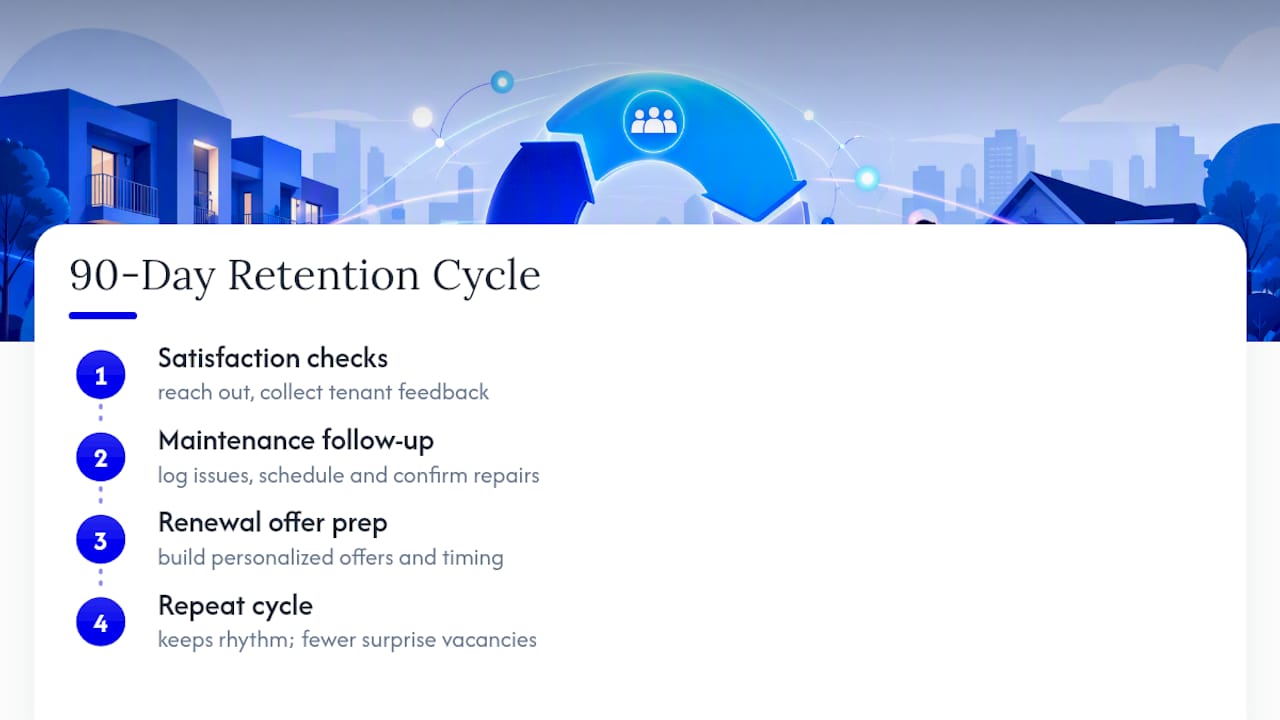
A structured 90-day cycle, splitting weeks between satisfaction outreach, maintenance follow-up, and offer preparation, gives small teams a repeatable rhythm instead of scattered effort. Milwaukeepm built its own version of this into a 90-day tenant retention playbook, and portfolios that follow a similar cadence tend to see fewer surprise vacancies and steadier renewal conversion over time.
Why Most Renewal Programs Fail at the Wrong Point
Most owners assume renewal problems are pricing problems. They're usually not. The data on maintenance satisfaction driving renewal behavior suggests the real failure point sits weeks earlier, in whether a repair ticket got closed fast enough for the tenant to trust the relationship again. Pricing conversations only go badly when trust is already gone.
The other misread is treating every tenant the same. A blanket 5% increase mailed to everyone ignores that your best tenants, the ones with clean payment records and low maintenance calls, are the ones you can least afford to lose and the ones most likely to leave over an impersonal offer. Segmenting outreach isn't a nice-to-have layered on top of a renewal program; it's the mechanism that makes the rest of the playbook work. Owners who skip it end up discounting for everyone or losing their best tenants to a competitor down the street who simply called them by name.
— Chaim
How Investment Property Management Pros Handles Renewals For You
Running a 120/90/60 cadence, tracking satisfaction scores, and coordinating maintenance before every offer letter goes out takes real staff time, time most owners don't have alongside a full-time job or a growing portfolio. A done-for-you system that pairs tenant screening, maintenance coordination with preferred vendors, and owner and tenant portals can help ensure renewal offers go out on schedule without you managing the spreadsheet.
The tenant portal keeps renewal offers, maintenance requests, and payment history in one place, so the personalization this article covers happens automatically instead of manually. Combined with a first-year tenant guarantee and transparent monthly reporting, owners get the retention benefits of a structured program without building one from scratch. If you're managing renewals on your own right now, see how Milwaukeepm's property management services can take the cadence, pricing, and maintenance coordination off your plate.
Sources
- Lease Renewal and Extension: Proactive Strategies for Tenant Retention — Re-Leased
- The Art of Tenant Retention — National Apartment Association
- How to Improve Resident Retention: 7 Proven Strategies | Lula
FAQ
What Are the Steps to Renewing a Lease?
Start with a T-120 review of payment and maintenance history, send a formal offer with term options at T-90, escalate with incentives for at-risk tenants at T-60, and finalize signatures by T-30.
What Are Some Red Flags in a Lease Agreement?
Watch for vague maintenance responsibility clauses, missing rent-increase caps, and renewal terms that don't specify notice periods. These leave both landlord and tenant guessing when it matters most.
Can a Landlord Refuse to Renew a Lease in Florida?
Florida landlords generally can decline to renew a lease at the end of its term without cause, as long as proper notice is given and the decision isn't based on illegal discrimination; check current Florida statutes for exact notice requirements.
What Are the New Lease Renewal Laws in Colorado?
Colorado has passed protections in recent years requiring landlords to provide advance notice before non-renewal or rent increases on residential leases; specific notice periods and rules vary by lease type, so confirm current requirements with a local housing authority or attorney.
When Should I Use a Lease Addendum Instead of a New Lease?
Use an addendum for simple changes like a new rent amount or extended term; draft a new lease when responsibilities, charges, or legal requirements have changed enough to need a full rewrite.