
Lease administration is the ongoing process of turning lease contract terms into accurate, auditable actions and reliable data. Its primary goal is simple: make sure every rent payment, notice deadline, and compliance obligation happens on time and gets recorded correctly. For a beginner, that means mastering three components right away — critical dates, payment schedules, and the specific obligations buried in each lease's fine print.
TL;DR:
- Centralized lease data management reduces errors and improves audit readiness, especially as portfolios grow beyond 10 to 15 leases.
- Accurate abstraction within 30 days of lease signing and regular updates for amendments or renewals are key to avoiding compliance issues and financial misstatements.
- Proper verification of CAM charges and escalations, aligned with lease language, prevents disputes and ensures correct payments.
- Automated alert systems for critical dates at 180, 90, 60, and 30 days improve strategic planning and prevent missed deadlines.
- Using dedicated lease management platforms or outsourced services becomes necessary once the portfolio exceeds small sizes or requires strict compliance with accounting standards.
Table of Contents
- What Is Lease Administration, and Who Handles It?
- What Does a Lease Administrator Actually Do Every Day?
- Building a Lease Abstract That Actually Prevents Problems
- Rent, CAM, and the Numbers Every Lease Admin Must Track
- Where Lease Administration Goes Wrong (and How to Fix It)
- Choosing the Right Tools for Your Portfolio Size
- How a Full-Service Property Manager Runs Lease Administration
- A 30/90/180-Day Plan for Getting Started
- When to Bring in Milwaukeepm for Lease Administration
- Sources
- FAQ
What Is Lease Administration, and Who Handles It?
Lease administration covers the entire life of a lease, from the day it's executed through renewal, amendment, or termination. It's the operational engine that keeps a lease's promises honest — the rent gets billed correctly, the option deadlines don't slip past, and the obligations both landlord and tenant signed up for actually get tracked.
This function typically involves negotiating terms, managing renewals, handling tenant relations, and maintaining ongoing portfolio management, and it rarely lives in one department alone. Depending on the organization, you'll find it housed in:
- Real estate or corporate facilities teams managing occupied space
- Legal departments reviewing clause interpretation and risk
- Accounting groups tracking financial obligations for reporting
- Property management firms handling leases on behalf of owners
Coordination across those groups matters because lease data touches almost every downstream decision a company or owner makes. Auditors want proof that rent was billed per the contract. Appraisers need accurate lease terms to value a property correctly. Operations teams need to know when a tenant's option window opens so they can plan space needs months in advance.
Centralized lease administration also has a direct payoff: it improves portfolio visibility, sharpens financial accuracy, and reduces real estate risk by giving finance and asset teams reliable, single-source data instead of scattered files and guesswork. Get this foundation right, and everything downstream, from CAM reconciliations to accounting compliance, gets easier.
What Does a Lease Administrator Actually Do Every Day?
A lease administrator juggles a mix of recurring tasks and one-off events, and the job rewards people who like structure more than surprises. Here's the core rotation you'll encounter:
- Lease intake and abstraction. Every new lease gets converted from dense legal language into a structured summary, or abstract, capturing rent amounts, dates, and obligations in a format anyone on the team can scan in minutes.
- Critical date tracking. You own the calendar for renewal windows, termination notices, rent escalations, and option deadlines, and you're the person who gets asked "did we catch that?" when a date approaches.
- Rent schedule setup and monitoring. Base rent, percentage rent, and any stepped increases need to be loaded into a billing or accounting system correctly, then checked against actual invoices and payments each month.
- CAM reconciliation and invoicing. Common area maintenance charges arrive annually or quarterly from landlords, and someone has to verify those numbers against the lease's actual recovery language before approving payment.
- Amendment and document management. Lease amendments, estoppel certificates, and subordination, non-disturbance, and attornment (SNDA) agreements all modify the original terms, and each one needs to be logged and reflected in the abstract.
- Tenant and landlord communication. Notices, maintenance requests, and clarification questions flow both directions, and a lease administrator is often the first point of contact.
- Reporting and handoffs. Finance needs rent rolls, legal needs compliance summaries, and ownership needs occupancy and expiration reports, each formatted for its audience.
These duties commonly require coordination across legal, accounting, and operations, which is why the role rewards someone who communicates clearly under pressure. Miss one CAM reconciliation deadline or one renewal notice, and the ripple effects show up in a tenant's rent bill or a company's balance sheet.
Building a Lease Abstract That Actually Prevents Problems
A lease abstract is only useful if it captures the right fields. At minimum, yours should include the lease term and commencement date, the full rent schedule with any escalations, renewal and termination options, tenant improvement (TI) allowances, insurance requirements, and the specific CAM or expense recovery language.
Timing matters here more than most beginners expect. The industry standard is to complete an abstract within 30 days of lease execution, while the terms are fresh and any ambiguities can still be resolved with the deal team. Waiting longer risks losing institutional memory about what a vague clause was actually meant to cover.
Abstracts aren't static documents. Every amendment, renewal, or side letter triggers an update, and each change should be logged with a date and a brief note explaining what shifted and why. That log becomes your defense during an audit or a dispute.
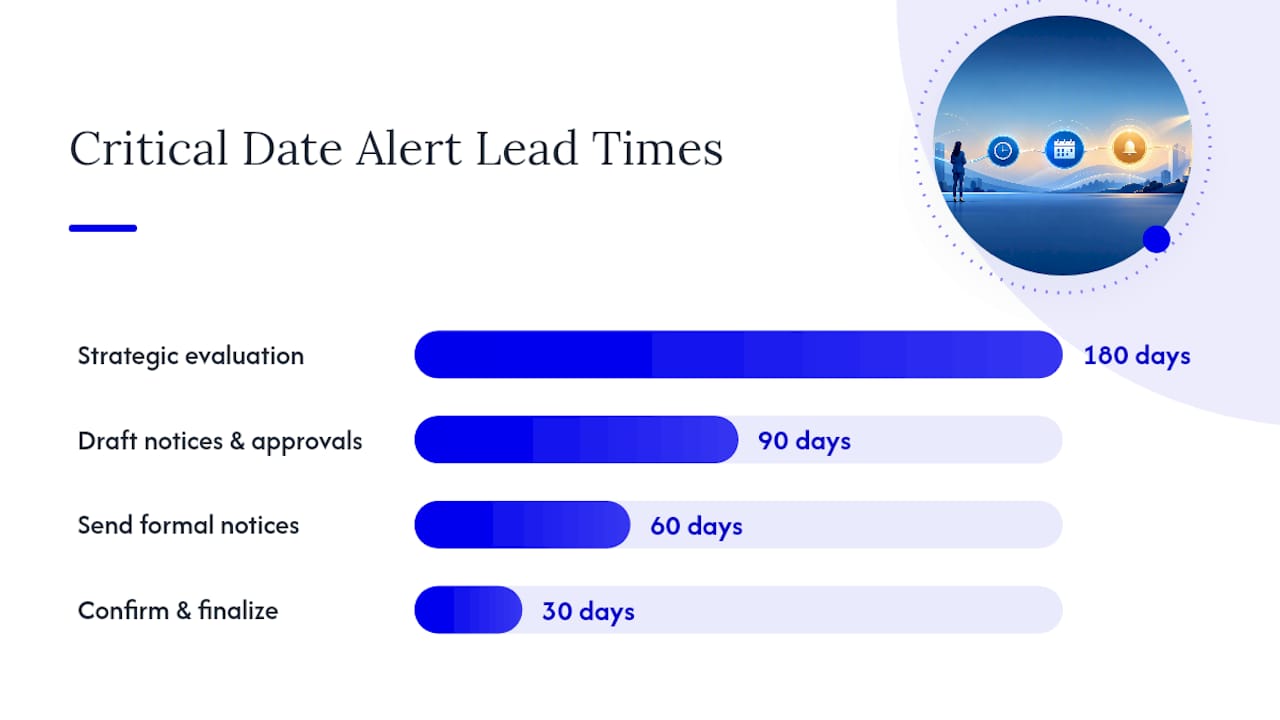
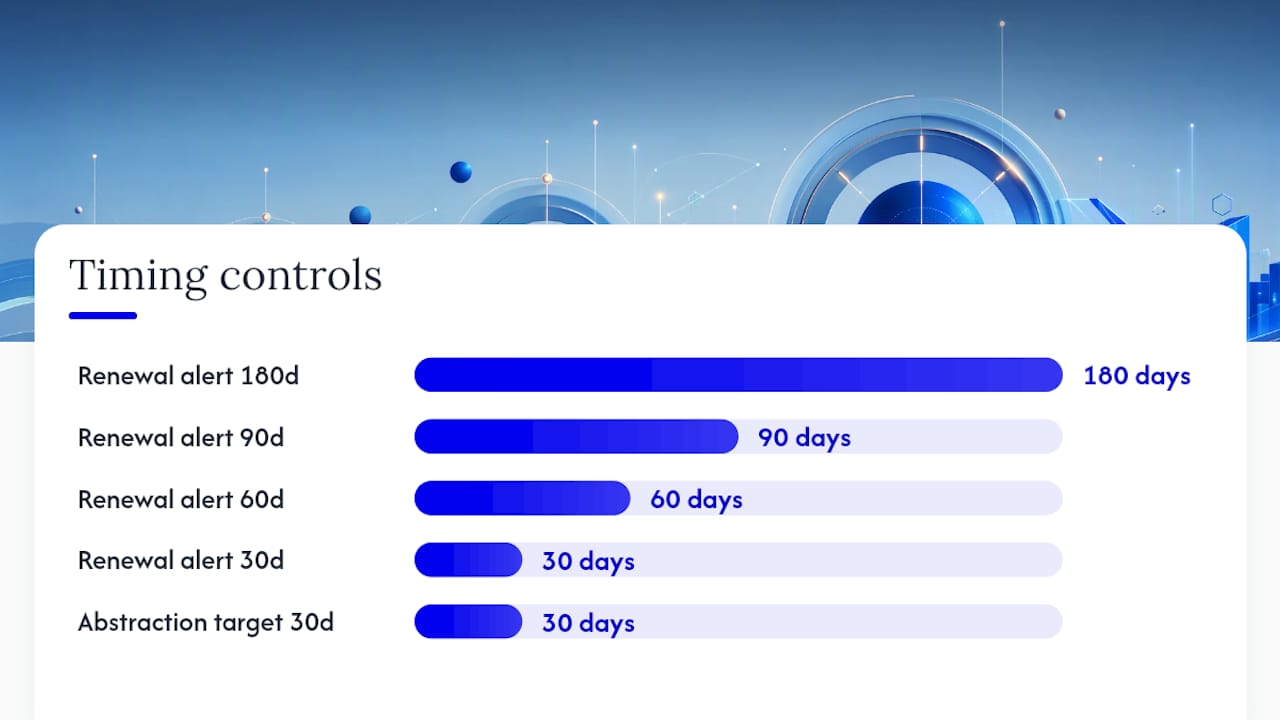
Critical dates deserve their own alert system, not a mental note. A dependable cadence flags key dates at 180, 90, 60, and 30 days before they hit, giving you time for strategic decisions early and administrative execution closer to the deadline.
- 180 days out: evaluate whether to renew, renegotiate, or exit
- 90 days out: begin required notice drafting and internal approvals
- 60 days out: send formal notices per the lease's notice provisions
- 30 days out: confirm receipt and finalize next steps
Pro Tip: Keep a simple running log of every amendment's effective date next to the original abstract. When a renewal option's deadline depends on a prior amendment, that log saves you from recalculating dates from scratch under time pressure.
Rent, CAM, and the Numbers Every Lease Admin Must Track
Financial accuracy sits at the center of the job, and the numbers get more complicated than "rent is due on the first." A typical commercial lease separates base rent from variable payments like percentage rent, utility reimbursements, and CAM charges, and each category has its own verification rules.
CAM and expense recovery deserve particular attention because landlords calculate these charges based on lease-specific formulas, not a flat percentage everyone assumes applies; for more detailed financial tracking guidance, refer to how to track HVAC repair costs across your portfolio. You need to check the lease's actual recovery language, including any caps, exclusions, or base-year stipulations, before approving a reconciliation statement.
Escalations come in a few common forms:
- Fixed percentage increases, applied on a set schedule regardless of market conditions
- CPI-based adjustments, tied to a published inflation index
- Fair market value resets, typically triggered at renewal and requiring appraisal or negotiation
Verifying each escalation type against the actual lease language, rather than trusting a prior year's number, catches errors before they compound.
This is also where lease accounting standards enter the picture. Modern lease administration has to account for requirements under ASC 842 and IFRS 16, which require organizations to record right-of-use assets and lease liabilities on the balance sheet. Manual spreadsheets often can't provide the data integrity these standards demand, which is a major reason companies formalize their lease administration process in the first place.
In practice, that means your accounting team needs clean, timely data from you: accurate lease commencement dates, full payment schedules, and any modifications that affect classification. Build those handoffs into your routine early, and the year-end audit stops being a fire drill.
Where Lease Administration Goes Wrong (and How to Fix It)
Spreadsheets feel manageable at first, but they tend to break down once a portfolio grows. Formulas get overwritten, version control disappears when multiple people edit the same file, and there's no audit trail showing who changed what. Spreadsheet tracking typically starts failing once a portfolio passes roughly 10 to 15 leases, as broken links and inconsistent updates start producing real financial errors.
The fix isn't complicated, but it requires discipline:
- Centralize every lease document and abstract in one repository, not scattered folders
- Standardize your abstract template so every lease gets tracked the same way
- Maintain version history and an amendment log for every change
- Assign clear ownership for each lease and each recurring task
- Set a service-level expectation, like updating critical dates within 48 hours of any amendment
CAM reconciliation deserves its own workflow because it's a common source of disputes. The sequence runs: receive the landlord's annual statement, review it against your lease's recovery language, send written notice within the audit window if you spot a discrepancy, then pursue a full audit if the notice doesn't resolve it. Sending that audit notice within the specified window preserves your right to challenge the charges even if the actual audit happens later.
| Common Failure Point | Practical Fix |
|---|---|
| Spreadsheet formula errors | Centralized system with locked calculation fields |
| No audit trail for changes | Amendment log tied to every abstract update |
| Missed CAM discrepancies | Standing review deadline for every landlord statement |
| Late renewal notices | 180/90/60/30 day alert cadence |
| Unclear task ownership | Named owner per lease, with backup coverage assigned |
A 30-day abstraction target paired with a disciplined amendment log is a simple governance control, but it materially reduces disputes and billing errors down the line.
Choosing the Right Tools for Your Portfolio Size
The right tool depends almost entirely on how many leases you're tracking and how much accounting complexity you're facing. A spreadsheet can work for a handful of leases, but it stops scaling fast, and the failure point arrives sooner than most beginners expect.
Three general tiers cover most situations:
- Spreadsheets for very small portfolios, roughly under 10 leases, where manual tracking is still manageable
- Dedicated lease administration platforms once portfolio size grows or audit pressure increases, offering centralized abstracts and automated alerts
- Integrated ERP or accounting-aligned systems when ASC 842 or IFRS 16 compliance requires tight coordination between lease data and financial reporting
Watch for a few clear upgrade signals: your portfolio crosses that 10 to 15 lease threshold, an audit reveals gaps in your documentation, or your accounting team starts asking for lease data faster than you can manually produce it. Some organizations are also turning to AI-assisted abstraction tools, which can cut manual abstraction time substantially and support clause-level searches across large portfolios.
Outsourcing makes sense when your team lacks the headcount to keep pace, when you need rapid audit-readiness, or when you'd rather have a guaranteed service-level commitment than manage the function internally. Whichever route you choose, evaluate any vendor or platform on integration with your existing accounting system, abstraction accuracy, audit trail quality, and responsiveness of support.
How a Full-Service Property Manager Runs Lease Administration
Watching an experienced property manager handle lease administration day to day gives beginners a useful model to follow. The workflow typically runs from intake through reporting: a new lease gets abstracted immediately, tenants and owners get access to dedicated portals for communication and payment tracking, maintenance requests route directly to vetted vendors, and monthly reports keep everyone informed without extra back-and-forth.
Milwaukeepm structures its own commercial property management work this way, layering a first-year tenant guarantee, owner and tenant portals, and coordinated vendor maintenance on top of standard lease administration duties. Those elements aren't incidental. They exist because timely maintenance response and transparent reporting directly affect tenant retention and rent collection consistency.
- Choose managed service when you lack the time, staff, or systems to track dates and reconciliations reliably.
- Keep it in-house when your portfolio is small enough for one person to abstract and monitor accurately.
Pro Tip: If you're evaluating a property manager's lease administration approach, ask specifically how they handle CAM reconciliation disputes. Their answer tells you more about their process discipline than almost any other question.
A 30/90/180-Day Plan for Getting Started
Start your first 30 days by inventorying every active lease, picking a centralized repository, and drafting abstracts for your highest-priority contracts. By day 90, you should have critical-date alerts running and your most recent CAM statements reconciled against actual lease language. By day 180, evaluate honestly whether spreadsheets still serve you or whether software or outsourcing better fits your portfolio, and sit down with your accounting team to confirm ASC 842 readiness before year-end reporting pressure hits.
— Chaim
When to Bring in Milwaukeepm for Lease Administration
Property management companies offer owners a full-service alternative to piecing together lease administration through spreadsheets and part-time attention, sometimes backed by tenant guarantees that re-rent a placed tenant at no extra charge if they leave within 12 months. That single commitment removes a risk most self-managed owners simply absorb.
If you're an owner watching renewal dates slip, chasing CAM statements you don't have time to verify, or juggling tenant communications across texts and emails, that's the signal to bring in a managed team. Milwaukeepm handles lease administration alongside tenant screening, maintenance coordination, and monthly reporting, all visible through owner and tenant portals built for transparency. For multi-family and single-family owners, the same structure applies: abstracts get built correctly, dates get tracked, and rent gets collected without you managing the details.
Pricing runs on a straightforward monthly management fee, with a one-time new tenant placement fee when a unit turns over. Check current rates and request a quote to see whether a managed approach fits your portfolio better than handling it yourself.
Sources
- ASC 842 vs IFRS 16 — 2026 compliance checklist for lease accounting
- What Is Lease Administration—and Why It's Critical to CRE Strategy | Vestian
FAQ
What Is the 90% Rule in Leasing?
Definitions vary widely depending on who's using the term, so always confirm the specific meaning within the lease or agreement you're reviewing rather than assuming a universal rule applies.
What Skills Are Needed to Become a Lease Administrator?
Strong attention to detail tops the list, since a missed date or misread clause creates real financial consequences. You also need comfort with financial reconciliation, clear written communication for tenant and landlord correspondence, and enough organizational discipline to manage abstracts, amendment logs, and critical-date alerts across an entire portfolio.
What Are the Main Responsibilities of a Lease Administrator?
Core responsibilities include lease abstraction, tracking critical dates, managing rent schedules and CAM reconciliations, and coordinating amendments, estoppels, and tenant communications. The role also commonly involves negotiating terms and ensuring legal compliance, which requires regular coordination with legal and accounting teams.
What Are the Five Lease Classification Tests?
Lease classification under ASC 842 generally examines factors like whether the lease transfers ownership, includes a bargain purchase option, covers a major portion of the asset's useful life, or whether the present value of payments approaches the asset's fair value. Exact criteria and thresholds vary by standard and situation, so consult your accounting team or ASC 842 guidance directly rather than relying on a general summary for classification decisions.
Does Milwaukeepm Handle Lease Administration for Owners?
Yes, Milwaukeepm manages lease administration as part of its full-service and commercial property management offerings, including abstraction, critical-date tracking, and tenant communication. Current pricing for management and placement fees is available directly on the Milwaukeepm pricing page.