
Lease abstraction converts a dense commercial lease into structured, decision-ready data: parties, dates, rent, expenses, and options pulled out and organized so a team doesn't have to reread 60 pages every time a question comes up. It matters because asset management, accounting, and due diligence all run faster and safer when the numbers and deadlines are already verified. The sections below walk through the fields, the workflow, the traps, and the tools.
TL;DR:
- Most leases require detailed abstraction of at least 20 to 50 fields, with key focus on critical dates, rent schedules, and lease options to ensure accuracy.
- Errors most often occur in calendar date entry, rent escalation calculations, CAM caps, renewal notice windows, guaranty types, and restriction clauses, making thorough QA essential.
- Automated, software, or AI-assisted abstraction reduces time but still demands human review for complex provisions, especially in large portfolios needing audit compliance.
- Assigning clear ownership, enforcing citation standards, and scheduling regular updates and audits transform abstracts into reliable, living records.
- Abstracting skills rely on experience in lease understanding and basic math, with institutional discipline and proper review processes vital to minimize errors and legal risks.
Table of Contents
- What Lease Abstracting Basics Actually Cover
- Core Fields Every Useful Lease Abstract Captures
- How to Create a Lease Abstract Step by Step
- Common Traps and a Fast QA Checklist
- Manual, Outsourced, Software, or AI: Which Approach Fits?
- Making Abstracts a Living, Auditable Record
- Training and Skill Requirements for Lease Abstractors
- Legal Considerations and Compliance Requirements for Lease Abstracts
- Practitioner Perspective: When to Trust the Abstract and When to Read the Lease
- A Managed Alternative for Owners Who Want Abstracts Built Into Daily Operations
- Sources
- FAQ
What Lease Abstracting Basics Actually Cover
Lease abstraction is the extraction step. It's not the same as lease administration, which is the ongoing discipline of using that extracted data to track deadlines and manage obligations month after month. An abstract is a snapshot; administration is what happens with the snapshot over the life of the tenancy. Confusing the two causes real headaches. Teams sometimes assume the abstract itself will flag an upcoming renewal deadline, but an abstract only holds the data. Someone or something still has to act on it.
Who actually uses these documents? More people than you might expect:
- Asset managers rely on abstracts to track rent roll accuracy and lease expirations across a portfolio.
- Accounting teams need them for ASC 842 lease classification and right-of-use asset calculations.
- Acquisitions and due diligence teams use abstracts to underwrite a deal without reading every lease line by line.
- Property managers use them daily to answer tenant questions and enforce lease terms.
- Legal counsel references them when a dispute or renewal negotiation requires a quick fact check before pulling the full lease.
The format changes depending on who's asking. A one-page PDF or Word abstract works for a lawyer who wants a quick reference. A spreadsheet row per lease works better for underwriting a portfolio acquisition. A database record feeds directly into a lease administration platform, where it can trigger automated alerts. Understanding lease abstracts starts with recognizing that the same underlying data gets packaged differently depending on the job it needs to do.
Core Fields Every Useful Lease Abstract Captures
A solid commercial lease abstract typically captures 20 to 50 or more distinct fields, and the exact number depends on lease complexity and property type. A single-tenant net lease might need fewer fields than a multi-tenant retail space with percentage rent and co-tenancy clauses.
By the Numbers: A useful lease abstract typically includes 20 to 50 or more fields covering parties, dates, rent schedules, CAM structure, options, and guaranty terms. Fewer fields usually means the abstract is missing something a downstream team will eventually need.
At minimum, a usable abstract needs these categories:
- Parties and premises: tenant legal name, landlord entity, guarantors, rentable and usable square footage, and suite or floor location.
- The five critical dates: execution date, commencement date, rent commencement date, expiration date, and every option deadline. Capture actual calendar dates, not just lease durations. A lease that says "renewal notice due 180 days before expiration" is useless to an abstract until someone converts it into an exact date.
- The full rent schedule: dollar amounts by period, the escalation method (fixed percentage, CPI-linked, or "greater of" clauses), any floor or cap on the index, free rent or abatement periods, and percentage rent breakpoints where they apply.
- Operating expenses and CAM: lease type (triple net, gross, or modified gross), base year or expense stop, whether caps are cumulative or reset annually, gross-up mechanics, exclusions, and audit rights.
- Options and rights: renewal terms with exercise windows converted to calendar dates, rights of first offer or refusal, assignment and subletting restrictions, guaranty type and burn-down schedule, default and cure periods, tenant improvement allowances, and security deposit terms.
Seasoned abstractors pay particular attention to CAM gross-up methods and guaranty burn-down language, since these clauses tend to hide inside dense boilerplate but drive years of cost exposure.
How to Create a Lease Abstract Step by Step
Building a defensible abstract follows a consistent sequence, whether you're doing it manually or leaning on software. Skipping steps is how errors sneak into a document everyone will treat as fact.
- Intake the full package. Gather the base lease, every amendment, exhibits, SNDAs, letters of intent, and any commencement letters. A lease abstracted from the original document alone, without amendments, is often wrong from day one.
- Read the full file before entering data. Skim first to map where key terms live and spot cross-references between sections. Leases rarely keep related terms together.
- Extract into a fixed schema. Use the same field structure every time, and cite the page and section for each material field so reviewers can trace values back to the source language during an audit or dispute.
- Resolve amendments and overrides. When a first amendment changes the rent schedule from the original lease, the abstract needs to reflect the controlling term, not the outdated one.
- Compute calendar deadlines. Convert every notice window (renewal, termination, ROFR) from a relative period into an exact date. This step alone prevents most of the costliest abstracting mistakes.
- QA and sign-off. Have a second person review the abstract, check the math on rent schedules, and spot-check clause pulls for money and date fields. Record who reviewed it and when.
- Deliver and govern. Store the finished abstract in a centralized system, update it whenever an amendment arrives, and schedule periodic audits against the source lease.
Pro Tip: Convert relative notice windows into calendar dates immediately during extraction, then set your alert 30 to 45 days before the notice window opens, not just before it closes. That earlier trigger gives you time to actually negotiate a renewal instead of scrambling to hit a deadline.
This whole intake to QA workflow stays the same whether a person or software does the extraction. What changes is speed, not the underlying discipline.
Common Traps and a Fast QA Checklist
Most abstracting errors cluster in the same six places. Experienced reviewers check these first because they catch the majority of costly mistakes in under 20 minutes of focused review.
- Dates: any of the five critical dates entered wrong or left as a duration instead of a calendar date.
- Rent escalations: compounding math errors, or misreading a "greater of" clause that compares a fixed percentage against an index.
- CAM caps, gross-up, and exclusions: confusing a cumulative cap with an annual reset, or missing an exclusion that changes the tenant's actual expense exposure.
- Renewal notice windows: the single most expensive category of error.
- Guaranty type: full, limited, or burn-down guaranties get treated as interchangeable when they aren't.
- Assignment and sublet restrictions: overlooked consent requirements that surface only when a tenant tries to sell or restructure.
By the Numbers: Missed renewal notice windows rank as the leading and costliest abstracting error, sometimes forcing a tenant into holdover rent at 150 to 200 percent of base rent because the option deadline passed unnoticed.
A quick QA pass runs through five checks: verify the five dates against the source lease, convert every escalation into an actual dollar schedule, confirm the CAM cap and base year, pull the guaranty clause directly, and compute the notice calendar dates. Budget 20 to 40 minutes to QA a finished abstract, and 2 to 3 hours for a first manual abstraction of a moderately complex lease.
Manual, Outsourced, Software, or AI: Which Approach Fits?
Four operating models dominate lease abstracting today, and the right one depends on portfolio size and how the data gets used downstream.
- Manual abstraction delivers the highest accuracy on edge cases and unusual clauses, but it's slow. A typical lease takes 2 to 4 hours for an experienced abstractor to complete properly.
- Outsourced abstraction works well for temporary scale, like a large acquisition that needs 200 leases abstracted in a month. Vet the provider's QA process and clause-citation standards before handing over sensitive lease files.
- Dedicated software platforms make sense when abstracts need to integrate directly with lease administration systems like Yardi or MRI, since centralized data beats a folder of standalone PDFs.
- AI-assisted extraction can cut abstraction time from hours to minutes per lease on structured fields, but complex provisions like unusual guaranty language or layered amendments still need a human reviewer.
Small portfolios often do fine with manual abstraction and a disciplined QA habit. Larger portfolios benefit from automation paired with human review, especially when the output feeds ASC 842 reporting, which requires auditable date and term extraction that will survive an audit.
Making Abstracts a Living, Auditable Record
An abstract that's never updated becomes a liability the moment an amendment gets signed. Governance means deciding, in writing, who updates the abstract, what citation standard applies, and how often audits happen against the source lease.
- Assign one owner responsible for updating abstracts whenever an amendment or renewal notice arrives.
- Require page and section citations on every money or date field, no exceptions.
- Schedule a recurring audit, quarterly or semiannually, comparing abstracts against the actual lease file.
- Route expiration and option dates through a system that generates automated alerts well ahead of the deadline, similar to how a tenant portal can push notice reminders to the right person automatically.
- When a lease heads toward default, tie the abstract's default-tracking fields into whatever eviction workflow your legal partners follow, so nothing falls through a gap between departments.
Treating the abstract as a living document, rather than a one-time deliverable, is what separates portfolios that catch problems early from ones that discover them during a dispute.
Training and Skill Requirements for Lease Abstractors
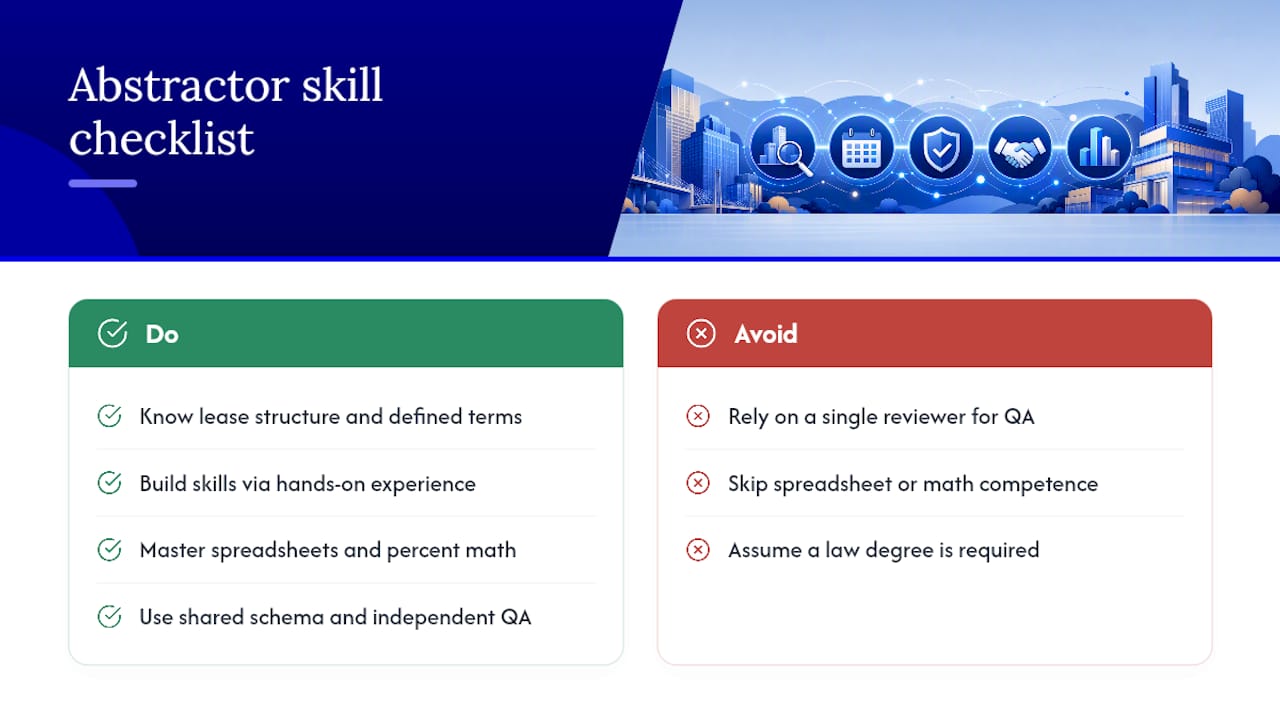
Lease abstracting doesn't require a law degree, but it does demand a specific skill set that combines reading comprehension with financial literacy. A strong abstractor needs to understand basic commercial lease structure well enough to know where a rent escalation clause typically lives, why a CAM reconciliation section connects to an exhibit three pages later, and how a defined term in Article 1 changes the meaning of a clause in Article 12.
Most abstractors build this skill through hands-on experience rather than formal certification. Real estate paralegals, lease administrators, and property accountants often transition into abstracting roles because they already read leases as part of their existing work. Commercial real estate firms that hire dedicated abstractors typically look for candidates with a background in real estate law, accounting, or property management, plus strong attention to detail.
The math matters as much as the reading. An abstractor who can't correctly calculate a compounding rent escalation, or who misreads a "greater of" clause comparing a fixed percentage against a CPI index, will produce an abstract that looks complete but contains a dollar figure that's simply wrong. Basic spreadsheet skills and comfort with percentage calculations are non-negotiable.
Beyond individual skill, quality abstracting requires institutional discipline: consistent field definitions, a shared schema across the team, and a QA process that doesn't rely on the same person who did the extraction. A single skilled abstractor without a peer review process will still produce errors that a second set of eyes would have caught.
Legal Considerations and Compliance Requirements for Lease Abstracts
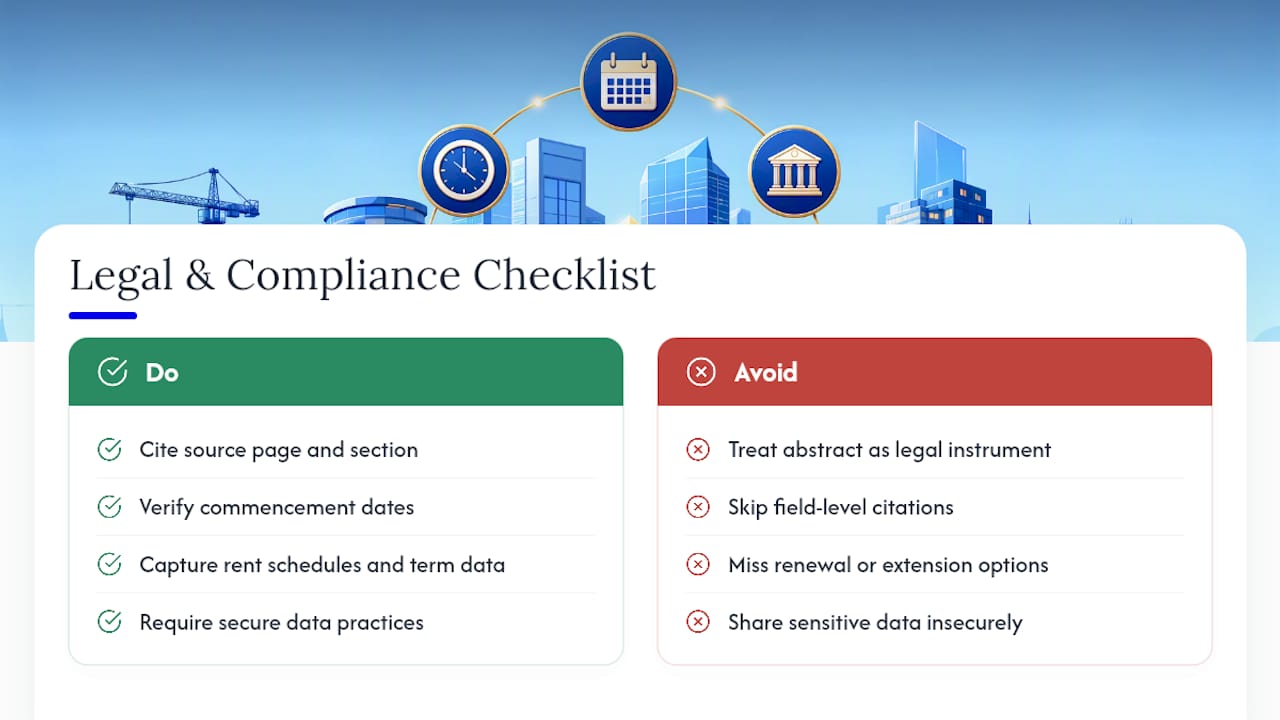
An abstract is a summary, not a legal instrument, and that distinction matters more than it sounds. Courts and counsel will always defer to the actual lease language over anything written in an abstract. That means an abstract with an error doesn't just create an internal headache. It can lead a property manager, accountant, or asset manager to make a decision based on wrong information, and the abstract itself offers no legal protection if that decision turns out badly.
This is exactly why field-level citation matters so much. When every material field in an abstract points back to a specific page and section of the source lease, anyone can verify the abstract against the actual controlling document in minutes rather than rereading the whole file. Skipping citations turns the abstract into an unverifiable claim rather than a useful shortcut.
Compliance obligations add another layer, particularly around ASC 842. Lease accounting standards require companies to classify leases and calculate right-of-use assets and lease liabilities based on accurate commencement dates, rent schedules, and lease term data. An abstract with an incorrect commencement date or a missed renewal option that should have extended the lease term can throw off financial statements in ways that draw auditor scrutiny.
Confidentiality deserves attention too. Lease abstracts often contain sensitive financial terms, and any third-party abstracting service or software platform handling that data should have clear data security practices in place, particularly for portfolios involving publicly traded landlords or tenants with disclosure obligations.
Practitioner Perspective: When to Trust the Abstract and When to Read the Lease
Treat the abstract as a map, not the territory. It's built for triage, quick answers, fast underwriting, and daily property management questions. It's not built to settle a dispute or anchor a negotiation.
The rule of thumb: whenever a decision touches cashflow, legal exposure, or renewal rights, pull the actual clause behind that field before acting on it. An abstract that says the renewal notice is due March 1 is useful for scheduling a reminder. It's not sufficient for arguing a legal position if the tenant disputes that date. Escalate to the full lease and counsel the moment the stakes justify it. The abstract got you 90 percent of the way. The remaining 10 percent is where the real risk lives.
— Chaim
A Managed Alternative for Owners Who Want Abstracts Built Into Daily Operations
Building an internal abstracting workflow from scratch takes time most owners don't have, especially across a growing portfolio. There are property management services that fold lease abstraction directly into day-to-day property operations, so critical dates, rent schedules, and expense terms don't sit in a spreadsheet nobody checks.
Milwaukeepm's owner and tenant portals turn abstracted lease data into working alerts, flagging renewal windows and rent changes before they become a scramble. Rent collection, maintenance coordination, and lease administration all run through the same system, so an amendment doesn't get abstracted once and then forgotten. For owners who'd rather have a team track expirations, CAM reconciliations, and default triggers than build that discipline internally, Milwaukeepm's property management services offer that structure already in place. Reach out through Milwaukeepm to see how your current leases would be handled under a managed system.
Sources
For deeper detail on abstracting timelines, field checklists, and error patterns, these sources informed the guidance above:
- Lease abstraction vs. lease administration | REA
- What Is Lease Abstraction? Complete Guide | LeaseParse
FAQ
What Is Lease Abstracting?
Lease abstracting is the process of extracting key terms from a commercial lease, such as dates, rent, and options, into a structured, summarized document that teams can use without rereading the full lease.
What Is the 90% Rule in Leasing?
There's no single standardized "90% rule" tied to lease abstracting; the term shows up differently across leasing contexts, so treat any specific version you encounter with caution unless it's tied to your particular market or lease type.
What Are Some Red Flags in a Lease Agreement?
The biggest red flags include vague renewal notice language, CAM caps without clear cumulative or annual reset terms, ambiguous "greater of" rent escalation clauses, and guaranty language that doesn't clearly define burn-down conditions.
Which AI Solution Is Best for Lease Abstraction?
No single AI tool fits every portfolio; the better question is whether the tool pairs automated extraction with mandatory human review on complex clauses, since accuracy on structured fields is high but nuanced language still needs a person checking it.
How Long Does It Take to Create a Lease Abstract?
A first manual abstract typically takes 2 to 3 hours to complete, while QA review of a finished abstract usually takes 20 to 40 minutes.