
A 1031 exchange lets you defer federal capital gains tax on the sale of investment or business real estate by reinvesting the proceeds into like-kind U.S. property under IRC Section 1031. It defers both the capital gains tax and depreciation recapture you'd otherwise owe. Two deadlines control everything: you have 45 days to identify replacement property and 180 days to close on it. Miss either one, and the entire exchange collapses into a taxable sale.
TL;DR:
- Ensuring you engage a qualified intermediary before listing your property prevents losing the exchange due to legal or timing errors.
- The 45-day identification and 180-day closing deadlines are strict, and missing them results in a taxable sale, especially if you sell late in the year without extensions.
- Only U.S. investment or business-use real estate qualifies, including multifamily, commercial, raw land, and vacation rentals with specific rental-use limits.
- To defer all taxes, you must reinvest all proceeds and meet value and timing rules; fall short, and you face boot and recognized gains.
- Proper operational planning, such as early communication with advisors, backup property identification, and pre-underwriting, is critical to avoid the common pitfalls that derail exchanges.
Table of Contents
- How a 1031 Exchange Works: Transaction Flow and the Qualified Intermediary's Role
- Who and What Qualifies for a 1031 Exchange?
- What Are the 1031 Exchange Timeline Rules?
- What Are the Main Types of 1031 Exchanges?
- What Happens to Boot, Basis, and Depreciation Recapture?
- A Practical Checklist Before You Start Your Exchange
- When Does a 1031 Exchange Make Sense, and When Doesn't It?
- How Milwaukeepm Supports Owners Through an Exchange
- What's the One Thing Investors Get Wrong About 1031 Exchanges?
- Protect Your Income While You Navigate an Exchange
- Sources
How a 1031 Exchange Works: Transaction Flow and the Qualified Intermediary's Role
A 1031 exchange follows a specific sequence, and skipping a step usually means losing the tax deferral entirely. Before you even close on the sale of your relinquished property, you need a qualified intermediary (QI), also called an accommodator, under contract. This isn't optional paperwork. It's the mechanism that keeps the exchange legally valid.
Here's the flow in practice:
- You sign an exchange agreement with a QI before your property sale closes.
- At closing, sale proceeds go directly to the QI, never to you.
- The QI holds those funds in a segregated account while you shop for replacement property.
- You identify replacement property in writing within a short, strictly enforced deadline known as the 45-day identification period.
- The QI uses the held funds to acquire the replacement property on your behalf, and title transfers to you.
The reason for this structure comes down to a legal concept called constructive receipt. Under Treasury Regulation 1.1031(k)-1-1), if you have access to the sale proceeds, even briefly, the IRS treats the exchange as complete and taxes the gain immediately. That's true even if you never actually touch the money. Once it lands in your bank account, or you gain the legal right to demand it, the deferral is gone.
Exchange funds held by the QI can cover legitimate transaction costs, such as closing costs, title fees, and even paying off a mortgage secured by the relinquished property. What they can't do is fund your next vacation or sit in your personal account for a few days "just in case."
Pro Tip: Line up your qualified intermediary before you list the property, not after you accept an offer. Some sellers wait until the day of closing, and by then it's often too late to structure the exchange properly.
Who and What Qualifies for a 1031 Exchange?
Eligibility hinges on how you use the property, not what kind of building it is. The IRS requires that both the relinquished and replacement properties be held for investment or use in a trade or business. Your primary residence doesn't qualify, and neither does a second home you use mostly for personal enjoyment.
Qualifying property covers more ground than most investors expect:
- Rental single-family homes, duplexes, and multifamily apartment buildings
- Commercial properties like retail centers, office buildings, and warehouses
- Raw land held for investment purposes
- Vacation rentals, if they meet specific rental-use thresholds and personal-use limits
The like-kind standard for real estate is broader than most people assume. Nearly any type of U.S. real property is considered like-kind to any other U.S. real property, according to IRS guidance. You can exchange an apartment building for raw farmland, or a strip mall for an industrial warehouse. The catch is geography: U.S. property is never like-kind to foreign property, so an exchange involving real estate outside the United States doesn't qualify.
A few special cases come up often enough to mention. Leaseholds with 30 years or more remaining can qualify as real property, and certain cooperative housing interests may qualify if state law treats them as real property rather than personal property. The American Bar Association's overview covers these nuances in more depth, particularly around leasehold treatment and related-party transactions.
What Are the 1031 Exchange Timeline Rules?
The 1031 exchange timeline runs on calendar days, not business days, and there's no mechanism to extend either deadline for convenience. Both clocks start on the day your relinquished property closes.
- Day 0: Your relinquished property sale closes, and the clock starts immediately.
- Day 45: You must identify replacement property in writing, delivered to your QI or another party involved in the exchange.
- Day 180: You must close on the replacement property, or by the due date of your tax return for that year, whichever comes first.
That tax-return caveat trips up more investors than any other rule. If you sell property late in the year, your exchange period could end before day 180 arrives, because it's capped by your tax filing deadline. Filing an extension can preserve the full 180-day window, so late-year sellers should coordinate with their CPA well before the sale closes, not after.
Identification itself follows one of three recognized methods:
- The 3-property rule: Identify up to three potential replacement properties, regardless of their combined value.
- The 200% rule: Identify any number of properties, as long as their combined fair market value doesn't exceed 200% of what you sold.
- The 95% rule: Identify any number of properties of any value, but you must actually acquire 95% of the total value identified.
Start your replacement search before closing, get financing pre-underwritten, and name at least one backup property in your identification letter. Deals fall through, and a named backup can save the entire exchange.
What Are the Main Types of 1031 Exchanges?
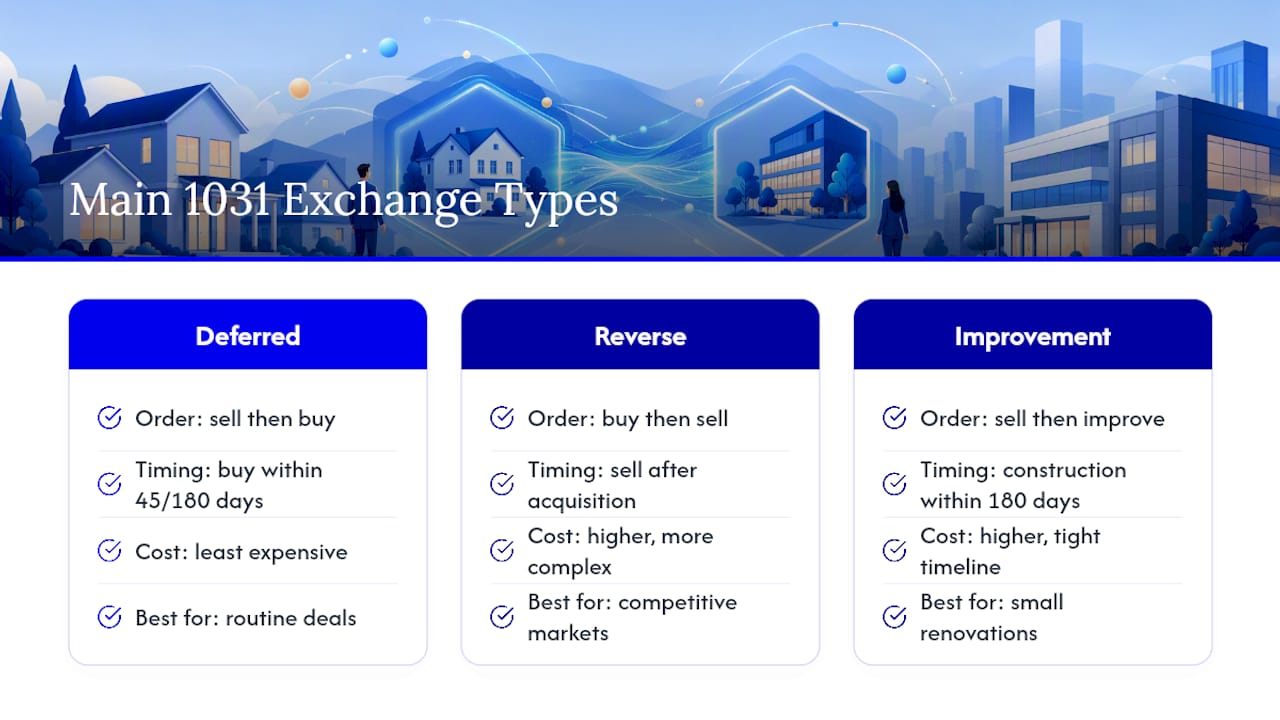
Most exchanges follow the standard deferred, or forward, structure: you sell first, then buy within the 45/180-day windows described above. It's the simplest version, the least expensive to execute, and the one most qualified intermediaries handle routinely.
A reverse exchange flips that order. You acquire the replacement property first, then sell your relinquished property, with an exchange accommodation titleholder or parked-entity LLC holding title to one of the properties in the interim. This structure exists for competitive markets where waiting to sell before buying means losing the property you want. It costs more and carries higher legal complexity, and the American Bar Association notes it's generally reserved for cases where timing makes a forward exchange impractical.
An improvement exchange, sometimes called a construction exchange, lets you use exchange funds to build or renovate the replacement property before you take title. The catch is that all construction must finish, and title must transfer, within the same 180-day window. That's a tight runway for any meaningful construction project, which is why this structure works best for smaller improvements rather than ground-up development.
What Happens to Boot, Basis, and Depreciation Recapture?
Full tax deferral requires what practitioners call the equal-or-up rule: your replacement property must be equal to or greater in value than the property you sold, and you must reinvest all of your net proceeds. Fall short on either measure, and you'll owe tax on the difference.
That taxable difference is called boot, and it comes in two forms:
- Cash boot: Any sale proceeds you keep instead of reinvesting.
- Mortgage boot: Replacing a loan with a smaller loan than the one you paid off, without adding cash to make up the gap.
Both trigger recognized gain up to the amount of the boot, even within an otherwise valid exchange.
Deferred gain doesn't disappear. It carries forward into the replacement property's basis under rules laid out in 26 U.S. Code Section 1031. Your replacement property inherits a lower basis than its purchase price would otherwise suggest, which means smaller depreciation deductions going forward and a larger taxable gain if you eventually sell without exchanging again.
Depreciation recapture follows the same deferral logic. It doesn't vanish, it gets pushed forward. Every exchange gets reported to the IRS on Form 8824, which calculates realized gain, recognized gain, and the adjusted basis of your new property. Your tax preparer needs accurate closing statements from both transactions to complete this form correctly. Get this wrong, and you risk an audit flag rather than a clean deferral.
A Practical Checklist Before You Start Your Exchange
Sequencing matters more in a 1031 exchange than almost any other real estate transaction. Miss a step, and you can't always go back and fix it.
- Engage a qualified intermediary and sign exchange papers before your sale closes. This has to happen first, not as an afterthought once you have a buyer.
- Get financing pre-underwritten for your likely replacement property. Lender delays are one of the most common reasons exchanges blow past day 180.
- Tour and vet replacement candidates before day 0, if possible. Waiting until after your sale closes to start looking wastes precious days off your 45-day clock.
- Submit your written identification by day 45, with at least one backup property named.
- Keep every closing statement, wire confirmation, and identification letter organized for Form 8824.
- Coordinate your title company, insurance carrier, and closing agents so replacement closing aligns with your 180-day deadline.
Pro Tip: Build a simple shared folder with your QI, your CPA, and your real estate attorney from day one. Exchanges fail more often from miscommunication between advisors than from any single legal misstep.
When Does a 1031 Exchange Make Sense, and When Doesn't It?
Exchanges fail for predictable reasons: missed deadlines, accidentally receiving proceeds, or financing that falls through after the 45-day window closes. Each of these is preventable with early planning, but the margin for error is thin once the clock starts.
- Constructive receipt of funds is the single most common operational failure, and it's entirely avoidable by keeping your QI in control of proceeds from day one.
- Financing delays that push closing past day 180 can be mitigated by pre-underwriting before you even identify replacement property.
- State tax treatment varies. Some states, including California, apply "clawback" rules that tax deferred gain if you later sell an out-of-state replacement property, even years down the line. Always check your specific state's conformity rules with a tax advisor before exchanging across state lines.
A 1031 exchange isn't always the right move. If you need liquidity now, the gain is small enough that the tax bill wouldn't meaningfully change your position, or you simply want out of real estate ownership, a straightforward taxable sale may serve you better than the complexity and cost of an exchange.
How Milwaukeepm Supports Owners Through an Exchange
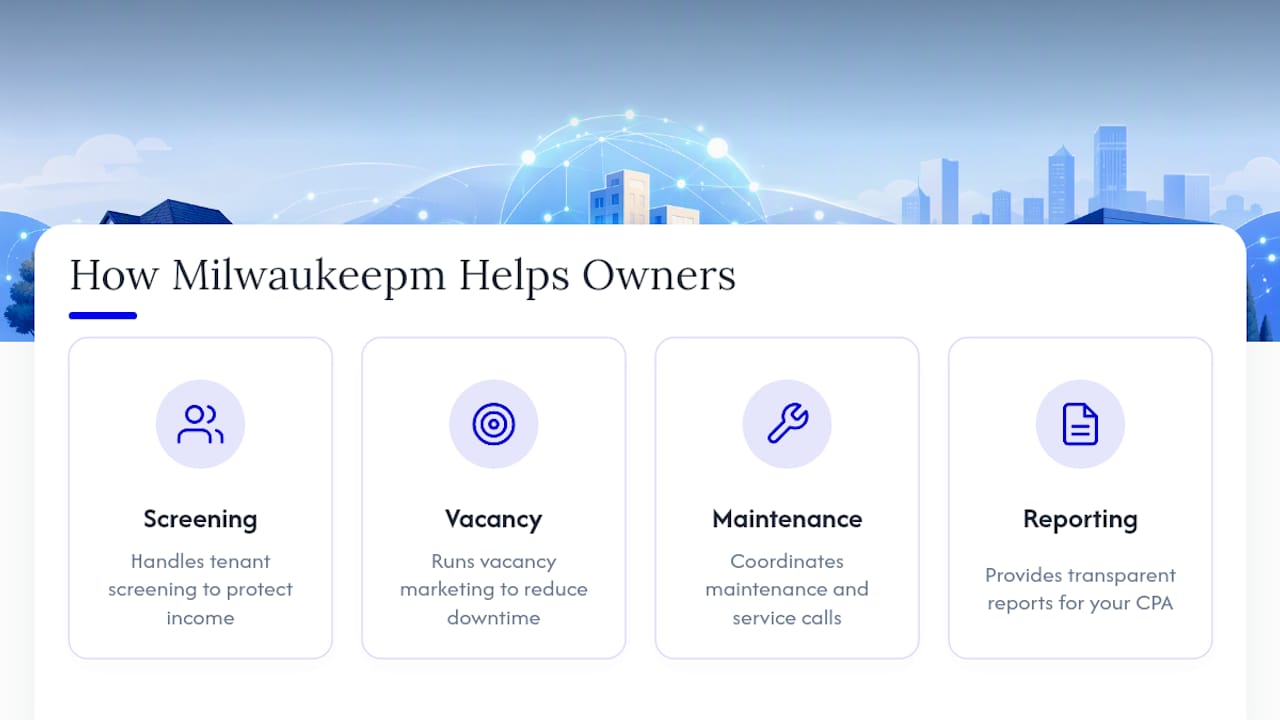
Trading one property for another doesn't pause the responsibilities of ownership. Tenants still need screening, maintenance calls still come in, and vacancy on either the relinquished or replacement property can quietly erode the returns you're trying to protect. Professional property management handles tenant screening, vacancy marketing, and maintenance coordination so your income stream stays steady while you navigate exchange deadlines, and transparent reporting keeps your numbers ready for your CPA come tax season. Related reading on maximizing real estate investment strategies covers positioning your portfolio beyond a single exchange.
This article, written under the guidance of Chaim, is for general informational purposes only and isn't tax or legal advice. Always consult a qualified CPA or tax attorney before initiating a 1031 exchange.
What's the One Thing Investors Get Wrong About 1031 Exchanges?
Most investors treat the tax code as the hard part of a 1031 exchange. It isn't. The rules in Section 1031 are stable and well-documented. What actually sinks exchanges is operational sloppiness: waiting too long to hire a qualified intermediary, assuming financing will come through in time, or failing to name a backup property when the first choice falls apart. Start the process before you list your property, not after you accept an offer, and treat the 45-day window as if it were 30. Talk to a CPA and a real estate attorney before you sign anything, because the cost of that conversation is nothing compared to the tax bill from a busted exchange.
— Chaim
Protect Your Income While You Navigate an Exchange
Professional property management gives owners something a DIY exchange rarely accounts for: continuity. While your capital is tied up in identification periods and closing logistics, your replacement property still needs a tenant screened, rent collected, and maintenance handled without interruption to your cash flow.
Owner and tenant portals keep communication and payments organized from the day you take title, and tenant guarantees help reduce occupancy risk right when you need income the most. Whether you're managing a relinquished property through its final months or settling a new replacement property into your portfolio, Milwaukeepm's property management services handle tenant screening, maintenance coordination, and monthly reporting so you're not doing it alone. If you're planning an exchange and want your replacement property managed from day one, request a consultation with Milwaukeepm to talk through what your portfolio needs next.
Sources
For primary rule text, see the IRS like-kind exchange guidance, Treasury Regulation 1.1031(k)-1, and 26 U.S. Code Section 1031. For execution details, see this 1031 exchange primer.
This article is general information, not a substitute for advice from a qualified financial advisor. Consult a qualified financial professional about your own circumstances before acting on anything here.
- Like-kind exchanges (real estate tax tips) | Internal Revenue Service
- 26 U.S. Code § 1031 — Exchange of real property held for productive use or investment
- 1031 Exchanges: The 2026 Definitive Guide | Baker 1031